


At least a dozen people who had routine operations claim they caught deadly viruses and other germs from body parts stolen from corpses in a scandal that has sent hundreds of people for tests.
The patients tested positive for germs that cause AIDS, hepatitis or syphilis after receiving tissue transplants, according to their lawyers and court records.
Lawsuits have been filed for two men, one in Nebraska and one in Ohio. Both claim they caught a hepatitis virus from tissue implanted in back and spine operations -- a contention that lawyers acknowledge will be difficult to prove.
A New Jersey company, Biomedical Tissue Services, is accused of failing to gain consent to take bones, tendons, ligaments, skin and other tissue from cadavers.
Lawyers for the two men who filed lawsuits say they know of no other factors that would put their clients at risk for hepatitis.
Lawyers representing at least a dozen other clients say medical tests show they have the AIDS or hepatitis virus or syphilis bacteria -- all of which can be acquired from infected tissue. Those suits have not yet been filed and the lawyers are continuing to investigate their claims.
So far, about two dozen lawsuits have been filed in federal courts across the country, most seeking class-action status for hundreds of people who were implanted with tissues that the US government recalled.
The owner of BTS and three others have pleaded not guilty to the charges against them.
The US Food and Drug Administration (FDA) has said the chance of getting a disease from BTS tissue is low. But plaintiff's lawyers challenge that assertion.
Steve Fogle thought the risk was low when he had spinal fusion surgery last year.
When the Blanchester, Ohio, man got a letter from his doctor explaining the tissue that was implanted in his neck and spine might carry an infectious disease, he didn't think much about it.
The letter and other documents explained that the tissue had been "terminally sterilized" and stated repeatedly the risk of infection was "low." The letter also said tissue had been recalled due to "improper documentation" and there were no reports of "adverse reactions."
Fogle, 41, felt reassured and put off getting tested for hepatitis, syphilis and HIV as recommended by the FDA.
Two months later, Fogle, who has no tattoos or history of intravenous drug use -- risk factors for hepatitis C -- learned the true circumstances of the recall after watching a TV news report describing the macabre scandal.
After eventually getting tested he was told that he was infected with hepatitis C, according to his affidavit.
Lawyers say the doctors and companies that processed and distributed the tissue diminished the risks in warning letters they sent to patients.
"People left the doctor's office thinking `big deal,' it was a document error," said Patrick D'Arcy, a New Jersey lawyer representing about 200 people who received the suspect tissue.
In Ned Jackson's case, he had surgery on his lower back in 2003. More than two years later, his doctor told him the tissue used in his surgery had been recalled.
Blood tests indicated Jackson had contracted hepatitis B and C, according to the lawsuit.
Both Fogle and Jackson will have to prove their case if the companies involved decline to settle. Plaintiff's lawyers acknowledge proving it won't be easy.

Republican US lawmakers on Friday criticized US President Joe Biden’s administration after sanctioned Chinese telecoms equipment giant Huawei unveiled a laptop this week powered by an Intel artificial intelligence (AI) chip. The US placed Huawei on a trade restriction list in 2019 for contravening Iran sanctions, part of a broader effort to hobble Beijing’s technological advances. Placement on the list means the company’s suppliers have to seek a special, difficult-to-obtain license before shipping to it. One such license, issued by then-US president Donald Trump’s administration, has allowed Intel to ship central processors to Huawei for use in laptops since 2020. China hardliners
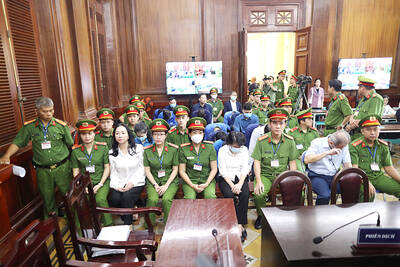
A top Vietnamese property tycoon was on Thursday sentenced to death in one of the biggest corruption cases in history, with an estimated US$27 billion in damages. A panel of three hand-picked jurors and two judges rejected all defense arguments by Truong My Lan, chair of major developer Van Thinh Phat, who was found guilty of swindling cash from Saigon Commercial Bank (SCB) over a decade. “The defendant’s actions ... eroded people’s trust in the leadership of the [Communist] Party and state,” read the verdict at the trial in Ho Chi Minh City. After the five-week trial, 85 others were also sentenced on

Conjoined twins Lori and George Schappell, who pursued separate careers, interests and relationships during lives that defied medical expectations, died this month in Pennsylvania, funeral home officials said. They were 62. The twins, listed by Guinness World Records as the oldest living conjoined twins, died on April 7 at the Hospital of the University of Pennsylvania, obituaries posted by Leibensperger Funeral Homes of Hamburg said. The cause of death was not detailed. “When we were born, the doctors didn’t think we’d make 30, but we proved them wrong,” Lori said in an interview when they turned 50, the Philadelphia Inquirer reported. The

RAMPAGE: A Palestinian man was left dead after dozens of Israeli settlers searching for a missing 14-year-old boy stormed a village in the Israeli-occupied West Bank US President Joe Biden on Friday said he expected Iran to attack Israel “sooner, rather than later” and warned Tehran not to proceed. Asked by reporters about his message to Iran, Biden simply said: “Don’t,” underscoring Washington’s commitment to defend Israel. “We are devoted to the defense of Israel. We will support Israel. We will help defend Israel and Iran will not succeed,” he said. Biden said he would not divulge secure information, but said his expectation was that an attack could come “sooner, rather than later.” Israel braced on Friday for an attack by Iran or its proxies as warnings grew of


 RSS
RSS