


The incoming prime minister has won the backing of Iraq's top Shiite cleric for his plan to disband militias, which the US believes is the key to calming sectarian strife and halting the country's slide toward civil war.
But violence flared across a wide area of Iraq on Thursday, as US Secretary of State Condoleezza Rice and US Defense Secretary Donald Rumsfeld departed after two days of talks with prime minister-designate Nouri al-Maliki and other Iraqi officials.
In Baghdad, gunmen assassinated the sister of the Sunni vice president a day after he endorsed the use of force to quell Sunni-led insurgents.
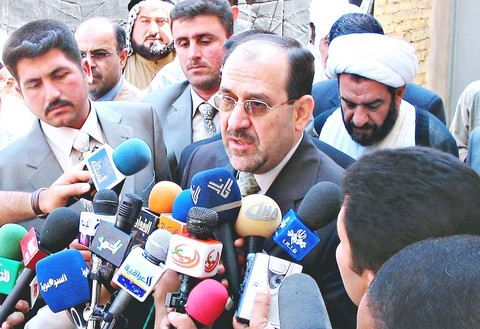
PHOTO: AP
Elsewhere, three Italian and one Romanian soldiers were killed in a bombing in southern Iraq, insurgents launched attacks northeast of the capital, and a US jet fired missiles at insurgent positions in Ramadi.
Security
The endorsement of al-Maliki's plan came during a meeting in Najaf with Grand Ayatollah Ali al-Sistani. The ayatollah told al-Maliki, a Shiite tapped last weekend to form a government, that security should be his top priority.
"Therefore, weapons must be exclusively in the hands of government forces, and these forces must be built on a proper national basis so that their loyalty is to the country alone, not to political or other sides," a statement from al-Sistani's office said.
Al-Maliki plans to integrate militias, many of them linked to Shiite parties, into the army and police. To ensure their loyalty to the government, he wants to appoint defense and interior ministers without connections to militias.
Former militiamen who have joined government forces, especially those run by the Shiite-led Interior Ministry, have been widely accused by Sunni Arabs of operating as death squads targeting Sunni civilians.
Attempts by previous Iraqi governments to abolish militias have failed, and their numbers have grown, in part because US and Iraqi forces have been unable to guarantee public safety.
The leader of one major militia, radical Shiite cleric Moqtada al-Sadr, refrained on Thursday from endorsing calls to disband his Mehdi Army.
After a separate meeting with al-Maliki, the cleric was asked if he would give up his militia.
He replied: "All groups inside or outside the government work for the people's interest and service."
Al-Maliki has until late next month to present his Cabinet to parliament, the final step in building a national unity government.
The US believes a government of Sunnis, Shiites and Kurds will help calm sectarian passions and tamp down the Sunni-led insurgency so the 130,000 US troops can begin to go home.
Sectarian tensions rose dramatically after the Feb. 22 bombing of a Shiite shrine in Samarra, triggering reprisal attacks against Sunni mosques and clerics.
No civil war
Lieutenant General Peter Chia-relli, the second-ranking US general in Iraq, told US reporters on Wednesday that militias pose an urgent threat to the country's stability and were "an issue we've got to get fixed."
In a briefing on Thursday, however, US spokesman Major General Rick Lynch told reporters that "we are not seeing widespread militia operations across Iraq" and that "ethno-sectarian" attacks had dropped by half in Baghdad over the last week.
Lynch also said US forces had found no "widespread movement" of Shiites and Sunnis away from religiously mixed areas, despite reports to the contrary by Iraqi officials.
"So we do not see us moving toward a civil war in Iraq," Lynch said. "In fact we see us moving away from it."
Nearly half of China’s major cities are suffering “moderate to severe” levels of subsidence, putting millions of people at risk of flooding, especially as sea levels rise, according to a study of nationwide satellite data released yesterday. The authors of the paper, published by the journal Science, found that 45 percent of China’s urban land was sinking faster than 3mm per year, with 16 percent at more than 10mm per year, driven not only by declining water tables, but also the sheer weight of the built environment. With China’s urban population already in excess of 900 million people, “even a small portion

UNSETTLING IMAGES: The scene took place in front of TV crews covering the Trump trial, with a CNN anchor calling it an ‘emotional and unbelievably disturbing moment’ A man who doused himself in an accelerant and set himself on fire outside the courthouse where former US president Donald Trump is on trial has died, police said yesterday. The New York City Police Department (NYPD) said the man was declared dead by staff at an area hospital. The man was in Collect Pond Park at about 1:30pm on Friday when he took out pamphlets espousing conspiracy theories, tossed them around, then doused himself in an accelerant and set himself on fire, officials and witnesses said. A large number of police officers were nearby when it happened. Some officers and bystanders rushed
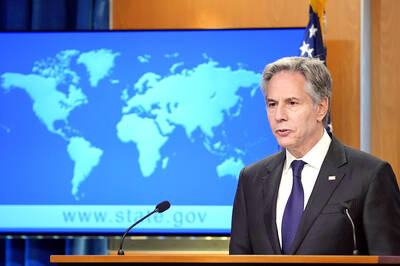
Beijing is continuing to commit genocide and crimes against humanity against Uyghurs and other Muslim minorities in its western Xinjiang province, U.S. Secretary of State Antony Blinken said in a report published on Monday, ahead of his planned visit to China this week. The State Department’s annual human rights report, which documents abuses recorded all over the world during the previous calendar year, repeated language from previous years on the treatment of Muslims in Xinjiang, but the publication raises the issue ahead of delicate talks, including on the war in Ukraine and global trade, between the top U.S. diplomat and Chinese

HYPOCRISY? The Chinese Ministry of Foreign Affairs yesterday asked whether Biden was talking about China or the US when he used the word ‘xenophobic’ US President Joe Biden on Wednesday called for a hike in steel tariffs on China, accusing Beijing of cheating as he spoke at a campaign event in Pennsylvania. Biden accused China of xenophobia, too, in a speech to union members in Pittsburgh. “They’re not competing, they’re cheating. They’re cheating and we’ve seen the damage here in America,” Biden said. Chinese steel companies “don’t need to worry about making a profit because the Chinese government is subsidizing them so heavily,” he said. Biden said he had called for the US Trade Representative to triple the tariff rates for Chinese steel and aluminum if Beijing was


 RSS
RSS