


Israeli aircraft fired three missiles at targets in the central Gaza Strip yesterday, killing one Palestinian militant and critically wounding another, Palestinian health officials said.
The army said the airstrikes were aimed at a cell preparing to carry out an attack. It said two vehicles were targeted, and one was hit.
Pillars of smoke billowed from the destroyed vehicle as rescue workers removed burned and dismembered bodies.
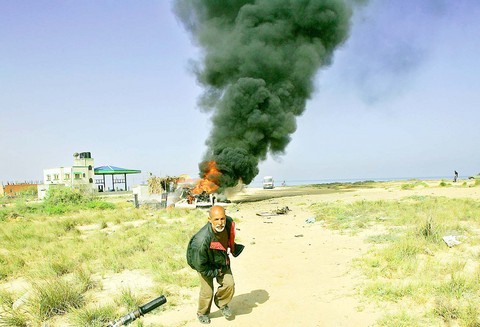
PHOTO: AFP
Palestinian officials initially said both men were dead after they were taken to the morgue by an ambulance. But a doctor at the morgue found them to be alive and sent them to the operating room. The injuries included lost legs, severe chest wounds and head injuries.
Later, Dr Baker Abu Safia confirmed that Wael Nassar, 23, of Islamic Jihad had died of his wounds.
Ahmad Abu Najam, 23, another Islamic Jihad militant remained in critical condition.
Islamic Jihad vowed to take revenge for the Israeli missile strike.
"God willing our reprisal is coming and it is going to be like air shaking," said spokesman Abu Ahmad.
"We are going to shake the air under their feet. They had experienced us in Tel Aviv and more is coming," he said.
Islamic Jihad, a small group with ties to Iran and Syria, claimed responsibility for last week's suicide bombing in Tel Aviv that killed nine and wounded dozens.
Jerusalem fence
In related developments, Israel's prime minister-designate Ehud Olmert told top security officials on Wednesday to swiftly plug the gaps in the separation barrier around Jerusalem.
Olmert ordered that "all gaps be closed immediately by means of temporary fences until they are permanently closed by the security fence," according to the prime minister's office.
The separation barrier, which is a network of fences, walls and guard points that stretches for about 720km, still has many openings around Jerusalem, and Israeli security officials consider the city one of the places most vulnerable to attack.
Legal challenges in Israel resulted in temporary injunctions against building the barrier in several parts of Jerusalem. The Supreme Court recently dismissed the injunctions against building, though the justices have yet to issue final rulings in the cases, said Marc Luria, a founder of Security Fence for Israel, a private group.
The court can still rule against the government's proposed route and require the barrier to be moved, but Olmert said some sort of obstacle should be put in place as soon as possible.
The International Court of Justice in The Hague ruled in 2004 that building the barrier inside the West Bank, where most of it is being erected, is a violation of international law.
Israel rejected the decision, saying the barrier was necessary to prevent suicide bombings and other attacks.
In Jerusalem much of the barrier runs along the eastern edge of the city, keeping virtually all of the city on the Israeli side. About three-quarters of the Jerusalem barrier has been completed or is under construction, while about one-quarter has been blocked by the legal challenges, Luria said.
In the most recent suicide bombing, a West Bank Palestinian killed nine people at a restaurant in Tel Aviv on April 17.
Israeli officials have not said how he reached the city, though Israeli news reports cited officials who said they believed that he had entered through an opening in the barrier in or near Jerusalem.
Court case
In another development, Israel's Justice Ministry said a prominent Palestinian militant, Ahmed Saadat, who was seized last month in a raid on the Palestinian jail in Jericho, would not be put on trial for the killing of an Israeli Cabinet minister in 2001. He is to be charged in a military court with other security offenses, the ministry said.
Attorney General Menachem Mazuz found that an inquiry had not produced enough evidence to put Saadat on trial in the killing of Tourism Minister Rehavam Zeevi, who was shot in a Jerusalem hotel.
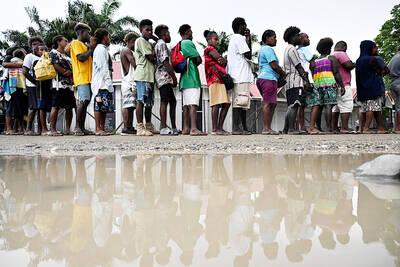
SEEKING CHANGE: A hospital worker said she did not vote in previous elections, but ‘now I can see that maybe my vote can change the system and the country’ Voting closed yesterday across the Solomon Islands in the south Pacific nation’s first general election since the government switched diplomatic allegiance from Taiwan to Beijing and struck a secret security pact that has raised fears of the Chinese navy gaining a foothold in the region. The Solomon Islands’ closer relationship with China and a troubled domestic economy weighed on voters’ minds as they cast their ballots. As many as 420,000 registered voters had their say across 50 national seats. For the first time, the national vote also coincided with elections for eight of the 10 local governments. Esther Maeluma cast her vote in the
Nearly half of China’s major cities are suffering “moderate to severe” levels of subsidence, putting millions of people at risk of flooding, especially as sea levels rise, according to a study of nationwide satellite data released yesterday. The authors of the paper, published by the journal Science, found that 45 percent of China’s urban land was sinking faster than 3mm per year, with 16 percent at more than 10mm per year, driven not only by declining water tables, but also the sheer weight of the built environment. With China’s urban population already in excess of 900 million people, “even a small portion

UNSETTLING IMAGES: The scene took place in front of TV crews covering the Trump trial, with a CNN anchor calling it an ‘emotional and unbelievably disturbing moment’ A man who doused himself in an accelerant and set himself on fire outside the courthouse where former US president Donald Trump is on trial has died, police said yesterday. The New York City Police Department (NYPD) said the man was declared dead by staff at an area hospital. The man was in Collect Pond Park at about 1:30pm on Friday when he took out pamphlets espousing conspiracy theories, tossed them around, then doused himself in an accelerant and set himself on fire, officials and witnesses said. A large number of police officers were nearby when it happened. Some officers and bystanders rushed

HYPOCRISY? The Chinese Ministry of Foreign Affairs yesterday asked whether Biden was talking about China or the US when he used the word ‘xenophobic’ US President Joe Biden on Wednesday called for a hike in steel tariffs on China, accusing Beijing of cheating as he spoke at a campaign event in Pennsylvania. Biden accused China of xenophobia, too, in a speech to union members in Pittsburgh. “They’re not competing, they’re cheating. They’re cheating and we’ve seen the damage here in America,” Biden said. Chinese steel companies “don’t need to worry about making a profit because the Chinese government is subsidizing them so heavily,” he said. Biden said he had called for the US Trade Representative to triple the tariff rates for Chinese steel and aluminum if Beijing was


 RSS
RSS