


Somber vigils and protests marked the 20th anniversary yesterday of the Chernobyl disaster, the world's worst nuclear accident that continues to scourge this corner of eastern Europe and haunt millions of people.
Hundreds of survivors gathered at monuments to those who died cleaning up after the disaster, holding flowers and candles at overnight ceremonies in Ukraine where the plant is located.
Ringing bells and wailing sirens pierced the cool night air around the time when two explosions ripped through Chernobyl's reactor No. 4 on April 26, 1986, releasing a huge radioactive cloud into the air and bathing the station in an eerie bluish glow.

PHOTO: EPA
"This is a night of remembrance and tragedy," Borys Ulavin, a 59-year-old who participated in the clean-up of the disaster said in the northern town of Slavutich, built to house staff and other evacuees after the accident.
"I knew all of these people," said 59-year-old Mykola Ryabushkin, who was on duty that night at the plant, as he wiped away tears and pointed to photographs of firemen and others who died putting out the flames that night.
Ukrainian President Viktor Yushchenko, who attended an overnight church service in Kiev for victims of the disaster, was to fly to the defunct plant later yesterday.
In neighboring Belarus to the north, where a quarter of the land was contaminated by the released radiation, opposition groups were expected to hold what has become a traditional protest rally in the evening against the government's handling of the accident and its aftermath.
The nation's authoritarian leadership has sought to repopulate areas abandoned in the wake of the accident and critics say that the authorities are ignoring serious health risks in doing so.
Memorial services were also to take place in Kiev and Minsk.
The cloud released by the Chernobyl explosion settled mostly in Ukraine and Belarus, but parts of it drifted across Russia and a large swathe of Europe, and its effects were felt from Scandinavia to Greece.
The impact was made worse by the fact that the Soviet authorities concealed the extent of what had happened for several days and did not begin to evacuate people from the area until more than a day and half later.
Some 5 million people are believed to have been affected by the disaster in Belarus, Russia and Ukraine, all of which still have regions where the levels of dangerous cesium-137 and strontium-90 radioisotopes are much higher than accepted norms.
Two decades on, millions of hectares of agricultural and forest land remain contaminated from the accident and its death toll is hotly debated.
UN agencies, backed by the three governments, estimate that between 4,000 and 9,000 people could be expected to die overall as a direct consequence of the accident. Environmental groups put the figure at 100,000 and higher.

Republican US lawmakers on Friday criticized US President Joe Biden’s administration after sanctioned Chinese telecoms equipment giant Huawei unveiled a laptop this week powered by an Intel artificial intelligence (AI) chip. The US placed Huawei on a trade restriction list in 2019 for contravening Iran sanctions, part of a broader effort to hobble Beijing’s technological advances. Placement on the list means the company’s suppliers have to seek a special, difficult-to-obtain license before shipping to it. One such license, issued by then-US president Donald Trump’s administration, has allowed Intel to ship central processors to Huawei for use in laptops since 2020. China hardliners
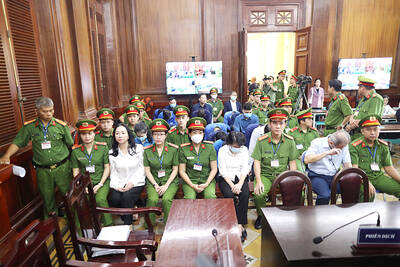
A top Vietnamese property tycoon was on Thursday sentenced to death in one of the biggest corruption cases in history, with an estimated US$27 billion in damages. A panel of three hand-picked jurors and two judges rejected all defense arguments by Truong My Lan, chair of major developer Van Thinh Phat, who was found guilty of swindling cash from Saigon Commercial Bank (SCB) over a decade. “The defendant’s actions ... eroded people’s trust in the leadership of the [Communist] Party and state,” read the verdict at the trial in Ho Chi Minh City. After the five-week trial, 85 others were also sentenced on

‘DELUSIONAL’: Targeting the families of Hamas’ leaders would not push the group to change its position or to give up its demands for Palestinians, Ismail Haniyeh said Israeli aircraft on Wednesday killed three sons of Hamas’ top political leader in the Gaza Strip, striking high-stakes targets at a time when Israel is holding delicate ceasefire negotiations with the militant group. Hamas said four of the leader’s grandchildren were also killed. Ismail Haniyeh’s sons are among the highest-profile figures to be killed in the war so far. Israel said they were Hamas operatives, and Haniyeh accused Israel of acting in “the spirit of revenge and murder.” The deaths threatened to strain the internationally mediated ceasefire talks, which appeared to gain steam in recent days even as the sides remain far
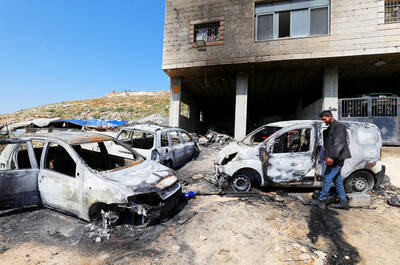
RAMPAGE: A Palestinian man was left dead after dozens of Israeli settlers searching for a missing 14-year-old boy stormed a village in the Israeli-occupied West Bank US President Joe Biden on Friday said he expected Iran to attack Israel “sooner, rather than later” and warned Tehran not to proceed. Asked by reporters about his message to Iran, Biden simply said: “Don’t,” underscoring Washington’s commitment to defend Israel. “We are devoted to the defense of Israel. We will support Israel. We will help defend Israel and Iran will not succeed,” he said. Biden said he would not divulge secure information, but said his expectation was that an attack could come “sooner, rather than later.” Israel braced on Friday for an attack by Iran or its proxies as warnings grew of


 RSS
RSS