


Nepal's powerful Maoists lifted a blockade of the capital yesterday following a plea by the country's prime minister-designate ahead of the first parliamentary session in four years.
The Maoists were forced into a U-turn following the public outpouring of joy when embattled King Gyanendra late on Monday handed control to politicians after weeks of violent street protests against his outright rule.
Gyanendra announced parliament, which he dismissed in 2002, would sit tomorrow as he conceded power in the face of the protests in which many sought to dislodge the world's last Hindu monarch. Authorities had warned the protesters they could be shot on sight.

PHOTO: AP
Gyanendra seized total power almost 15 months ago after sacking the government, accusing it of corruption and of failing to quell a decade-long Maoist rebellion.
The Maoists, who have a loose alliance with seven leading political parties, initially rejected the king's move saying it did not answer their key demand for a constitutional review of the role of the monarchy.
The rebels want a legislative body, called a constituent assembly, to draft a new constitution which would likely clip the king's powers.
The opposition, now led by three-time former prime minister Girija Prasad Koirala, 81, said the main business tomorrow would be to call for a constituent assembly to placate the rebels in hope that they lay down their arms and join the political process.
Yesterday, the rebels responded.
"We have withdrawn our blockade until the first session of parliament taking into account the commitment made for constituent assembly elections and the request made by Koirala," Maoist leader Prachanda said in a statement.
But he warned that the blockades, in Kathmandu and other centers, would be reimposed if parliament failed to call for a constituent assembly tomorrow.
The wrangling in the run-up to the re-opening of parliament came after tens of thousands hit the streets on Tuesday to celebrate the king's climbdown.
A protester, fired on by police during a demonstration last week in west Nepal, died of his injuries four days later taking the toll to at least 15 dead across the country from clashes between security forces and demonstrators. Hundreds more were injured.
Meanwhile the authorities on Tuesday released 320 political detainees who had been held in and around Kathmandu, police confirmed.
"Among the released were political leaders, human rights activists, civil society members and protesters," a police official said on condition of anonymity.
Leaders of the alliance said one of their first acts would be to call a ceasefire against the Maoists and urged the rebel group to do the same.
The Maoists began their armed uprising to win a republic in 1996 and more than 12,500 people have since been killed. The rebels effectively control large parts of the countryside.
Koirala's staff said the aging leader was ill yesterday, but he met the Indian ambassador amid reports that Nepal's giant republican neighbor was preparing an aid package to help lift the country's shattered economy.

Republican US lawmakers on Friday criticized US President Joe Biden’s administration after sanctioned Chinese telecoms equipment giant Huawei unveiled a laptop this week powered by an Intel artificial intelligence (AI) chip. The US placed Huawei on a trade restriction list in 2019 for contravening Iran sanctions, part of a broader effort to hobble Beijing’s technological advances. Placement on the list means the company’s suppliers have to seek a special, difficult-to-obtain license before shipping to it. One such license, issued by then-US president Donald Trump’s administration, has allowed Intel to ship central processors to Huawei for use in laptops since 2020. China hardliners

Conjoined twins Lori and George Schappell, who pursued separate careers, interests and relationships during lives that defied medical expectations, died this month in Pennsylvania, funeral home officials said. They were 62. The twins, listed by Guinness World Records as the oldest living conjoined twins, died on April 7 at the Hospital of the University of Pennsylvania, obituaries posted by Leibensperger Funeral Homes of Hamburg said. The cause of death was not detailed. “When we were born, the doctors didn’t think we’d make 30, but we proved them wrong,” Lori said in an interview when they turned 50, the Philadelphia Inquirer reported. The
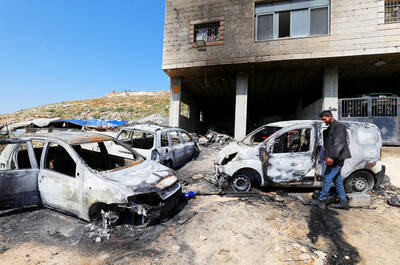
RAMPAGE: A Palestinian man was left dead after dozens of Israeli settlers searching for a missing 14-year-old boy stormed a village in the Israeli-occupied West Bank US President Joe Biden on Friday said he expected Iran to attack Israel “sooner, rather than later” and warned Tehran not to proceed. Asked by reporters about his message to Iran, Biden simply said: “Don’t,” underscoring Washington’s commitment to defend Israel. “We are devoted to the defense of Israel. We will support Israel. We will help defend Israel and Iran will not succeed,” he said. Biden said he would not divulge secure information, but said his expectation was that an attack could come “sooner, rather than later.” Israel braced on Friday for an attack by Iran or its proxies as warnings grew of

A prominent Christian leader has allegedly been stabbed at the altar during a Mass yesterday in southwest Sydney. Bishop Mar Mari Emmanuel was saying Mass at Christ The Good Shepherd Church in Wakeley just after 7pm when a man approached him at the altar and allegedly stabbed toward his head multiple times. A live stream of the Mass shows the congregation swarm forward toward Emmanuel before it was cut off. The church leader gained prominence during the COVID-19 pandemic, amassing a large online following, Officers attached to Fairfield City police area command attended a location on Welcome Street, Wakeley following reports a number


 RSS
RSS