


Panama unveiled an ambitious US$5.25 billion plan on Monday to expand its famous canal to handle a new generation of mammoth cargo ships and oil tankers.
Opened in 1914 at a cost of 25,000 lives, the Panama canal was considered a masterpiece of engineering. It makes a shortcut between the Pacific and Atlantic oceans, saving ships the long trip around South America and the treacherous Cape Horn.
While much of the canal is made up of roomy lakes, modern, large bulk ships are too wide and too long to fit in its narrow lock systems, meaning Panama needs to expand it or risk losing business.
President Martin Torrijos and Panama Canal Authority executives said the expansion centers on building a second lane and a new set of locks to double its capacity. Construction should be completed by 2014, exactly a century after the canal was opened.
"Without doubt, it is a formidable challenge and a gigantic project," Torrijos said as the plan was announced.
It calls for up to US$2.3 billion in loans or bond issues to be paid back with the revenues from higher tolls on the canal. There will be no increase in Panama's sovereign debt.
The expansion has been Torrijos' main goal since he took office in 2004, and he urged Congress and ordinary Panamanians to back it.
"If we do not confront the challenge of expanding the canal and improving its capacity to continue providing an efficient and competitive service, other routes will inevitably emerge to replace ours," Torrijos said.
About 38 to 40 ships pass through the 80km canal every day.
Without an expansion, experts say the waterway could hit saturation point in as little as three years, forcing shippers to use different routes.
Mexico and some Central American nations have suggested they might dig their own canals.
The planned expansion must be approved by Panama's Congress, where Torrijos' party has a majority. Torrijos said information on the project will be made available to the public to fuel debate before the referendum, expected later this year.
Recent polls indicate that a majority of Panamanians favor the expansion.
France's Ferdinand de Lesseps, builder of the Suez Canal, started the Panama Canal in 1880, but abandoned it nine years later amid bankruptcy and construction problems, as well as malaria and yellow fever, which claimed most of the lost lives.
The US government under President Theodore Roosevelt bought the canal in 1904 and 10 years later, after a Herculean effort by 75,000 workers from 50 countries, opened the inter-oceanic waterway dividing North and South America.
The US, which saw the canal as key to naval supremacy, then ran the canal for most of last century.
In treaties signed in 1977 by then US president Jimmy Carter and Panama's populist dictator General Omar Torrijos, father of the current elected president, the US agreed to hand the canal over to Panama in 1999.
Last year Panama earned US$1.2 billion in canal fees, maintenance and other related services levied on some 13,000 ship crossings.
Opponents, however, contend the project is unnecessary and risky.
Former canal administrator Fernando Manfredo, who opposes the project, contends that it depends on variables like the growth of maritime world trade, world economic fluctuations and even politics.
"Our most important natural resource is not the canal, but our geographic position," Manfredo said in an interview, pointing out that the Pacific is becoming the "ocean of commerce."
Manfredo is the leader of a group that would prefer Panama build a mega-port near the Pacific end of the canal, where large ships could transfer their loads to smaller vessels to carry them to the Atlantic. The project would come at one-tenth of the cost, or about US$600 million, he says.
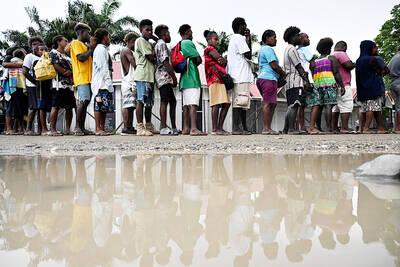
SEEKING CHANGE: A hospital worker said she did not vote in previous elections, but ‘now I can see that maybe my vote can change the system and the country’ Voting closed yesterday across the Solomon Islands in the south Pacific nation’s first general election since the government switched diplomatic allegiance from Taiwan to Beijing and struck a secret security pact that has raised fears of the Chinese navy gaining a foothold in the region. The Solomon Islands’ closer relationship with China and a troubled domestic economy weighed on voters’ minds as they cast their ballots. As many as 420,000 registered voters had their say across 50 national seats. For the first time, the national vote also coincided with elections for eight of the 10 local governments. Esther Maeluma cast her vote in the
Nearly half of China’s major cities are suffering “moderate to severe” levels of subsidence, putting millions of people at risk of flooding, especially as sea levels rise, according to a study of nationwide satellite data released yesterday. The authors of the paper, published by the journal Science, found that 45 percent of China’s urban land was sinking faster than 3mm per year, with 16 percent at more than 10mm per year, driven not only by declining water tables, but also the sheer weight of the built environment. With China’s urban population already in excess of 900 million people, “even a small portion

UNSETTLING IMAGES: The scene took place in front of TV crews covering the Trump trial, with a CNN anchor calling it an ‘emotional and unbelievably disturbing moment’ A man who doused himself in an accelerant and set himself on fire outside the courthouse where former US president Donald Trump is on trial has died, police said yesterday. The New York City Police Department (NYPD) said the man was declared dead by staff at an area hospital. The man was in Collect Pond Park at about 1:30pm on Friday when he took out pamphlets espousing conspiracy theories, tossed them around, then doused himself in an accelerant and set himself on fire, officials and witnesses said. A large number of police officers were nearby when it happened. Some officers and bystanders rushed

HYPOCRISY? The Chinese Ministry of Foreign Affairs yesterday asked whether Biden was talking about China or the US when he used the word ‘xenophobic’ US President Joe Biden on Wednesday called for a hike in steel tariffs on China, accusing Beijing of cheating as he spoke at a campaign event in Pennsylvania. Biden accused China of xenophobia, too, in a speech to union members in Pittsburgh. “They’re not competing, they’re cheating. They’re cheating and we’ve seen the damage here in America,” Biden said. Chinese steel companies “don’t need to worry about making a profit because the Chinese government is subsidizing them so heavily,” he said. Biden said he had called for the US Trade Representative to triple the tariff rates for Chinese steel and aluminum if Beijing was


 RSS
RSS