


Karl Marx's birthplace is a stately three-story house that has been a fixture of this ancient town on the Mosel River since it was built in 1727. What is changing are the large groups that visit almost every day from China, one of the few countries in the world still under the control of something calling itself a Communist Party.
Chinese tourists have started to become common in Europe as China has become richer and tourist agencies have sprung into action. Trier is a worthy destination by any standard, having impressive and important Roman ruins as well as an 11th century cathedral built in the very place where Emperor Constantine's mother first built a church in the fourth century.
But the Chinese clearly come to see the place where Marx was born in 1818, and the local authorities try to take full advantage of it, promoting their city in China itself and with the travel agencies that serve Chinese tourists.
They even offer cultural sensitivity training for merchants, restaurateurs and others in Trier, instructing them in the finer points of dealing with Chinese customers.
"Years ago, state visitors from China used to come to see the Marx House," Robert Noll, chief of Trier's Tourist Development office, said. "They would spend a couple of hours, take a picture and then leave. But in the late 1990s, when Chinese tourism picked up in Europe, we saw the opportunity."
"Now the Chinese are second after the Dutch in overnight stays," Noll continued, adding that about 100,000 Chinese citizens visited Trier last year, and about 40,000 of them spent at least one night.
"And they come all year," he said, "even in the low season."
But what of the Chinese themselves? After all, the ruling party in China might call itself Communist, but China is capitalist today, having rejected Marxism in practice if not in theory. Do they come to Trier as pilgrims to a kind of shrine?
"Nah," one man, who said he was from Harbin in the far north of Manchuria, said dismissively. A minute earlier, the man had struck a sort of mock revolutionary pose for a photograph next to the inscription identifying the house as Marx's birthplace. He did not seem reverential.
"It's just a stop on the tour," he said. "We went to Paris and Brussels, too. It's a six-day trip."
Judging from the comments in the Marx House guest book, most of the Chinese visitors seem to agree, extolling him as a great figure whose name will burn brightly in China forever.
But widely spaced on the book's pages were some dissenting opinions, all unsigned, one going so far as to bemoan what the writer described as the Communist authorities' use of Marxism as a pretext for oppression.
"Marxism is not bad," one person wrote. "But it is a dream, beautiful only as philosophy."

Republican US lawmakers on Friday criticized US President Joe Biden’s administration after sanctioned Chinese telecoms equipment giant Huawei unveiled a laptop this week powered by an Intel artificial intelligence (AI) chip. The US placed Huawei on a trade restriction list in 2019 for contravening Iran sanctions, part of a broader effort to hobble Beijing’s technological advances. Placement on the list means the company’s suppliers have to seek a special, difficult-to-obtain license before shipping to it. One such license, issued by then-US president Donald Trump’s administration, has allowed Intel to ship central processors to Huawei for use in laptops since 2020. China hardliners
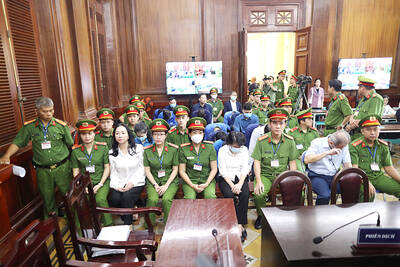
A top Vietnamese property tycoon was on Thursday sentenced to death in one of the biggest corruption cases in history, with an estimated US$27 billion in damages. A panel of three hand-picked jurors and two judges rejected all defense arguments by Truong My Lan, chair of major developer Van Thinh Phat, who was found guilty of swindling cash from Saigon Commercial Bank (SCB) over a decade. “The defendant’s actions ... eroded people’s trust in the leadership of the [Communist] Party and state,” read the verdict at the trial in Ho Chi Minh City. After the five-week trial, 85 others were also sentenced on

‘DELUSIONAL’: Targeting the families of Hamas’ leaders would not push the group to change its position or to give up its demands for Palestinians, Ismail Haniyeh said Israeli aircraft on Wednesday killed three sons of Hamas’ top political leader in the Gaza Strip, striking high-stakes targets at a time when Israel is holding delicate ceasefire negotiations with the militant group. Hamas said four of the leader’s grandchildren were also killed. Ismail Haniyeh’s sons are among the highest-profile figures to be killed in the war so far. Israel said they were Hamas operatives, and Haniyeh accused Israel of acting in “the spirit of revenge and murder.” The deaths threatened to strain the internationally mediated ceasefire talks, which appeared to gain steam in recent days even as the sides remain far
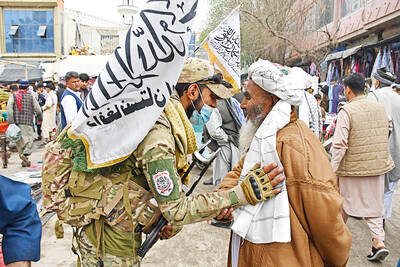
The Taliban’s reclusive supreme leader made a rare public appearance yesterday, an Afghan government spokesman said, leading thousands of worshipers in prayers marking Eid al-Fitr. Hibatullah Akhundzada has made only a handful of public appearances since inheriting the leadership of the Taliban in 2016 and leading the movement back to power with the withdrawal of US forces in 2021. Taliban government spokesman Zabihullah Mujahid said prayer in the largest mosque in Kandahar was “performed under the leadership of the supreme leader.” In a statement on X, he said the early-morning service “was attended by thousands of compatriots” in the southern province considered the


 RSS
RSS