


It was a year ago on Saturday that Chinese security agents arrested Hong Kong journalist Ching Cheong (程翔), searched his laptop computer and eventually accused him of spying for Taiwan -- a charge his family denies.
Since then, Ching's face -- with his gray crew cut and oversized brown-framed glasses -- has haunted Hong Kong's media. He was a veteran reporter, widely respected for his wide network of sources and insights about the secretive world of the Communist Party leadership.
Ching's disappearance and long detention without any sort of trial serve as a chilling reminder to Hong Kong journalists of the risks of reporting on the mainland -- especially as they excel at collecting information that often tips off the foreign media to major China stories.
Ching was working as the chief China correspondent for Singapore's Straits Times newspaper when security agents picked him up on April 22, last year, in the southern city of Guangzhou.
Shortly before he was taken away, an unidentified source in the city gave Ching a manuscript for a book about the late Chinese leader Zhao Ziyang (趙紫陽), who sympathized with pro-democracy protesters at the bloody Tiananmen Square crackdown in 1989, Ching's wife, Mary Lau (劉敏儀), has said.
Four months later, the official Xinhua News Agency said Ching was charged with spying for Taiwan. The state media said Ching confessed to setting up extensive espionage channels and selling classified state secrets -- especially military secrets -- to Taiwan.
No details have since been officially released about Ching's case. Ching's wife and supporters, who insist he is innocent, said they have received no updates.
"So far the case has been lying there like it hasn't moved anywhere. All we can do is continue waiting," Lau told Hong Kong's Cable TV.
Reports in February said state prosecutors had transferred the case to Beijing's State Security Bureau for further investigation -- a move analysts say may mean authorities have insufficient evidence against him. It has also led others to speculate that the case may be endlessly delayed.
"This is a highly unusual scenario. Throwing the case back and forth between different officials doesn't comply with Chinese criminal procedures," said law professor Priscilla Leung.
"In ordinary cases prosecutors and state security should each have only 30 to 60 days to finish their investigations," said Leung, who teaches at Hong Kong's City University.
Veteran Hong Kong journalist and China analyst Willy Lam (林和立) said Ching's treatment was "unreasonable, even by Chinese standards."
Lam said the extent of Ching's alleged offenses was still murky. He also believed authorities would not easily let Ching go, in light of ongoing investigations into the detained New York Times researcher Zhao Yan (趙岩).
"Zhao is still held despite his employer's level of influence. The charges against him are also much less serious than Ching's," Lam said.
Zhao has been detained since 2004. A court dropped state secret charges against him last month, but officials have recently reopened an investigation into the case.
Ching is the only Hong Kong journalist to have been held so long in the mainland and his case is the most serious so far, Lam said.
Other Hong Kong journalists have in the past been detained on the mainland for reporting "state secrets" -- including publishing political appointments several days before the official release date, he said.
Hong Kong has traditionally served as a keyhole to China and helped uncover news that the mainland media -- controlled by state propaganda authorities -- did not have access to.
Although the former British colony returned to Chinese rule in 1997, Hong Kong still enjoys civil liberties and press freedoms that mainlanders can only dream about. Newspapers often criticize Chinese leaders in hard-hitting editorials, and journalists are frequently the first to report on important stories such as disease outbreaks.
"Our opportunities for covering news in the mainland have clearly increased as the relationship between Hong Kong and the mainland becomes closer. But we haven't seen any government effort to help us if we get in trouble there," said Cheung Ping-ling (張炳玲), head of the Hong Kong Journalists' Association.
Hong Kong journalists must report all aspects of their work to Chinese authorities, or face detention that usually lasts from several hours to overnight, Cheung said. They get no protection from the Hong Kong government once they step on mainland soil, she said.
"We have to take risks in almost everything we do. We get barred from conducting investigative reports on issues like independence and democracy, but often the Chinese standards for `sensitive' news is baffling," Cheung said. "We're not spies, so it's not fair to leave it to us to guess what constitutes `state secrets.'"

Republican US lawmakers on Friday criticized US President Joe Biden’s administration after sanctioned Chinese telecoms equipment giant Huawei unveiled a laptop this week powered by an Intel artificial intelligence (AI) chip. The US placed Huawei on a trade restriction list in 2019 for contravening Iran sanctions, part of a broader effort to hobble Beijing’s technological advances. Placement on the list means the company’s suppliers have to seek a special, difficult-to-obtain license before shipping to it. One such license, issued by then-US president Donald Trump’s administration, has allowed Intel to ship central processors to Huawei for use in laptops since 2020. China hardliners
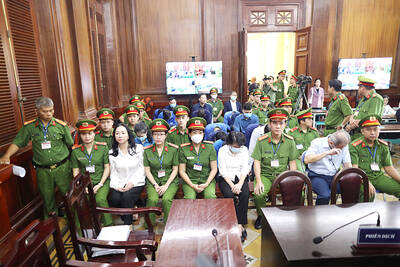
A top Vietnamese property tycoon was on Thursday sentenced to death in one of the biggest corruption cases in history, with an estimated US$27 billion in damages. A panel of three hand-picked jurors and two judges rejected all defense arguments by Truong My Lan, chair of major developer Van Thinh Phat, who was found guilty of swindling cash from Saigon Commercial Bank (SCB) over a decade. “The defendant’s actions ... eroded people’s trust in the leadership of the [Communist] Party and state,” read the verdict at the trial in Ho Chi Minh City. After the five-week trial, 85 others were also sentenced on

‘DELUSIONAL’: Targeting the families of Hamas’ leaders would not push the group to change its position or to give up its demands for Palestinians, Ismail Haniyeh said Israeli aircraft on Wednesday killed three sons of Hamas’ top political leader in the Gaza Strip, striking high-stakes targets at a time when Israel is holding delicate ceasefire negotiations with the militant group. Hamas said four of the leader’s grandchildren were also killed. Ismail Haniyeh’s sons are among the highest-profile figures to be killed in the war so far. Israel said they were Hamas operatives, and Haniyeh accused Israel of acting in “the spirit of revenge and murder.” The deaths threatened to strain the internationally mediated ceasefire talks, which appeared to gain steam in recent days even as the sides remain far
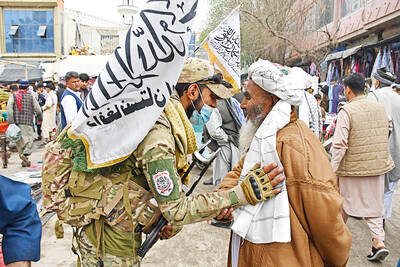
The Taliban’s reclusive supreme leader made a rare public appearance yesterday, an Afghan government spokesman said, leading thousands of worshipers in prayers marking Eid al-Fitr. Hibatullah Akhundzada has made only a handful of public appearances since inheriting the leadership of the Taliban in 2016 and leading the movement back to power with the withdrawal of US forces in 2021. Taliban government spokesman Zabihullah Mujahid said prayer in the largest mosque in Kandahar was “performed under the leadership of the supreme leader.” In a statement on X, he said the early-morning service “was attended by thousands of compatriots” in the southern province considered the


 RSS
RSS