


Millions of Beijing residents woke up yesterday to find their city covered in a thin layer of sand -- another reminder that the desert is moving closer to the Chinese capital.
People drove to work in cars colored yellow and brown by the dust that had blown in overnight, while pedestrians donned face masks and shopkeepers cleared the sidewalks with brooms.
"I got out of bed to see my Mercedes entirely covered in dust," said a driver, who gave his surname as Yang. "There was just no way I could handle it myself, and I had to take it to a car wash."
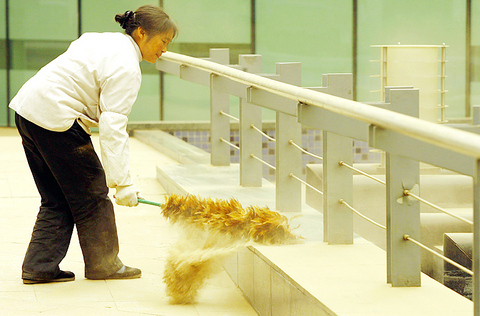
PHOTO: AFP
The sandstorm engulfed Beijing despite intensive efforts to clean the air and prepare for the 2008 Olympics by planting broad belts of trees around the city.
The Beijing Environmental Protection Bureau warned the sandstorm, the worst to hit so far this year, could be harmful.
"Sandstorms can affect the human body, especially the respiratory system," said an official with the bureau, who declined to give her name. "We tell people who have problems breathing, especially the old, to stay at home."
Xie Jun, the owner of a car wash in the Chaoyang district, was one of the few Beijing residents who welcomed the sand.
"Normally I only get to wash a few dozen cars every day," he said. "So far this morning, I've washed 100."
The sandstorm originated on the border of China and Mongolia and started affecting Beijing on Sunday night, the environmental bureau said on its Web site.
The municipal government has launched a pollution control scheme, dispatching sprinklers and ordering construction companies to halt earthworks.
It was the eighth sandstorm to sweep across Beijing since the New Year, compared with a historical average of just six per year, according to state radio.
It conforms with other data suggesting that the air quality is getting worse in Beijing.
So far this year, the city has reported 56 "blue sky days," defined as days with excellent or fairly good air quality, 16 days fewer than the same period last year.
Northern China experiences sandstorms almost every spring but this year the situation has worsened because of high temperatures and a prolonged drought, according to Qiao Lin, an expert at the China Meteorological Administration.
China has 2.6 million square kilometers of desert, an area nearly 2.5 times the country's total farmland, according to government statistics.
More than a quarter of China's total area has been classified as desert, and its degradation is adversely affecting the lives of more than 400 million people, or 30 percent of its population, according to the statistics.
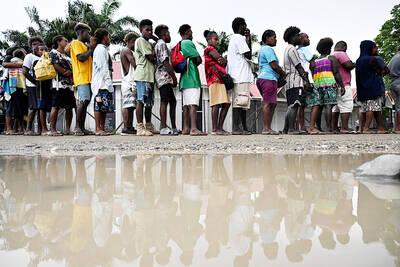
SEEKING CHANGE: A hospital worker said she did not vote in previous elections, but ‘now I can see that maybe my vote can change the system and the country’ Voting closed yesterday across the Solomon Islands in the south Pacific nation’s first general election since the government switched diplomatic allegiance from Taiwan to Beijing and struck a secret security pact that has raised fears of the Chinese navy gaining a foothold in the region. The Solomon Islands’ closer relationship with China and a troubled domestic economy weighed on voters’ minds as they cast their ballots. As many as 420,000 registered voters had their say across 50 national seats. For the first time, the national vote also coincided with elections for eight of the 10 local governments. Esther Maeluma cast her vote in the
Nearly half of China’s major cities are suffering “moderate to severe” levels of subsidence, putting millions of people at risk of flooding, especially as sea levels rise, according to a study of nationwide satellite data released yesterday. The authors of the paper, published by the journal Science, found that 45 percent of China’s urban land was sinking faster than 3mm per year, with 16 percent at more than 10mm per year, driven not only by declining water tables, but also the sheer weight of the built environment. With China’s urban population already in excess of 900 million people, “even a small portion

UNSETTLING IMAGES: The scene took place in front of TV crews covering the Trump trial, with a CNN anchor calling it an ‘emotional and unbelievably disturbing moment’ A man who doused himself in an accelerant and set himself on fire outside the courthouse where former US president Donald Trump is on trial has died, police said yesterday. The New York City Police Department (NYPD) said the man was declared dead by staff at an area hospital. The man was in Collect Pond Park at about 1:30pm on Friday when he took out pamphlets espousing conspiracy theories, tossed them around, then doused himself in an accelerant and set himself on fire, officials and witnesses said. A large number of police officers were nearby when it happened. Some officers and bystanders rushed

HYPOCRISY? The Chinese Ministry of Foreign Affairs yesterday asked whether Biden was talking about China or the US when he used the word ‘xenophobic’ US President Joe Biden on Wednesday called for a hike in steel tariffs on China, accusing Beijing of cheating as he spoke at a campaign event in Pennsylvania. Biden accused China of xenophobia, too, in a speech to union members in Pittsburgh. “They’re not competing, they’re cheating. They’re cheating and we’ve seen the damage here in America,” Biden said. Chinese steel companies “don’t need to worry about making a profit because the Chinese government is subsidizing them so heavily,” he said. Biden said he had called for the US Trade Representative to triple the tariff rates for Chinese steel and aluminum if Beijing was


 RSS
RSS