


Baton-wielding police beat journalists who were protesting against a media clampdown in the Nepalese capital yesterday, as a general strike called by the opposition to demand the king's ouster shut down the Himalayan nation.
About 200 journalists marched through Kathmandu demanding restoration of press freedom and the release of dozens of journalists detained since King Gyanendra seized power over a year ago.
Police blocked the rally and charged at them with batons. Seven journalists were wounded and at least a dozen detained, protest organizers said.
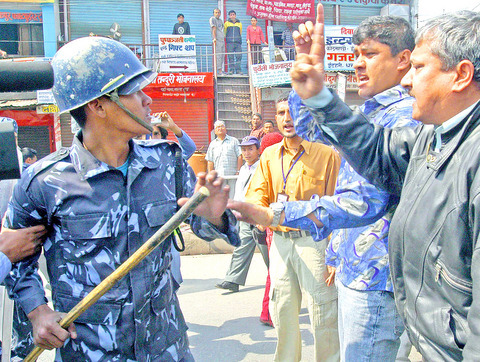
PHOTO: EPA
"We condemn the crackdown on peaceful protests. We will continue to take out protests until all restrictions on the media are fully lifted,'' said Bishnu Nisthuri of the Federation of Nepalese Journalists.
A few more sporadic protests broke out in Kathmandu yesterday, a day after the political opposition rejected Gyanendra's plea for dialogue and vowed to continue their campaign to demand his ouster.
The seven main opposition parties opposed to the king's rule decided late on Friday that they would continue with a general strike and organize more protests.
"We have decided to strictly enforce the general strike. The strike appeared to be relaxed over the last two days, but that will change from today," Subash Nemwang of the Communist Party of Nepal said yesterday. "Life will be brought to a standstill."
Traffic had picked up in Kathmandu, on Friday, with many stores open.
But few vehicles plied the streets yesterday. Only a handful of stores were open.
Activists trying to enforce the strike vandalized a taxi in Kathmandu yesterday, and blocked traffic on the city's outskirts.
Highways remained deserted in most parts of Nepal, where roads are the only way to transport food, fuel and other supplies.
Krishna Sitaula of the Nepali Congress party said the opposition is changing its strategy from mass rallies in Kathmandu to protests in other cities.
On Friday, Gyanendra broke his silence after more than a week of protests that left four dead. He called for dialogue with the country's seven major political parties and for a general election, but did not specify a date.
He did not mention the protests or the communist insurgency that has killed nearly 13,000 people in the past decade.
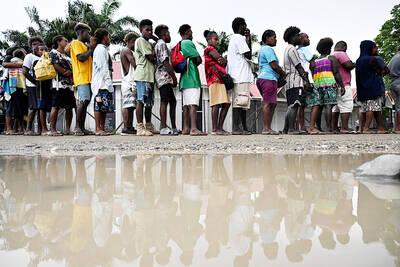
SEEKING CHANGE: A hospital worker said she did not vote in previous elections, but ‘now I can see that maybe my vote can change the system and the country’ Voting closed yesterday across the Solomon Islands in the south Pacific nation’s first general election since the government switched diplomatic allegiance from Taiwan to Beijing and struck a secret security pact that has raised fears of the Chinese navy gaining a foothold in the region. The Solomon Islands’ closer relationship with China and a troubled domestic economy weighed on voters’ minds as they cast their ballots. As many as 420,000 registered voters had their say across 50 national seats. For the first time, the national vote also coincided with elections for eight of the 10 local governments. Esther Maeluma cast her vote in the
Nearly half of China’s major cities are suffering “moderate to severe” levels of subsidence, putting millions of people at risk of flooding, especially as sea levels rise, according to a study of nationwide satellite data released yesterday. The authors of the paper, published by the journal Science, found that 45 percent of China’s urban land was sinking faster than 3mm per year, with 16 percent at more than 10mm per year, driven not only by declining water tables, but also the sheer weight of the built environment. With China’s urban population already in excess of 900 million people, “even a small portion

UNSETTLING IMAGES: The scene took place in front of TV crews covering the Trump trial, with a CNN anchor calling it an ‘emotional and unbelievably disturbing moment’ A man who doused himself in an accelerant and set himself on fire outside the courthouse where former US president Donald Trump is on trial has died, police said yesterday. The New York City Police Department (NYPD) said the man was declared dead by staff at an area hospital. The man was in Collect Pond Park at about 1:30pm on Friday when he took out pamphlets espousing conspiracy theories, tossed them around, then doused himself in an accelerant and set himself on fire, officials and witnesses said. A large number of police officers were nearby when it happened. Some officers and bystanders rushed

HYPOCRISY? The Chinese Ministry of Foreign Affairs yesterday asked whether Biden was talking about China or the US when he used the word ‘xenophobic’ US President Joe Biden on Wednesday called for a hike in steel tariffs on China, accusing Beijing of cheating as he spoke at a campaign event in Pennsylvania. Biden accused China of xenophobia, too, in a speech to union members in Pittsburgh. “They’re not competing, they’re cheating. They’re cheating and we’ve seen the damage here in America,” Biden said. Chinese steel companies “don’t need to worry about making a profit because the Chinese government is subsidizing them so heavily,” he said. Biden said he had called for the US Trade Representative to triple the tariff rates for Chinese steel and aluminum if Beijing was


 RSS
RSS