


The humble prune is set to be recognized as one of the secret weapons of World War II.
A London auction house, Spink, is selling two grizzled prunes that it says were destined to be stuffed with maps or other documents and smuggled to prisoners of war. The prunes were part of the memorabilia collection of a British spy.
``They are very dry and hard and it's amazing that they have survived,'' Spink spokeswoman Emily Johnston said on Tuesday.
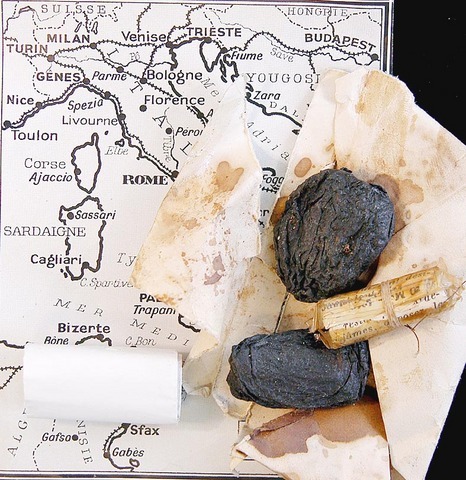
PHOTO: EPA/SPINK
The prunes are part of a collection of World War II memorabilia collected by a British woman, the late Doreen Mulot, a former member of Britain's Special Operations Executive, which was set up to carry out operations behind enemy lines.
Sometimes referred to as ``the Baker Street Irregulars'' after Sherlock Holmes' fictional group of spies, the executive was set up by then British prime minister Winston Churchill and Hugh Dalton to conduct warfare by means other than direct military engagement.
Mulot was one of as many as a million operatives. Her collection is being sold as one lot by her great-nephew Richard Marshall from the town of Crook in northern England and is expected to raise more than ?1,000 (US$1,800).
Interviewed by telephone, Marshall said his great-aunt had lived in a large house in the north London neighborhood of Hampstead ``with a large bathroom where they prepared the prunes.''
The dried fruit were softened in water, then de-pitted to allow carefully rolled documents covered in waxed paper to be inserted. The fruit was then re-dried and packed into food parcels for the prisoners, who used the information to escape and find their way home.
``She told me how she and a colleague would sit over the bathtub filled with dried prunes,'' he said.
Water was added, and ``as the prunes swelled up they picked out the [pits] and filled the cavities with waxed paper. The prunes were then dried out and sent to prisoners in Red Cross parcels. It was quite ingenious, but not the sort of thing you usually associate with fighting a war.''
These particular prunes were never used in an operation, the auction house said.
Marshall said the maps contained details of railway lines in Europe.
Mulot's collection also includes accurate forgeries of official German rubber document stamps.
Nearly half of China’s major cities are suffering “moderate to severe” levels of subsidence, putting millions of people at risk of flooding, especially as sea levels rise, according to a study of nationwide satellite data released yesterday. The authors of the paper, published by the journal Science, found that 45 percent of China’s urban land was sinking faster than 3mm per year, with 16 percent at more than 10mm per year, driven not only by declining water tables, but also the sheer weight of the built environment. With China’s urban population already in excess of 900 million people, “even a small portion

UNSETTLING IMAGES: The scene took place in front of TV crews covering the Trump trial, with a CNN anchor calling it an ‘emotional and unbelievably disturbing moment’ A man who doused himself in an accelerant and set himself on fire outside the courthouse where former US president Donald Trump is on trial has died, police said yesterday. The New York City Police Department (NYPD) said the man was declared dead by staff at an area hospital. The man was in Collect Pond Park at about 1:30pm on Friday when he took out pamphlets espousing conspiracy theories, tossed them around, then doused himself in an accelerant and set himself on fire, officials and witnesses said. A large number of police officers were nearby when it happened. Some officers and bystanders rushed

Beijing is continuing to commit genocide and crimes against humanity against Uyghurs and other Muslim minorities in its western Xinjiang province, U.S. Secretary of State Antony Blinken said in a report published on Monday, ahead of his planned visit to China this week. The State Department’s annual human rights report, which documents abuses recorded all over the world during the previous calendar year, repeated language from previous years on the treatment of Muslims in Xinjiang, but the publication raises the issue ahead of delicate talks, including on the war in Ukraine and global trade, between the top U.S. diplomat and Chinese

HYPOCRISY? The Chinese Ministry of Foreign Affairs yesterday asked whether Biden was talking about China or the US when he used the word ‘xenophobic’ US President Joe Biden on Wednesday called for a hike in steel tariffs on China, accusing Beijing of cheating as he spoke at a campaign event in Pennsylvania. Biden accused China of xenophobia, too, in a speech to union members in Pittsburgh. “They’re not competing, they’re cheating. They’re cheating and we’ve seen the damage here in America,” Biden said. Chinese steel companies “don’t need to worry about making a profit because the Chinese government is subsidizing them so heavily,” he said. Biden said he had called for the US Trade Representative to triple the tariff rates for Chinese steel and aluminum if Beijing was


 RSS
RSS