


Biologically engineered crops and pharmaceuticals are critical to the long-term economic and agricultural security of India, the science and technology minister said on Sunday.
While some nations like France may be wary of genetically modified food, India cannot afford not to invest in technologies that will boost production and can also serve to address the nutritional deficiencies of India's largely vegetarian population, Kapil Sibal said.
"We can't close our eyes to biotechnology for agriculture," he said at a biotechnology conference in Chicago.
"At the same time we cannot deviate from the goal of sustainable development in terms of environment and the basic interest of the farmer and consumer safety. So our approach is a case by case basis," he said.
Yields in India are significantly lower than in most other nations and the current production growth rate will have to triple if India will be able to feed its growing population.
Scientists are currently working on creating crops enriched with a significantly higher iron content that will allow the 70 percent of South Asians with iron deficiencies improve their hemoglobin counts.
India has been producing genetically modified cotton for three years now and 13 other crops -- including rice, chick peas, potatoes, cauliflower and eggplants -- ought to be approved in the near-term.
"We have to be very, very careful about safety standards," Sibal said. "We must ensure that the regulatory procedures are such that we don't damage our biodiversity and that in fact we make our biodiversity a source of innovation rather than destroy it."
In the health sector, India companies must invest in biotech research to find new treatments and cures for the "diseases of the poor" like malaria which are being ignored by large multinational corporations, Sibal said.
India aims to develop its life sciences industry in the same way it has developed its information technology industry.
This will create much-needed jobs but will also help drastically reduce the price of treatments because of India's low production costs. India already produces about half of the world's vaccines at just pennies a dose.
One area which India hopes to specialize in is genomics-based preventative medicine which will develop therapies tailored to subgroups said Maharaj Bhan, secretary of the department of biotechnology at the ministry of science and technology.
The Indian government has undertaken a number of measures to jump-start research and development, Bhan said.
It has revised its patent protections to meet global standards, has a goal of doubling the number of students entering life science PhD programs in the next two years and will open 50 centers of excellence over the next five years which will focus on cross-disciplinary research in the life sciences.
But more help is needed from abroad, Sibal said.
"It's very important for the scientific community to remember that yes they should make profits but they have to share knowledge," Sibal said. "Sometimes there is a clash between societal interests and proprietary interests and the world scientific community has to remember that," Sibal said.
Cutting prices in order to make products affordable to developing nations can ultimately result in profits, Sibal said.
A few weeks ago he met with Monsanto and convinced the agricultural product giant to cut its royalty fees by 30 percent on genetically modified cotton seeds.
That will help production of GM cotton to nearly triple to a forecasted 35 million hectares.

Republican US lawmakers on Friday criticized US President Joe Biden’s administration after sanctioned Chinese telecoms equipment giant Huawei unveiled a laptop this week powered by an Intel artificial intelligence (AI) chip. The US placed Huawei on a trade restriction list in 2019 for contravening Iran sanctions, part of a broader effort to hobble Beijing’s technological advances. Placement on the list means the company’s suppliers have to seek a special, difficult-to-obtain license before shipping to it. One such license, issued by then-US president Donald Trump’s administration, has allowed Intel to ship central processors to Huawei for use in laptops since 2020. China hardliners
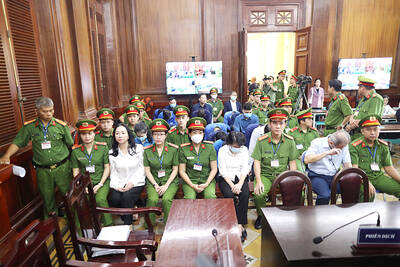
A top Vietnamese property tycoon was on Thursday sentenced to death in one of the biggest corruption cases in history, with an estimated US$27 billion in damages. A panel of three hand-picked jurors and two judges rejected all defense arguments by Truong My Lan, chair of major developer Van Thinh Phat, who was found guilty of swindling cash from Saigon Commercial Bank (SCB) over a decade. “The defendant’s actions ... eroded people’s trust in the leadership of the [Communist] Party and state,” read the verdict at the trial in Ho Chi Minh City. After the five-week trial, 85 others were also sentenced on

‘DELUSIONAL’: Targeting the families of Hamas’ leaders would not push the group to change its position or to give up its demands for Palestinians, Ismail Haniyeh said Israeli aircraft on Wednesday killed three sons of Hamas’ top political leader in the Gaza Strip, striking high-stakes targets at a time when Israel is holding delicate ceasefire negotiations with the militant group. Hamas said four of the leader’s grandchildren were also killed. Ismail Haniyeh’s sons are among the highest-profile figures to be killed in the war so far. Israel said they were Hamas operatives, and Haniyeh accused Israel of acting in “the spirit of revenge and murder.” The deaths threatened to strain the internationally mediated ceasefire talks, which appeared to gain steam in recent days even as the sides remain far

The Taliban’s reclusive supreme leader made a rare public appearance yesterday, an Afghan government spokesman said, leading thousands of worshipers in prayers marking Eid al-Fitr. Hibatullah Akhundzada has made only a handful of public appearances since inheriting the leadership of the Taliban in 2016 and leading the movement back to power with the withdrawal of US forces in 2021. Taliban government spokesman Zabihullah Mujahid said prayer in the largest mosque in Kandahar was “performed under the leadership of the supreme leader.” In a statement on X, he said the early-morning service “was attended by thousands of compatriots” in the southern province considered the


 RSS
RSS