


Deeply divided along class lines, Peruvians headed to the polls yesterday in a tightly contested presidential race led by a leftist nationalist vowing "a revolution to give Peru's riches to the poor."
But with no candidate expected to win a majority in the triangular race, the vote may only decide the final matchup for a runoff in late May or early June.
Political newcomer Ollanta Humala, 43, a retired army lieutenant colonel, has promised to spend more on the poor and take on Peru's elite. He has aligned himself with populist firebrand leader Hugo Chavez of Venezuela, with whom he shares a similar history of having led a military rebellion against an elected government.
PHOTO: AFP
A big woman with a toothy smile, former congresswoman Lourdes Flores is an embracing maternal figure in a country where women are symbols of honesty, and she hopes that image will help her replicate the triumph of socialist Michelle Bachelet, who was elected as neighboring Chile's first woman president last December.
The third strong candidate out of 20 contenders is former president Alan Garcia, 56, a skilled orator and seasoned politician -- whose 1985-90 administration ended in surging guerrilla violence, food shortages and annual inflation that exceeded 7,000 percent.
Humala's lead in the polls has withered in the last week and the three are running neck-and-neck.
Preaching a nationalist message, Humala has pledged to give preference to Peruvian-owned businesses over foreign investors, impose higher taxes on foreign companies and spend the money on the poor. He says he'll rewrite Peru's constitution to strip power from a political class widely viewed as corrupt.
Humala openly admires the 1968-75 leftist dictatorship of General Juan Velasco, who took over Peru's media, implemented a largely failed agrarian reform and forged close ties with the Soviet Union.
Novelist and one-time presidential candidate Mario Vargas Llosa has appealed to his countrymen to reject Humala, urging them "not to be so blind, so amnesiac, so foolish" as to elect another authoritarian leader six years after Alberto Fujimori's decade-long presidency collapsed.
Humala burst onto the political scene when he led a small bloodless military rebellion in 2000 a month before Fujimori's corruption-riddled government fell.
In his final campaign rally on Thursday night in Arequipa in the southern Andes, his stronghold, Humala vowed to take down the "fascist dictatorship of the economically powerful," drawing a roar from his supporters, most of them from his base of dark-skinned mestizos.
International investors and Peru's middle and upper classes are frightened by Humala's rhetoric, as are many working-class Peruvians who have a job or small business to lose.
But the rhetoric resonates with Peru's poorest. President Alejandro Toledo, who cannot run for immediate re-election, boasts of Peru's annual 5 percent growth during the past five years, but during the same time the poverty level dropped only two points -- from 54 percent of the population to 52 percent.
Even Flores, labeled the candidate of big business by her rivals, has criticized Toledo's "trickle-down" economics and promised government support for small business owners and farmers.
Nearly half of China’s major cities are suffering “moderate to severe” levels of subsidence, putting millions of people at risk of flooding, especially as sea levels rise, according to a study of nationwide satellite data released yesterday. The authors of the paper, published by the journal Science, found that 45 percent of China’s urban land was sinking faster than 3mm per year, with 16 percent at more than 10mm per year, driven not only by declining water tables, but also the sheer weight of the built environment. With China’s urban population already in excess of 900 million people, “even a small portion
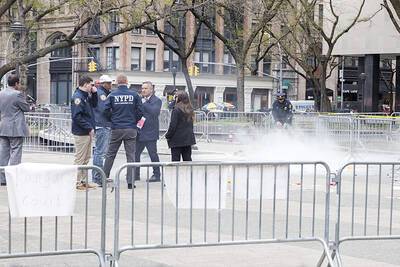
UNSETTLING IMAGES: The scene took place in front of TV crews covering the Trump trial, with a CNN anchor calling it an ‘emotional and unbelievably disturbing moment’ A man who doused himself in an accelerant and set himself on fire outside the courthouse where former US president Donald Trump is on trial has died, police said yesterday. The New York City Police Department (NYPD) said the man was declared dead by staff at an area hospital. The man was in Collect Pond Park at about 1:30pm on Friday when he took out pamphlets espousing conspiracy theories, tossed them around, then doused himself in an accelerant and set himself on fire, officials and witnesses said. A large number of police officers were nearby when it happened. Some officers and bystanders rushed
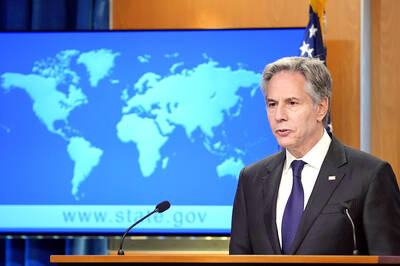
Beijing is continuing to commit genocide and crimes against humanity against Uyghurs and other Muslim minorities in its western Xinjiang province, U.S. Secretary of State Antony Blinken said in a report published on Monday, ahead of his planned visit to China this week. The State Department’s annual human rights report, which documents abuses recorded all over the world during the previous calendar year, repeated language from previous years on the treatment of Muslims in Xinjiang, but the publication raises the issue ahead of delicate talks, including on the war in Ukraine and global trade, between the top U.S. diplomat and Chinese

HYPOCRISY? The Chinese Ministry of Foreign Affairs yesterday asked whether Biden was talking about China or the US when he used the word ‘xenophobic’ US President Joe Biden on Wednesday called for a hike in steel tariffs on China, accusing Beijing of cheating as he spoke at a campaign event in Pennsylvania. Biden accused China of xenophobia, too, in a speech to union members in Pittsburgh. “They’re not competing, they’re cheating. They’re cheating and we’ve seen the damage here in America,” Biden said. Chinese steel companies “don’t need to worry about making a profit because the Chinese government is subsidizing them so heavily,” he said. Biden said he had called for the US Trade Representative to triple the tariff rates for Chinese steel and aluminum if Beijing was


 RSS
RSS