


Before the massive earthquake that laid waste to a swathe of South Asia on Oct. 8 last year, Assia Begum had four children. A few terrifying minutes afterwards, she had nine.
Assia instantly took charge of five children born to her husband's second wife, Shenaz, who lay crushed to death in the ruins of their shared house in the mountains of Pakistani-administered Kashmir.
Six months later, looking far older than her 39 years, she is still trying to eke out a life for them all in the pair of grubby UN High Commission for Refugees-sourced tents they share in the region's capital, Muzaffarabad.
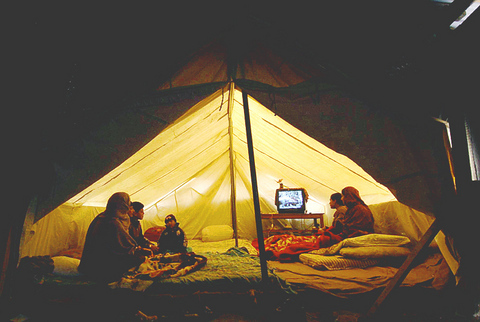
PHOTO: AFP
"From morning till night, it's non-stop," sighed Assia, cradling nine-month Hamidali, the youngest of her adoptive children. "But what else could I do? I am their mother now."
Assia and her family are among more than 200,000 people still living in tent camps after the 7.6-magnitude quake destroyed their homes. The tremor also killed more than 73,000 people in Pakistan and 1,300 in Indian Kashmir.
Day begins at dawn when she and two of her own daughters rouse themselves from the plastic and cardboard-covered floor of the tent and start to prepare breakfast on the dirt pathway outside, she said.
Her husband, Mukhtar Ahmed, 47, a former policeman, takes the only makeshift bed because his collar bone was dislocated in the earthquake and remains grossly distended.
Assia cooks on a kerosene stove, one of the only possessions the family could bring with them on the 60km trek from their devastated home village of Lamnian, where hundreds died.
When they arrived in the capital of Muzaffarabad amid apocalyptic scenes five days after the quake, they gravitated towards a tent camp near the half-built Nurul sports stadium, one of dozens that sprang up across the city.
Since the quake, non-governmental organizations have built 15 latrines to be shared by the 100 families who live at the camp. An enterprising trader has even set up a cigarette stall.
But an open sewer still rings the camp, exuding a foul stench, and little else has changed, except for the haphazard tarpaulins hanging from the tents to protect them from the elements.
The bitter Himalayan winter -- while milder than usual -- made conditions almost unbearable.
"Winter was a terrible time, terrible," mumbled Mukhtar, ruffling the hair of four-year-old Waqar, another son with his late wife.
"Our clothes were wet, the tent was wet, the floor was wet, we had to drain everything just to survive," Assia added.
All members of the family developed respiratory infections, while Assia has a persistent problem with her reddened left eye.
The overcrowded conditions also led to an accident when a pot of scalding tea spilled on baby Hamidali's leg a few weeks ago. Assia pulls up the thin shawl covering him to display a livid scar.
Yet eating and drinking is the only pleasure they have, even if it is a daily diet of rice, bread, vegetable curry and lentils for lunch and supper, with the occasional chicken or mutton dish on special days.
In between cooking meals, Assia tries to keep the squalid tent as clean as possible and washes the family's meagre selection of clothes under a nearby tap.
Now that spring has come to Kashmir, life in Assia's tent is more comfortable, although they fear the advent of malarial mosquitoes that summer will bring.
Nevertheless they are finally planning to return to the snowcapped mountains that loom over Muzaffarabad.
Pakistani authorities fixed March 31 as the deadline for the formal end of rescue operations and the beginning of the rebuilding phase.
Nearly half of China’s major cities are suffering “moderate to severe” levels of subsidence, putting millions of people at risk of flooding, especially as sea levels rise, according to a study of nationwide satellite data released yesterday. The authors of the paper, published by the journal Science, found that 45 percent of China’s urban land was sinking faster than 3mm per year, with 16 percent at more than 10mm per year, driven not only by declining water tables, but also the sheer weight of the built environment. With China’s urban population already in excess of 900 million people, “even a small portion

UNSETTLING IMAGES: The scene took place in front of TV crews covering the Trump trial, with a CNN anchor calling it an ‘emotional and unbelievably disturbing moment’ A man who doused himself in an accelerant and set himself on fire outside the courthouse where former US president Donald Trump is on trial has died, police said yesterday. The New York City Police Department (NYPD) said the man was declared dead by staff at an area hospital. The man was in Collect Pond Park at about 1:30pm on Friday when he took out pamphlets espousing conspiracy theories, tossed them around, then doused himself in an accelerant and set himself on fire, officials and witnesses said. A large number of police officers were nearby when it happened. Some officers and bystanders rushed

Beijing is continuing to commit genocide and crimes against humanity against Uyghurs and other Muslim minorities in its western Xinjiang province, U.S. Secretary of State Antony Blinken said in a report published on Monday, ahead of his planned visit to China this week. The State Department’s annual human rights report, which documents abuses recorded all over the world during the previous calendar year, repeated language from previous years on the treatment of Muslims in Xinjiang, but the publication raises the issue ahead of delicate talks, including on the war in Ukraine and global trade, between the top U.S. diplomat and Chinese

HYPOCRISY? The Chinese Ministry of Foreign Affairs yesterday asked whether Biden was talking about China or the US when he used the word ‘xenophobic’ US President Joe Biden on Wednesday called for a hike in steel tariffs on China, accusing Beijing of cheating as he spoke at a campaign event in Pennsylvania. Biden accused China of xenophobia, too, in a speech to union members in Pittsburgh. “They’re not competing, they’re cheating. They’re cheating and we’ve seen the damage here in America,” Biden said. Chinese steel companies “don’t need to worry about making a profit because the Chinese government is subsidizing them so heavily,” he said. Biden said he had called for the US Trade Representative to triple the tariff rates for Chinese steel and aluminum if Beijing was


 RSS
RSS