


Arsenic may be called the king of poisons, but it is everywhere: in the environment, in the water we drink and sometimes in the food we eat.
The amount is not enough to kill anyone in one fell swoop, but arsenic is a recognized cancer-causing agent and many experts say that no level should be considered safe. Arsenic may also contribute to other life-threatening illnesses, including heart disease and diabetes, and to a decline in mental functioning.
Yet it is deliberately being added to chicken in the US, with many scientists saying it is unnecessary. Until recently there was a very high chance that if you ate chicken some arsenic would be present because it has been a government-approved additive in poultry feed for decades. It is used to kill parasites and to promote growth.
The chicken industry's largest trade group says that arsenic levels in its birds are safe.
"We are not aware of any study that shows implications of any possibility of harm to human health as the result of the use of these products at the levels directed," said Richard Lobb, a spokesman for the National Chicken Council.
Chickens are not the only environmental source of arsenic. In addition to drinking water, for which the Environmental Protection Agency now sets a level of 10 parts per billion (ppb), other poultry, rice, fish and a number of foods also contain the poison. Soils are contaminated with arsenical pesticides from chicken manure; chicken litter containing arsenic is fed to other animals; and until 2003, arsenic was used in pressure-treated wood for decks and playground equipment.
Human exposure to it has been compounded because the consumption of chicken has exploded. In 1960, each American ate 12.7kg of chicken a year. For last year, the figure is estimated at about 39.46kg per person. In spite of this threefold rise, the Food and Drug Administration (FDA) tolerance level for arsenic in chicken of 500ppb, set decades ago, has not been revised.
A 2004 Department of Agriculture study on arsenic concluded that "the higher than previously recognized concentrations of arsenic in chicken combined with increasing levels of chicken consumption may indicate a need to review assumptions regarding overall ingested arsenic intake."
Those at greatest risk from arsenic are small children and people who consume chicken at a higher rate than what is considered average: 0.05kg per day for a 70kg person. The good news for US consumers is that arsenic-free chicken is more readily available than it has been in the past.
Tyson Foods, the US' largest chicken producer, has stopped using arsenic in its chicken feed. Bell & Evans and Eberly chickens are arsenic-free. There is a growing market in organic chicken and birds labeled "antibiotic-free": neither contains arsenic. But there are still plenty of chickens out there with arsenic.
A report by the Institute for Agriculture and Trade Policy, based in Minnesota, Minnesota, examined the levels of arsenic in supermarket chicken and chicken sold in fast-food outlets and found considerable variation. None of the samples in the study, collected in December 2004 and January last year, exceeded the FDA tolerance levels (the report is at iatp.org).
Consumers can reduce their exposure by buying from companies that have stopped using arsenic. They can also remove the skin from chicken treated with arsenic, which reduces levels significantly.

Republican US lawmakers on Friday criticized US President Joe Biden’s administration after sanctioned Chinese telecoms equipment giant Huawei unveiled a laptop this week powered by an Intel artificial intelligence (AI) chip. The US placed Huawei on a trade restriction list in 2019 for contravening Iran sanctions, part of a broader effort to hobble Beijing’s technological advances. Placement on the list means the company’s suppliers have to seek a special, difficult-to-obtain license before shipping to it. One such license, issued by then-US president Donald Trump’s administration, has allowed Intel to ship central processors to Huawei for use in laptops since 2020. China hardliners
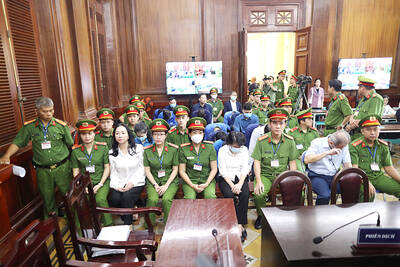
A top Vietnamese property tycoon was on Thursday sentenced to death in one of the biggest corruption cases in history, with an estimated US$27 billion in damages. A panel of three hand-picked jurors and two judges rejected all defense arguments by Truong My Lan, chair of major developer Van Thinh Phat, who was found guilty of swindling cash from Saigon Commercial Bank (SCB) over a decade. “The defendant’s actions ... eroded people’s trust in the leadership of the [Communist] Party and state,” read the verdict at the trial in Ho Chi Minh City. After the five-week trial, 85 others were also sentenced on

DISADVANTAGE: Erin O’Toole, who led the Conservatives during the election campaign in 2021, estimated that the interference cost his party as many as nine legislative seats Canada’s domestic spy agency on Monday concluded that China interfered in the past two elections, an official probe heard, the firmest evidence so far of suspected Chinese meddling in Canadian politics. Canadian Prime Minister Justin Trudeau’s Liberal Party won both the elections, held in 2019 and 2021. Under pressure from opposition lawmakers unhappy about media reports on China’s possible role, Trudeau set up a commission into foreign interference. The commission was shown a slide on Monday containing an extract of a briefing in February last year from the Canadian Security Intelligence Service (CSIS). “We know that the PRC [People’s Republic of China] clandestinely

‘DELUSIONAL’: Targeting the families of Hamas’ leaders would not push the group to change its position or to give up its demands for Palestinians, Ismail Haniyeh said Israeli aircraft on Wednesday killed three sons of Hamas’ top political leader in the Gaza Strip, striking high-stakes targets at a time when Israel is holding delicate ceasefire negotiations with the militant group. Hamas said four of the leader’s grandchildren were also killed. Ismail Haniyeh’s sons are among the highest-profile figures to be killed in the war so far. Israel said they were Hamas operatives, and Haniyeh accused Israel of acting in “the spirit of revenge and murder.” The deaths threatened to strain the internationally mediated ceasefire talks, which appeared to gain steam in recent days even as the sides remain far


 RSS
RSS