


A leading Indian environmentalist's hunger strike against a massive dam entered its eighth day yesterday, as her allies demanded that the government detail its plans to compensate thousands of people to be left homeless.
Medha Patkar, who has been leading a struggle for two decades on behalf of villagers displaced by the Narmada River dam project, has refused to end her hunger strike, saying the government has failed to reassure around 35,000 people that they will be fairly compensated and resettled once their houses are submerged.
Three other less well-known activists are also participating in the hunger strike with her.
The Narmada dam project will eventually include about 30 large, 135 medium and 3,000 small dams that will channel water into irrigation canals and electricity projects.
Changes to project
Patkar's hunger strike, which began March 29, was prompted by a decision to raise the height of one of the main dams from 110m to 121m.
Some 10,000 people are still awaiting resettlement from the building of that dam, and the new height will affect about 25,000 additional people.
Patkar, who is in her 50s, has not eaten any food in the last seven days. She has grown weak and pale in recent days, and seldom sits up anymore at the site of her protest, at a central New Delhi monument.
Saifuddin Soz, the federal minister for water resources, visited Patkar on Tuesday, bringing a request from Prime Minister Manmohan Singh that she call off the hunger strike because a team of three federal ministers was scheduled to visit the dam site soon in India's Madhya Pradesh state to review resettlement efforts.
Patkar refused, however, saying that the government had yet to bring sufficient assurances to the villagers.
Debate over benefits
Authorities said the dam project will bring drinking water to 40 million people, irrigate land and generate electricity which would benefit people in three drought-prone states -- Maharashtra, Madhya Pradesh and Gujarat.
But critics say the project will displace 200,000 people and irreversibly damage the region's fragile environment.
The dam project has sparked a raging debate among policy planners and social and environmental activists about the benefits of large dams and whether powerless farmers should be displaced for the sake of development.
"If people are displaced due to a development project, then it is a violation of their human rights and a violation by the government of its commitment to observing human rights," said Miloon Kothari, a housing rights activist.
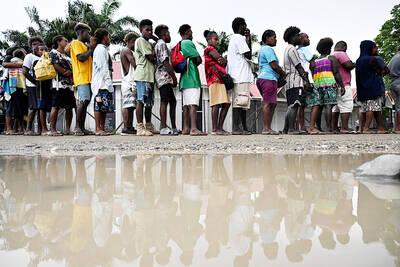
SEEKING CHANGE: A hospital worker said she did not vote in previous elections, but ‘now I can see that maybe my vote can change the system and the country’ Voting closed yesterday across the Solomon Islands in the south Pacific nation’s first general election since the government switched diplomatic allegiance from Taiwan to Beijing and struck a secret security pact that has raised fears of the Chinese navy gaining a foothold in the region. The Solomon Islands’ closer relationship with China and a troubled domestic economy weighed on voters’ minds as they cast their ballots. As many as 420,000 registered voters had their say across 50 national seats. For the first time, the national vote also coincided with elections for eight of the 10 local governments. Esther Maeluma cast her vote in the
Nearly half of China’s major cities are suffering “moderate to severe” levels of subsidence, putting millions of people at risk of flooding, especially as sea levels rise, according to a study of nationwide satellite data released yesterday. The authors of the paper, published by the journal Science, found that 45 percent of China’s urban land was sinking faster than 3mm per year, with 16 percent at more than 10mm per year, driven not only by declining water tables, but also the sheer weight of the built environment. With China’s urban population already in excess of 900 million people, “even a small portion

UNSETTLING IMAGES: The scene took place in front of TV crews covering the Trump trial, with a CNN anchor calling it an ‘emotional and unbelievably disturbing moment’ A man who doused himself in an accelerant and set himself on fire outside the courthouse where former US president Donald Trump is on trial has died, police said yesterday. The New York City Police Department (NYPD) said the man was declared dead by staff at an area hospital. The man was in Collect Pond Park at about 1:30pm on Friday when he took out pamphlets espousing conspiracy theories, tossed them around, then doused himself in an accelerant and set himself on fire, officials and witnesses said. A large number of police officers were nearby when it happened. Some officers and bystanders rushed

HYPOCRISY? The Chinese Ministry of Foreign Affairs yesterday asked whether Biden was talking about China or the US when he used the word ‘xenophobic’ US President Joe Biden on Wednesday called for a hike in steel tariffs on China, accusing Beijing of cheating as he spoke at a campaign event in Pennsylvania. Biden accused China of xenophobia, too, in a speech to union members in Pittsburgh. “They’re not competing, they’re cheating. They’re cheating and we’ve seen the damage here in America,” Biden said. Chinese steel companies “don’t need to worry about making a profit because the Chinese government is subsidizing them so heavily,” he said. Biden said he had called for the US Trade Representative to triple the tariff rates for Chinese steel and aluminum if Beijing was


 RSS
RSS