


Japan's top diplomat said yesterday that China's offer to hold summit talks only if Prime Minister Junichiro Koizumi halts visits to a controversial war shrine makes no sense and shows Beijing doesn't want to meet to discuss problems.
Chinese President Hu Jintao (
However, Foreign Minister Taro Aso rejected the condition, telling reporters that China's "method is beyond our comprehension."
"It sounds as though the Japanese government is entirely responsible for all of the difficult discussions between Japan and China," Aso said. "Don't you have to meet with someone if you want to resolve a problem?"
Two other Cabinet members also criticized the Chinese position.
"Both sides need to work hard sitting at the same table," said Economy, Trade and Industry Minister Toshihiro Nikai.
"Visiting Yasukuni should not be mixed up with such other problems as those involving the East China Sea gas fields, reducing energy use, the environment and so forth," Nikai said.
Finance Minister Sadakazu Tanigaki reiterated the stance.
The Chinese government has repeatedly criticized Koizumi's visits, calling them offensive for victims of Japanese aggression in the first half of the 20th century. Koizumi -- who has visited the shrine in downtown Tokyo five times since taking office in 2001 -- has said he goes to Yasukuni to pray for peace.
Beijing has refused to meet with Koizumi since his latest visit, and the two sides have not held a formal summit since 2001, fanning tensions that erupted in anti-Japanese riots last April in several Chinese cities.
Despite the tensions, China remains Asia's top market for Japanese investment. Statistics released by a Japanese trade group on Monday showed Japan's direct investment in China rose 19.8 percent to a record US$6.53 billion last year.
Nonetheless, the recent deterioration in the bilateral relationship threatens to destabilize a region already tense over North Korea's nuclear weapons program.
The two countries have also been feuding over gas and oil deposits in the East China Sea and Japanese textbooks that China claims whitewash Japan's past militarism.

Republican US lawmakers on Friday criticized US President Joe Biden’s administration after sanctioned Chinese telecoms equipment giant Huawei unveiled a laptop this week powered by an Intel artificial intelligence (AI) chip. The US placed Huawei on a trade restriction list in 2019 for contravening Iran sanctions, part of a broader effort to hobble Beijing’s technological advances. Placement on the list means the company’s suppliers have to seek a special, difficult-to-obtain license before shipping to it. One such license, issued by then-US president Donald Trump’s administration, has allowed Intel to ship central processors to Huawei for use in laptops since 2020. China hardliners
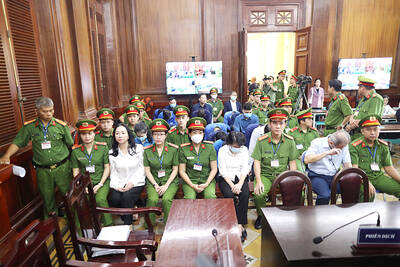
A top Vietnamese property tycoon was on Thursday sentenced to death in one of the biggest corruption cases in history, with an estimated US$27 billion in damages. A panel of three hand-picked jurors and two judges rejected all defense arguments by Truong My Lan, chair of major developer Van Thinh Phat, who was found guilty of swindling cash from Saigon Commercial Bank (SCB) over a decade. “The defendant’s actions ... eroded people’s trust in the leadership of the [Communist] Party and state,” read the verdict at the trial in Ho Chi Minh City. After the five-week trial, 85 others were also sentenced on

Conjoined twins Lori and George Schappell, who pursued separate careers, interests and relationships during lives that defied medical expectations, died this month in Pennsylvania, funeral home officials said. They were 62. The twins, listed by Guinness World Records as the oldest living conjoined twins, died on April 7 at the Hospital of the University of Pennsylvania, obituaries posted by Leibensperger Funeral Homes of Hamburg said. The cause of death was not detailed. “When we were born, the doctors didn’t think we’d make 30, but we proved them wrong,” Lori said in an interview when they turned 50, the Philadelphia Inquirer reported. The

RAMPAGE: A Palestinian man was left dead after dozens of Israeli settlers searching for a missing 14-year-old boy stormed a village in the Israeli-occupied West Bank US President Joe Biden on Friday said he expected Iran to attack Israel “sooner, rather than later” and warned Tehran not to proceed. Asked by reporters about his message to Iran, Biden simply said: “Don’t,” underscoring Washington’s commitment to defend Israel. “We are devoted to the defense of Israel. We will support Israel. We will help defend Israel and Iran will not succeed,” he said. Biden said he would not divulge secure information, but said his expectation was that an attack could come “sooner, rather than later.” Israel braced on Friday for an attack by Iran or its proxies as warnings grew of


 RSS
RSS