


A convoy of cars, their roof racks piled high with boxes and bags, inches along the hairpin bends of the mountain road, passing men on foot bent double under the weight of sacks of belongings. As they near their destination, passengers point at piles of rubble where their homes stood before the Pakistani earthquake ripped them apart six months ago and contemplate the huge task of rebuilding their lives that lies ahead.
They are among tens of thousands who fled to the safety of refugee settlements and are returning to their villages, many reluctantly, after a government decision to close the camps this weekend.
The closure could not have come at a worse time for Jamela, who has six children. She was nine months pregnant when she was told of a truck going back to her village of Kerry Saddat, 1,829m up in the remote Siran Valley, and that she and her family would have to leave.

PHOTO: EPA
She liked the camp -- it provided them with shelter, food, a school and hospital. She knew she was going back to nothing.
Three days after returning, Jamela, 35, gave birth to her daughter Tabasum in a tent in front of a pile of bricks and broken timber once their home. Cuddling her baby, she pointed to the timber frame of their new house being built by her husband, Inayat Ali Shah.
Work had stopped because he had run out of materials.
"We were far more comfortable in the camp," she said. "Everything was there. My husband and son had typhoid when we arrived and they were treated. Everything was destroyed here and it was coming up to winter so the army sent us away."
"The tremors that have come since the earthquake are much more frightening up here. I made a lot of friends from other areas and I miss them. We said we would visit each other, but it's hard. I can't write, so it's difficult to stay in touch. It is very empty here. We lost many relatives and neighbors. All of the 35 houses collapsed," she said.
At the mention of the earthquake, her 12-year-old daughter Wahida's face crumples, her body racked with sobs.
There has been much resistance among inhabitants to the closure of the 148 camps six months after the Oct. 8 quake, which killed 75,000 people and made millions more homeless. The sites were managed by the army and some of the soldiers cried as they broke the news of the closure. The government argues it is necessary to prevent people becoming so dependent on handouts that the camps will never shut.
Many of the aid agencies in the relief effort agree.
The region's mayor, Sardar Muhammad Yousaf, said: "People must go back to begin rehabilitation. This is the right time of year to start rebuilding and replanting crops. The monsoon rain comes in July and then the winter sets in. It is a short window of time."
"We don't want people to get used to living in camps. The district [government] cannot bear the burden in the long run," he said.
It is an argument that even Jamela concedes.
"I'd rather have stayed, but I know we couldn't live there forever. If we hadn't left now we'd have had to stay for another year. It is difficult, because we have to start again from nothing -- even our one goat ran off during the earthquake," she said.
One camp will remain open to take care of the vulnerable: the wounded, widowed and those who have nowhere to go because they lost land in landslides.
A study by an international group of seismologists of Balakot, a town near the center which was levelled by the violent jolting, threw up some worrying results. It showed the ground beneath the town was more porous than previously thought and predicted another tremor could cause the land to be swallowed.
The mayor said no one would be allowed to live within a 10km radius of the town, and a second camp would be kept open while refugees from Balakot are found alternative places to live.
Compensation is being given to all those affected by the earthquake: each family initially received 25,000 rupees (US$562)and now 150,000 rupees is being given to everyone who lost a house. Food is being distributed to villagers until the crops are harvested, and charities are working with the government to provide schooling, healthcare and counselling.
"It is unique to close camps so quickly after a major disaster. Some people remain in them for 20 or more years in some countries. A conscious effort is being made to avoid that, and it is the best solution for people to go back and rebuild their lives, if they can,"said Mia Haglund Heelas, the Pakistan director of the children's charity Plan International.
"We are very scared. We don't want to go back to where we were, because there is nothing there for us and the ground is cracked," Sabiha Sadiq, 35, said.
As she spoke, singing could be heard from the tent school and Sabiha said proudly that her 12-year-old daughter Nazia was top of the class. Many of the children and parents say it is the school they will miss most. For some, especially girls, it is their first time at school.
Abid, 12, and Asama, 10, had never been to school.
Their mother Zojan said: "There is no tradition of going to school in our family."
"There is no school in our village. I never went, nor did my husband," she said.
"When my neighbors on this row of tents talked about school I was not sure. My children were afraid but they spoke to other children who liked it. Now they insist on going when they're ill. I want Abid to be a doctor and Asama a teacher," she said.
Plan International is setting up temporary tent classrooms in the hillside villages in the Siran Valley while working on plans to rebuild 40 primary schools.
More than 2,400 of the 2,570 schools collapsed across the region during the earthquake, crushing thousands of children at their desks.
The charity also wants to set up new secondary schools for girls.

Republican US lawmakers on Friday criticized US President Joe Biden’s administration after sanctioned Chinese telecoms equipment giant Huawei unveiled a laptop this week powered by an Intel artificial intelligence (AI) chip. The US placed Huawei on a trade restriction list in 2019 for contravening Iran sanctions, part of a broader effort to hobble Beijing’s technological advances. Placement on the list means the company’s suppliers have to seek a special, difficult-to-obtain license before shipping to it. One such license, issued by then-US president Donald Trump’s administration, has allowed Intel to ship central processors to Huawei for use in laptops since 2020. China hardliners

A top Vietnamese property tycoon was on Thursday sentenced to death in one of the biggest corruption cases in history, with an estimated US$27 billion in damages. A panel of three hand-picked jurors and two judges rejected all defense arguments by Truong My Lan, chair of major developer Van Thinh Phat, who was found guilty of swindling cash from Saigon Commercial Bank (SCB) over a decade. “The defendant’s actions ... eroded people’s trust in the leadership of the [Communist] Party and state,” read the verdict at the trial in Ho Chi Minh City. After the five-week trial, 85 others were also sentenced on

Conjoined twins Lori and George Schappell, who pursued separate careers, interests and relationships during lives that defied medical expectations, died this month in Pennsylvania, funeral home officials said. They were 62. The twins, listed by Guinness World Records as the oldest living conjoined twins, died on April 7 at the Hospital of the University of Pennsylvania, obituaries posted by Leibensperger Funeral Homes of Hamburg said. The cause of death was not detailed. “When we were born, the doctors didn’t think we’d make 30, but we proved them wrong,” Lori said in an interview when they turned 50, the Philadelphia Inquirer reported. The
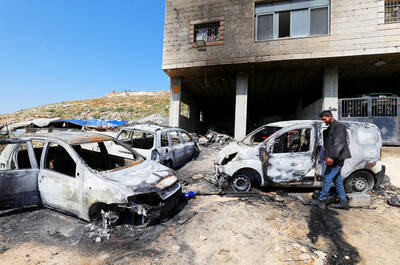
RAMPAGE: A Palestinian man was left dead after dozens of Israeli settlers searching for a missing 14-year-old boy stormed a village in the Israeli-occupied West Bank US President Joe Biden on Friday said he expected Iran to attack Israel “sooner, rather than later” and warned Tehran not to proceed. Asked by reporters about his message to Iran, Biden simply said: “Don’t,” underscoring Washington’s commitment to defend Israel. “We are devoted to the defense of Israel. We will support Israel. We will help defend Israel and Iran will not succeed,” he said. Biden said he would not divulge secure information, but said his expectation was that an attack could come “sooner, rather than later.” Israel braced on Friday for an attack by Iran or its proxies as warnings grew of


 RSS
RSS