


Five years after they first pledged to work together to find ways to open legal channels for Mexicans to seek work in the US, US President George W. Bush and Mexican President Vicente Fox ended a two-day meeting on Friday essentially where they were in 2001: agreeing on an approach, but unable to win the support they needed to turn their vision into law.
At a news conference with Canadian Prime Minister Stephen Harper, Bush and Fox spoke with conviction about the reasons they supported comprehensive immigration changes that would include expanding guest worker programs and opening new paths to citizenship.
But their comments also made clear that the bold immigration agenda that they supported at the start of their administrations never got far off the ground, in part because of their own missteps and miscalculations, but mostly because of forces out of their control.

PHOTO: AP
"I believe a guest worker program will help us rid the society and the border of these coyotes, who smuggle people in the back of 18-wheelers," Bush said.
"I believe it'll help get rid of the document forgers. I believe it'll help people on both sides of our border to respect the laws of our border, and enforce our borders," he said.
The US president added, "I believe it is important to bring people out of the shadows of American society, so they don't have to fear the life they live."
Still, the president dodged a question about the plans by Republican leaders in Congress to press for an immigration plan that does not include guest worker programs and focuses instead on border security.
When pressed on whether he would veto such a plan, Bush said, "I said I want a comprehensive bill. You're presuming there won't be a comprehensive bill. I believe there will be."
Harper announced that the three nations had formed a committee of business leaders to discuss ways to keep North America competitive with Asia. And he announced a summit meeting on development, scheduled for next year in Canada.
The longstanding dispute over US tariffs on imports of Canadian softwood lumber remained unresolved, with Bush promising to negotiate and Harper threatening legal action.
Bush stood firm against Canada's opposition to a new law that will require all people coming into the US after next year -- whether from Canada or Mexico -- to present a passport or some other tamper-proof document.
For Bush the past two days have been as much about trying to defuse a debate over immigration in the US that pits him against leaders of his own party, as about reviving a relationship that turned sour after the terrorist attacks of Sept. 11.
For Fox, the meeting was an opportunity for a little vindication before he leaves office on Dec. 1. He made sweeping immigration reforms in the US the center of his foreign policy. In pursuit of those goals, he has stood with the US to defend free trade and tight border security against leftist leaders across Latin America.
Referring to Fox and Bush, Demetrios Papademetriou, the co-director of the Migration Policy Institute, said, "Both countries misjudged the political situation in the United States, and so they miscalculated what they could really deliver to each other."
Harley Shaiken, director of the Center for Latin American Studies at the University of California at Berkeley, said of the two presidents, "They began dating five years ago. They are dating five years later. There isn't much more activity than that."
Shaiken added: "In Mr. Fox's case, the causes could be traced to his poor political skills. For Bush, it was the lack of political capital he put behind Mexico. But in the end, it's Fox who will leave office a spinster."
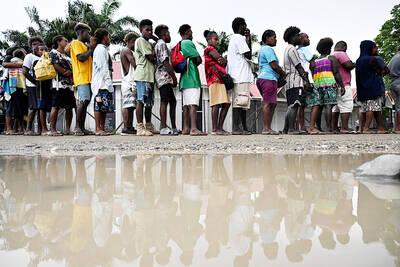
SEEKING CHANGE: A hospital worker said she did not vote in previous elections, but ‘now I can see that maybe my vote can change the system and the country’ Voting closed yesterday across the Solomon Islands in the south Pacific nation’s first general election since the government switched diplomatic allegiance from Taiwan to Beijing and struck a secret security pact that has raised fears of the Chinese navy gaining a foothold in the region. The Solomon Islands’ closer relationship with China and a troubled domestic economy weighed on voters’ minds as they cast their ballots. As many as 420,000 registered voters had their say across 50 national seats. For the first time, the national vote also coincided with elections for eight of the 10 local governments. Esther Maeluma cast her vote in the
Nearly half of China’s major cities are suffering “moderate to severe” levels of subsidence, putting millions of people at risk of flooding, especially as sea levels rise, according to a study of nationwide satellite data released yesterday. The authors of the paper, published by the journal Science, found that 45 percent of China’s urban land was sinking faster than 3mm per year, with 16 percent at more than 10mm per year, driven not only by declining water tables, but also the sheer weight of the built environment. With China’s urban population already in excess of 900 million people, “even a small portion

UNSETTLING IMAGES: The scene took place in front of TV crews covering the Trump trial, with a CNN anchor calling it an ‘emotional and unbelievably disturbing moment’ A man who doused himself in an accelerant and set himself on fire outside the courthouse where former US president Donald Trump is on trial has died, police said yesterday. The New York City Police Department (NYPD) said the man was declared dead by staff at an area hospital. The man was in Collect Pond Park at about 1:30pm on Friday when he took out pamphlets espousing conspiracy theories, tossed them around, then doused himself in an accelerant and set himself on fire, officials and witnesses said. A large number of police officers were nearby when it happened. Some officers and bystanders rushed

HYPOCRISY? The Chinese Ministry of Foreign Affairs yesterday asked whether Biden was talking about China or the US when he used the word ‘xenophobic’ US President Joe Biden on Wednesday called for a hike in steel tariffs on China, accusing Beijing of cheating as he spoke at a campaign event in Pennsylvania. Biden accused China of xenophobia, too, in a speech to union members in Pittsburgh. “They’re not competing, they’re cheating. They’re cheating and we’ve seen the damage here in America,” Biden said. Chinese steel companies “don’t need to worry about making a profit because the Chinese government is subsidizing them so heavily,” he said. Biden said he had called for the US Trade Representative to triple the tariff rates for Chinese steel and aluminum if Beijing was


 RSS
RSS