


Post-apartheid South Africa has experienced exponential growth in its black middle class with a new study showing the birth of a powerful consumer market.
According to the most comprehensive study to date on the emerging black middle class in South Africa, the group is responsible for nearly a quarter of the annual cash buying power of 600 billion rand (US$96 million).
"There were huge surprises for the average marketer in this study," said John Simpson, director of the Unilever Institute at the University of Cape Town which conducted the research.
"The one is the sheer size of the group and then it also accounts for 23 percent of total consumer power in this country, which has been achieved in a very, very short period and continues to grow very rapidly indeed," he added.
The so-called "Black Diamond" marketing survey found the new black middle class to be about 2-million-strong, or about 10 percent of the black adult population.
"It's taken off in a space of 10 or 15 years," said Simpson, referring to the end of apartheid in 1994 when Nelson Mandela became the first democratically-elected president.
"We've had political intervention which has suddenly unleashed opportunities for a group of people who normally would have been part of a vibrant middle class," he told reporters.
The report said that under apartheid, "black society was a single, monolithic, classless society with limited, menial jobs, no home ownership and under-educated."
But the end of apartheid caused a "dramatic disruption" with "enormous and immediate effects -- access to jobs, finance, credit, homes, education," he said.
The research was compiled from 750 face-to-face countrywide interviews lasting about 50 minutes in November and December last year.
Research project leader Refiloe Mataboge said the black middle class was a very complex group to understand because they lived in two worlds -- modern and traditional.
"What makes South Africa's scenario more intricate is the cultural paradox," she said.

Republican US lawmakers on Friday criticized US President Joe Biden’s administration after sanctioned Chinese telecoms equipment giant Huawei unveiled a laptop this week powered by an Intel artificial intelligence (AI) chip. The US placed Huawei on a trade restriction list in 2019 for contravening Iran sanctions, part of a broader effort to hobble Beijing’s technological advances. Placement on the list means the company’s suppliers have to seek a special, difficult-to-obtain license before shipping to it. One such license, issued by then-US president Donald Trump’s administration, has allowed Intel to ship central processors to Huawei for use in laptops since 2020. China hardliners

Conjoined twins Lori and George Schappell, who pursued separate careers, interests and relationships during lives that defied medical expectations, died this month in Pennsylvania, funeral home officials said. They were 62. The twins, listed by Guinness World Records as the oldest living conjoined twins, died on April 7 at the Hospital of the University of Pennsylvania, obituaries posted by Leibensperger Funeral Homes of Hamburg said. The cause of death was not detailed. “When we were born, the doctors didn’t think we’d make 30, but we proved them wrong,” Lori said in an interview when they turned 50, the Philadelphia Inquirer reported. The
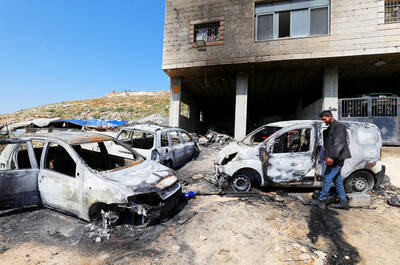
RAMPAGE: A Palestinian man was left dead after dozens of Israeli settlers searching for a missing 14-year-old boy stormed a village in the Israeli-occupied West Bank US President Joe Biden on Friday said he expected Iran to attack Israel “sooner, rather than later” and warned Tehran not to proceed. Asked by reporters about his message to Iran, Biden simply said: “Don’t,” underscoring Washington’s commitment to defend Israel. “We are devoted to the defense of Israel. We will support Israel. We will help defend Israel and Iran will not succeed,” he said. Biden said he would not divulge secure information, but said his expectation was that an attack could come “sooner, rather than later.” Israel braced on Friday for an attack by Iran or its proxies as warnings grew of

IN PURSUIT: Israel’s defense minister said the revenge attacks by Israeli settlers would make it difficult for security forces to find those responsible for the 14-year-old’s death Israeli Prime Minister Benjamin Netanyahu on Saturday condemned the “heinous murder” of an Israeli teenager in the occupied West Bank as attacks on Palestinian villages intensified following news of his death. After Benjamin Achimeir, 14, was reported missing near Ramallah on Friday, hundreds of Jewish settlers backed by Israeli forces raided nearby Palestinian villages, torching vehicles and homes, leaving at least one villager dead and dozens wounded. The attacks escalated in several villages on Saturday after Achimeir’s body was found near the Malachi Hashalom outpost. Agence France-Presse correspondents saw smoke rising from burned houses and fields. Mayor Amin Abu Alyah, of the


 RSS
RSS