


French students snubbed an invitation to talks yesterday with French Prime Minister Dominique de Villepin, bringing the prospect of further social unrest and a nationwide strike next week a step closer.
On Friday, union leaders failed in talks to force Villepin to withdraw a divisive new jobs law and said they would go ahead with plans for a nationwide strike next week.
"We are facing a total refusal," said Francois Chereque, secretary general of the CFDT union, after a meeting with Villepin.
In a further blow to the prospects of a resolution, the leading high school and university student unions decided not to accept an invitation from the prime minister for talks yesterday, said Karl Stoeckel of UNL, the National High School Union. Instead, they planned a news conference in front of the prime minister's office.
Two smaller, less representative student unions have agreed to meet with Villepin.
The lack of any breakthrough left France facing the prospect of widespread transport disruptions during Tuesday's strike and the possibility of a protracted face-off over the law, which makes it easier for companies to hire -- and fire -- young workers. Civil aviation authorities said on Friday that they expect disturbances and canceled flights.
Villepin described Friday's meeting as "a first step" and said he hoped for more talks next week. But it remained unclear how he would extricate himself from the crisis and calm the nationwide swell of student protests that has led to blockades at dozens of universities and violent clashes with police.
Employers' organizations, who also met with the prime minister, voiced support for the jobs contract but serious concern for France and its image.
"We believe [the violence] endangers our country's economy, endangers the image and reputation of our country and also endangers the solidity of the social fabric," the head of the powerful employers' group MEDEF, Laurence Parisot, said after the talks.
The impasse over the jobs measure has exposed France's deep divisions about the direction of reform, between those who argue that such new approaches are needed to free up the economy and others who insist that change must not come at the expense of the country's cherished social protection.
Youths have been at the forefront of opposition to the law, backed by France's powerful labor unions and parties on the left who sense an opportunity to wound French President Jacques Chirac's governing conservatives ahead of next year's presidential and legislative elections.
Villepin's meeting on Friday with five leading unions -- their first since he introduced the "first job contract" in January -- got off to a combative start, with labor leaders riled by Chirac's declaration earlier in the day that the jobs law must be applied.
The only apparent concession from Villepin was the invitation for student leaders to meet with him Saturday.
Although he said that "everyone is aware of the importance of the current crisis,'' the gap between him and labor leaders still appeared unbridgeable.
"We were here today to tell him: `If you want the situation to calm down, if you want real negotiations to open, you must understand that you must withdraw''' the job contract, said Jean-Claude Mailly of the Workers Force union.
"He talked to us about the possibilities of making changes, improvements, and we told him that that was not what we are asking for," he said.
But the government and unions also run the risk that violence at demonstrations against the law could spin out of control, increasing pressure on both sides to seek a solution or at least not appear intransigent.
On Thursday, rioters mixed in with student demonstrators and turned the park in front of Napoleon's tomb into a battlefield. Youths with baseball bats attacked students and others hurled concrete chunks at riot police, who responded with baton charges and tear gas.

Republican US lawmakers on Friday criticized US President Joe Biden’s administration after sanctioned Chinese telecoms equipment giant Huawei unveiled a laptop this week powered by an Intel artificial intelligence (AI) chip. The US placed Huawei on a trade restriction list in 2019 for contravening Iran sanctions, part of a broader effort to hobble Beijing’s technological advances. Placement on the list means the company’s suppliers have to seek a special, difficult-to-obtain license before shipping to it. One such license, issued by then-US president Donald Trump’s administration, has allowed Intel to ship central processors to Huawei for use in laptops since 2020. China hardliners
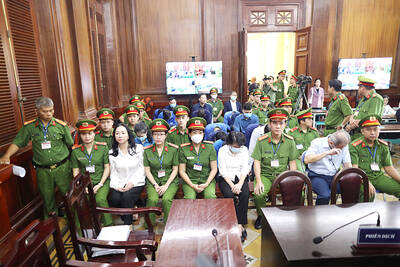
A top Vietnamese property tycoon was on Thursday sentenced to death in one of the biggest corruption cases in history, with an estimated US$27 billion in damages. A panel of three hand-picked jurors and two judges rejected all defense arguments by Truong My Lan, chair of major developer Van Thinh Phat, who was found guilty of swindling cash from Saigon Commercial Bank (SCB) over a decade. “The defendant’s actions ... eroded people’s trust in the leadership of the [Communist] Party and state,” read the verdict at the trial in Ho Chi Minh City. After the five-week trial, 85 others were also sentenced on

Conjoined twins Lori and George Schappell, who pursued separate careers, interests and relationships during lives that defied medical expectations, died this month in Pennsylvania, funeral home officials said. They were 62. The twins, listed by Guinness World Records as the oldest living conjoined twins, died on April 7 at the Hospital of the University of Pennsylvania, obituaries posted by Leibensperger Funeral Homes of Hamburg said. The cause of death was not detailed. “When we were born, the doctors didn’t think we’d make 30, but we proved them wrong,” Lori said in an interview when they turned 50, the Philadelphia Inquirer reported. The

RAMPAGE: A Palestinian man was left dead after dozens of Israeli settlers searching for a missing 14-year-old boy stormed a village in the Israeli-occupied West Bank US President Joe Biden on Friday said he expected Iran to attack Israel “sooner, rather than later” and warned Tehran not to proceed. Asked by reporters about his message to Iran, Biden simply said: “Don’t,” underscoring Washington’s commitment to defend Israel. “We are devoted to the defense of Israel. We will support Israel. We will help defend Israel and Iran will not succeed,” he said. Biden said he would not divulge secure information, but said his expectation was that an attack could come “sooner, rather than later.” Israel braced on Friday for an attack by Iran or its proxies as warnings grew of


 RSS
RSS