


Israeli soldiers shot dead a Palestinian militant and arrested two others in a raid yesterday near the West Bank town of Jericho, the Israeli army said.
Witnesses said the soldiers surrounded a house in the Aqabat Jaber refugee camp and opened fire, killing a 22-year-old from the Islamic Jihad militant group after he refused to surrender.
"The suspect was identified hiding under a bed during a search in one of the rooms. He shot at us and was killed after fire was returned," an army officer, Major Sharon Asman, said, adding two other Islamic Jihad militants were arrested.
The raid occurred a day after Israel arrested 10 Palestinians in a van outside Jerusalem with explosives the Jewish state suspected were for use in a suicide bomb attack.
Israel has been on high alert for possible suicide bombings in the run-up to its March 28 national elections.
Meanwhile, Israel linked West Bank Palestinians with the al-Qaeda network for the first time when a military court charged two youths with receiving funds from the jihad group to carry out a coordinated double bombing in the city of Jerusalem.
The Palestinians, from the Balata refugee camp near Nablus, met with al-Qaeda operatives in Jordan, arranged for secret e-mail communication, opened a bank account and received 3,000 Jordanian dinars (US$4,240) from al-Qaeda to carry out the Jerusalem attack, according to the indictment, released on Tuesday.
The indictment comes just weeks after Palestinian President Mahmoud Abbas said al-Qaeda was trying to recruit West Bank and Gaza Palestinians. Abbas said his security forces "are trying with all means to prevent their [al-Qaeda's] arrival here, or their carrying out any ... acts in this region."
Israeli security officials, including Defense Minister Shaul Mofaz, have confirmed that al-Qaeda has been trying to infiltrate the Palestinian territories, and Israel is considered a prime target for such attacks.
The indictment gives a detailed look at how the Palestinians met the al-Qaeda operatives and how the international terror network went about recruiting and financing them.
Azzam Abu Aladas, 19, and Balal Hafnai, 19, were arrested by Israeli security forces in December while crossing the Allenby Bridge from Jordan into the West Bank, according to the indictment.
The military said the two missed their original Oct. 30 date for the Jerusalem attack, and their arrest in December prevented them from carrying it out later.
The two visited Jordan at least three times, together and separately, to meet their al-Qaeda handlers, named Abdullah and Abu Talha, the indictment said.
Abu Aladas made the first contact with Abdullah in May last year, according to the indictment.
A month later, Abdullah and Abu Talha gave Abu Aladas a security briefing that included telling him how to behave, how to identify if he is being followed, how to follow others, how to secretly form cells and draft people without them knowing one another and what to do if a member of the cell is caught.
In June, during a visit to the Jordanian city of Irbid, Abu Aladas introduced Hafnai to Abdullah.
When they returned to Nablus, Abu Aladas and Hafnai met at their homes in Balata and at a cemetery in the refugee camp. At these meetings, Abu Aladas and Hafnai drafted other people into the group and planned their double bombing.

Republican US lawmakers on Friday criticized US President Joe Biden’s administration after sanctioned Chinese telecoms equipment giant Huawei unveiled a laptop this week powered by an Intel artificial intelligence (AI) chip. The US placed Huawei on a trade restriction list in 2019 for contravening Iran sanctions, part of a broader effort to hobble Beijing’s technological advances. Placement on the list means the company’s suppliers have to seek a special, difficult-to-obtain license before shipping to it. One such license, issued by then-US president Donald Trump’s administration, has allowed Intel to ship central processors to Huawei for use in laptops since 2020. China hardliners

Conjoined twins Lori and George Schappell, who pursued separate careers, interests and relationships during lives that defied medical expectations, died this month in Pennsylvania, funeral home officials said. They were 62. The twins, listed by Guinness World Records as the oldest living conjoined twins, died on April 7 at the Hospital of the University of Pennsylvania, obituaries posted by Leibensperger Funeral Homes of Hamburg said. The cause of death was not detailed. “When we were born, the doctors didn’t think we’d make 30, but we proved them wrong,” Lori said in an interview when they turned 50, the Philadelphia Inquirer reported. The
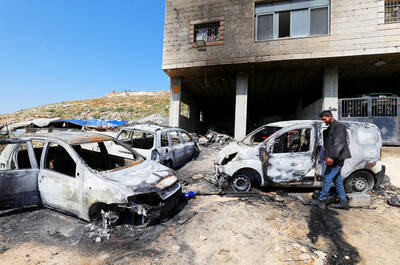
RAMPAGE: A Palestinian man was left dead after dozens of Israeli settlers searching for a missing 14-year-old boy stormed a village in the Israeli-occupied West Bank US President Joe Biden on Friday said he expected Iran to attack Israel “sooner, rather than later” and warned Tehran not to proceed. Asked by reporters about his message to Iran, Biden simply said: “Don’t,” underscoring Washington’s commitment to defend Israel. “We are devoted to the defense of Israel. We will support Israel. We will help defend Israel and Iran will not succeed,” he said. Biden said he would not divulge secure information, but said his expectation was that an attack could come “sooner, rather than later.” Israel braced on Friday for an attack by Iran or its proxies as warnings grew of
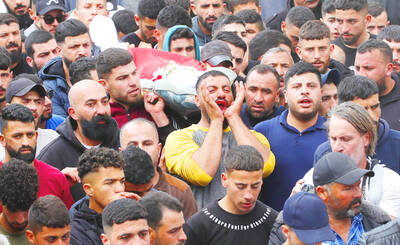
IN PURSUIT: Israel’s defense minister said the revenge attacks by Israeli settlers would make it difficult for security forces to find those responsible for the 14-year-old’s death Israeli Prime Minister Benjamin Netanyahu on Saturday condemned the “heinous murder” of an Israeli teenager in the occupied West Bank as attacks on Palestinian villages intensified following news of his death. After Benjamin Achimeir, 14, was reported missing near Ramallah on Friday, hundreds of Jewish settlers backed by Israeli forces raided nearby Palestinian villages, torching vehicles and homes, leaving at least one villager dead and dozens wounded. The attacks escalated in several villages on Saturday after Achimeir’s body was found near the Malachi Hashalom outpost. Agence France-Presse correspondents saw smoke rising from burned houses and fields. Mayor Amin Abu Alyah, of the


 RSS
RSS