


Wadeng Puteh, a 90-year-old Muslim farmer, vividly remembers how he was trudging home from the fields half-naked with his water buffalo when he met the king of Thailand one evening long ago. A lifetime friendship followed, along with big benefits for his once poverty-stricken village.
"I worry about the king's health. I miss him every day," Wadeng said, his wizened face sparkling as he relates how he once traveled to Bangkok to visit King Bhumibol Adulyadej when the monarch was hospitalized.
In a region where Muslim insurgents wage a bloody struggle for autonomy and sharp criticism of the central government is common even by non-radicals, warm statements still are frequently heard about the king, who has traveled often to the south -- meeting Wadeng on one such visit.
By fostering development in the south over the decades, the king and his family have earned the respect and trust of a sizable portion of Muslims in the country's three southernmost provinces where more than 1,300 people have been slain over the past two years.
Significantly, among the almost daily shootings, bombings and arson, which routinely target government institutions, the region's numerous royal projects have been left largely untouched by the rebels.
In face of the violence, Bhumibol has advised that Prime Minister Thaksin Shinawatra take a "gentle approach" to the region, but Thaksin has been widely criticized for heavy-handed, sometimes brutal tactics that have only escalated the bloodletting.
Security forces stormed a mosque, killing 107 lightly armed militants in 2004, and later that year 85 suspected rebels died, most of them of suffocation, after being stuffed into army trucks. Both incidents were condemned by Muslims worldwide.
"The crown has made the south one of its top priorities," said Zachary Abuza, an expert on the region's Islamic insurgencies. "The royal family did a lot in stemming past rebellions and they see themselves as having a role now."
Prem Tinsulanonda, president of the king's advisory body, and other members of the Privy Council are making frequent trips to the south, advocating good governance and development in contrast to Thaksin's stress on security and suppression. A National Reconciliation Commission, set up as an independent body last year, is widely seen as a royally inspired initiative.
But so far these efforts haven't led to significant shifts in government policies, which analysts say are unlikely to change until Thaksin exits the political scene. Almost daily demonstrations in the Thai capital are calling for his ouster, accusing him of corruption and abuse of power.
"I am a Muslim. I was educated in Egypt, but I tell you, `The king is the essential pillar,'" said Nidir Waba, deputy head of the area's Islamic Council who joined other Muslim leaders last year in appealing to the constitutional monarch to appoint an interim government in place of Thaksin's.
"Many Thai Buddhists say that we Muslims are not real Thais, but the king has been able to gather up Buddhists, Christians, Muslims, Hindus under one umbrella," he said.
The highly popular king, a Buddhist like most in Thailand, has stressed his constitutional role as protector of all religions. But his standing in the south also springs from having seeded hundreds of projects going back to the early 1970s aimed at fighting grassroots poverty -- one of the causes of unrest.
Driving his own vehicle, sometimes on foot, and armed with nitty-gritty knowledge of development work, Bhumibol traveled deep into the countryside, leaving behind a fish pond here, a cow herd there, as well as large-scale efforts to revitalize infertile land and bring irrigation to parched zones.
On such trips, taken year after year, he forged face-to-face bonds with thousands of southerners, and an older generation still cherishes such memories.
Although the Royal Household says the 78-year-old Bhumibol, the world's longest reigning monarch, monitors his projects in considerable detail, bouts of ill health have kept him largely confined to a seaside palace south of Bangkok. But members of his family carry on the field work.
Queen Sirikit, who spent 45 days in the south last year, has issued an emotional plea to the rebels: "You don't have to shoot anyone, but show the [government] that you are dissatisfied, that there is harassment of the people who are poor and earning a living day by day."
"We have received good cooperation from people at the top, such as religious leaders. However, young Muslims are rather indifferent to our projects no matter how poor they are. It might be because they have been brainwashed," the queen's military aide, General Napol Boonthap, told reporters recently.
Abuza, the expert on Islamic insurgencies who teaches at Simmons College in the US, said that the hard-core insurgents, imbued with radical Islamic ideology, are unlikely to lay down their arms before a Buddhist king. But he added that the royals can do a great deal to alleviate grievances which breed discontent and "to restore the dignity of local Muslims."
"I feel that the queen is like my second mother," said Asi Phandao, a Muslim widow with five children, whose policeman husband was gunned down by rebels.
The 45-year-old woman is among 150 Buddhist and Muslim families, all victims of the violence, given free land, houses, fields and vocational training by the queen at Rotan Batu, in the province of Narathiwat.
"Here we call him `Rajo Kito,' `Our King,'" said Je Ma Uma, a 65-year-old father of nine children.

Republican US lawmakers on Friday criticized US President Joe Biden’s administration after sanctioned Chinese telecoms equipment giant Huawei unveiled a laptop this week powered by an Intel artificial intelligence (AI) chip. The US placed Huawei on a trade restriction list in 2019 for contravening Iran sanctions, part of a broader effort to hobble Beijing’s technological advances. Placement on the list means the company’s suppliers have to seek a special, difficult-to-obtain license before shipping to it. One such license, issued by then-US president Donald Trump’s administration, has allowed Intel to ship central processors to Huawei for use in laptops since 2020. China hardliners
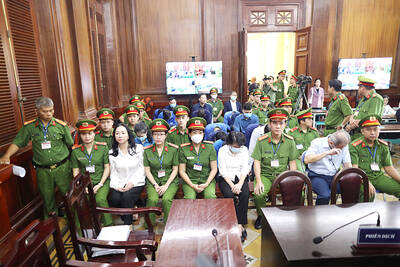
A top Vietnamese property tycoon was on Thursday sentenced to death in one of the biggest corruption cases in history, with an estimated US$27 billion in damages. A panel of three hand-picked jurors and two judges rejected all defense arguments by Truong My Lan, chair of major developer Van Thinh Phat, who was found guilty of swindling cash from Saigon Commercial Bank (SCB) over a decade. “The defendant’s actions ... eroded people’s trust in the leadership of the [Communist] Party and state,” read the verdict at the trial in Ho Chi Minh City. After the five-week trial, 85 others were also sentenced on

‘DELUSIONAL’: Targeting the families of Hamas’ leaders would not push the group to change its position or to give up its demands for Palestinians, Ismail Haniyeh said Israeli aircraft on Wednesday killed three sons of Hamas’ top political leader in the Gaza Strip, striking high-stakes targets at a time when Israel is holding delicate ceasefire negotiations with the militant group. Hamas said four of the leader’s grandchildren were also killed. Ismail Haniyeh’s sons are among the highest-profile figures to be killed in the war so far. Israel said they were Hamas operatives, and Haniyeh accused Israel of acting in “the spirit of revenge and murder.” The deaths threatened to strain the internationally mediated ceasefire talks, which appeared to gain steam in recent days even as the sides remain far
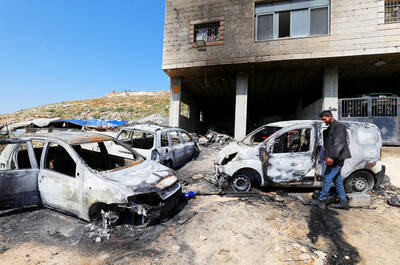
RAMPAGE: A Palestinian man was left dead after dozens of Israeli settlers searching for a missing 14-year-old boy stormed a village in the Israeli-occupied West Bank US President Joe Biden on Friday said he expected Iran to attack Israel “sooner, rather than later” and warned Tehran not to proceed. Asked by reporters about his message to Iran, Biden simply said: “Don’t,” underscoring Washington’s commitment to defend Israel. “We are devoted to the defense of Israel. We will support Israel. We will help defend Israel and Iran will not succeed,” he said. Biden said he would not divulge secure information, but said his expectation was that an attack could come “sooner, rather than later.” Israel braced on Friday for an attack by Iran or its proxies as warnings grew of


 RSS
RSS