


Iraqi Shiite pilgrims ran a gauntlet of bullets and bombs this weekend as they headed south for a major religious celebration, while political leaders in Baghdad bickered over a "unity" government.
One Iraqi civilian was killed in southern Baghdad by a roadside bomb, and at least five Shiite pilgrims were wounded by a separate roadside bomb in the Yarmuk neighborhood of western Baghdad yesterday, an interior ministry official said.
This followed the drive-by shooting that killed three pilgrims in the same area on Friday, while a roadside bomb claimed the life of one pilgrim and wounded four more south of the capital.
The string of attacks on pilgrims, making their way on foot to the main commemoration tomorrow in Karbala, 110km south of Baghdad, comes amid heightened sectarian tension in the aftermath of the bombing of a Shiite shrine in Samarra, north of Baghdad, and retaliatory attacks on Sunnis which left hundreds dead.
Tens of thousands of Iraq's Shiite majority are heading to Karbala for the annual commemoration of the end of the 40-day mourning period for Prophet Mohammed's grandson, Imam Hussein, killed near the city in 680.
US and Iraqi forces have bol-stered security and the US military has called up an additional battal-ion size force of 700 troops from Kuwait for the holiday.
Sunni Islamic extremists have repeatedly attacked Shiites on their religious holidays since the fall of Saddam Hussein's regime three years ago.
In March 2004, at the start of the Ashura holiday, suicide bombings in Karbala and Baghdad killed more than 170 people.
Public display
In Baghdad, Iraqi Defense Minister Saadun al-Dulaimi said yesterday that six men suspected of involvement in the murder of a female journalist and her two-person crew from al-Arabiyah television in Dubai have been arrested.
"The six terrorists who killed the Iraqi television crew will be put on public display today or tomorrow," the defense minister said in a statement.
They were arrested in the course of "Operation Swarmer," a major Iraqi and US military sweep north of Samarra, which kicked off on Thursday.
The three Iraqi journalists -- presenter Atwar Bahjat, cameraman Adnan Abdullah and soundman Khaled Mohsen -- were kidnapped and murdered on the outskirts of Samarra, after traveling to the city to report on the bombing of the Shiite shrine on Feb. 22.
More violence
In other violence yesterday, eight policemen were wounded in two separate bomb attacks in the east and northeast of Baghdad, security officials said. A car bomb injured two civilians in the capital.
Two insurgents were killed and 19 others arrested, including a Jordanian, when Iraqi forces yesterday raided an area near Baqubah, northeast of the capital.
Political deadlock
In Baghdad, political leaders remained deadlocked in their talks on forming a broad-based coalition in the wake of the December general elections.
Iraq's interim Prime Minister Ibrahim Jaafari, whom the dominant Shiite Alliance would like to see head the next government, made clear yesterday he was opposed to diluting executive authority by handing over responsibility for security matters to a national security council which would include representatives from all major parties.
"Our recommendation is that it should be a consultative group and not interfere with executive authority," he told a news conference held jointly with Defense Minister Sadun al-Dulaimi and visiting British Defense Secretary John Reid.
The security council does not yet exist and its opponents argue there is no provision for it in the Constitution adopted in October.
Reid stressed that British forces would remain in Iraq "until the job is finished."
"The job will not be finished until the Iraqi government decides that it is willing, able and capable of maintaining its own security," he said.
"As soon as they indicate that to us and that they wish us to go, we will go," he said.
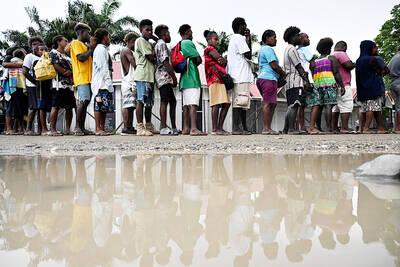
SEEKING CHANGE: A hospital worker said she did not vote in previous elections, but ‘now I can see that maybe my vote can change the system and the country’ Voting closed yesterday across the Solomon Islands in the south Pacific nation’s first general election since the government switched diplomatic allegiance from Taiwan to Beijing and struck a secret security pact that has raised fears of the Chinese navy gaining a foothold in the region. The Solomon Islands’ closer relationship with China and a troubled domestic economy weighed on voters’ minds as they cast their ballots. As many as 420,000 registered voters had their say across 50 national seats. For the first time, the national vote also coincided with elections for eight of the 10 local governments. Esther Maeluma cast her vote in the
Nearly half of China’s major cities are suffering “moderate to severe” levels of subsidence, putting millions of people at risk of flooding, especially as sea levels rise, according to a study of nationwide satellite data released yesterday. The authors of the paper, published by the journal Science, found that 45 percent of China’s urban land was sinking faster than 3mm per year, with 16 percent at more than 10mm per year, driven not only by declining water tables, but also the sheer weight of the built environment. With China’s urban population already in excess of 900 million people, “even a small portion

UNSETTLING IMAGES: The scene took place in front of TV crews covering the Trump trial, with a CNN anchor calling it an ‘emotional and unbelievably disturbing moment’ A man who doused himself in an accelerant and set himself on fire outside the courthouse where former US president Donald Trump is on trial has died, police said yesterday. The New York City Police Department (NYPD) said the man was declared dead by staff at an area hospital. The man was in Collect Pond Park at about 1:30pm on Friday when he took out pamphlets espousing conspiracy theories, tossed them around, then doused himself in an accelerant and set himself on fire, officials and witnesses said. A large number of police officers were nearby when it happened. Some officers and bystanders rushed

HYPOCRISY? The Chinese Ministry of Foreign Affairs yesterday asked whether Biden was talking about China or the US when he used the word ‘xenophobic’ US President Joe Biden on Wednesday called for a hike in steel tariffs on China, accusing Beijing of cheating as he spoke at a campaign event in Pennsylvania. Biden accused China of xenophobia, too, in a speech to union members in Pittsburgh. “They’re not competing, they’re cheating. They’re cheating and we’ve seen the damage here in America,” Biden said. Chinese steel companies “don’t need to worry about making a profit because the Chinese government is subsidizing them so heavily,” he said. Biden said he had called for the US Trade Representative to triple the tariff rates for Chinese steel and aluminum if Beijing was


 RSS
RSS