


They came to banish ghosts, rid themselves of eczema, seek succor for a cheating husband or unruly child. Their feet bare, heads covered, the believers, both Hindu and Muslim, entered the shrine in droves, stopping only to kiss each stair.
That was the scene at the tomb of Hazarat Syed Baba Bahadur Shahid, a Muslim, two days after a pair of homemade bombs tore through a Hindu temple and a railway station here in Hinduism's holiest city, raising the specter of Hindu-Muslim violence.
But such violence did not come to pass. Indeed, the scene at the Bahadur Shahid shrine served as a reminder of a fact often obscured by the spasms of ruthless sectarian violence that strike India: that after living cheek by jowl here for so many centuries, Hindus and Muslims often find themselves quietly braided together in worship as in daily life.
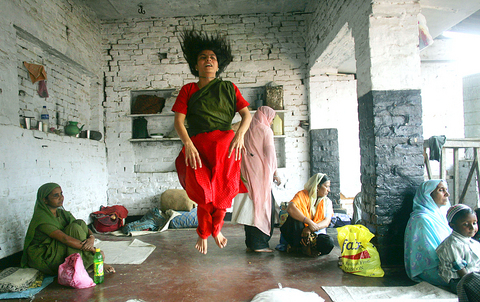
PHOTO: NY TIMES NEWS SERVICE
Like a great many Sufi shrines across India, the Bahadur Shahid shrine is considered holy by Hindus and Muslims alike.
The Bahadur Shahid shrine is nothing as storied as others scattered across this country, from Anantnag on the Indian side of Kashmir Province to Ajmer in the Rajasthani desert, which draw Hindu, Muslim and Sikh pilgrims by the thousands every year. This is an unsung poor people's temple, sitting on a dirty field where cows loll and the smell of sewage rises up as the day unfolds.
Little is known about its origins, except that the man buried in the tomb was probably a soldier from the 11th century who came to conquer Varanasi, also known as Benares, and lost.
"It lies in the imagination of the folk," said Mohammed Toha, a professor of sociology at Benares Hindu University. "It is part of folklore of Benares. It symbolizes Hindu-Muslim integration, the syncretic culture of Benares."
The shrine is a symbol of a city in which Hindus and Muslims have lived in varying states of ease and unease for hundreds of years. Varanasi's famous Hindu temple, Kashi Viswanath, is pressed against its most famous mosque, called Gyanvapi, and guarded by heavily armed police.
Varanasi has long been a mecca for mystics and iconoclasts, including the 15th century poet Kabir, who rejected Hindu and Muslim strictures with equal vehemence. He was so revered that when he died, Hindus and Muslims sparred bitterly over his remains. According to legend, a deal was brokered to divide them up. But when his shroud was lifted, nothing was there.
Hindus and Muslims are also tied together in more commercial affairs. That, some Benarasis surmise, perhaps best explains why the temple bombing of March 7, which the police blamed on an Islamist militant group with ties to Pakistan, did not incite further violence.
Muslim weavers make the famous Benarasi silk saris for the weddings of wealthy Hindus. Muslim craftsmen also produce the crowns of Hindu temple deities.
Muslim musicians play concerts at Hindu temples. The city's most celebrated musician, the Muslim shehnai player Bismillah Khan, approaching 90, is famous for beginning his mornings with songs before the Hindu Shiva temple.
On a recent Thursday, as on every other, the Bahadur shrine brought together thousands of believers.
Hindu women with red vermillion powder smeared on their heads jostled for a glimpse of the tomb along with Muslim women in black burqas. Hindu men donned skullcaps in deference to Muslim custom.
Offerings that are ordinarily seen at Hindu temples -- flowers, incense, sugar candy -- were presented before the tomb.
It hardly mattered whether the believers prayed to Hanuman or to Allah the rest of the week. On Thursdays, they came to the tomb of Bahadur Shahid -- or Baba, as they called him -- and prayed for a miracle.
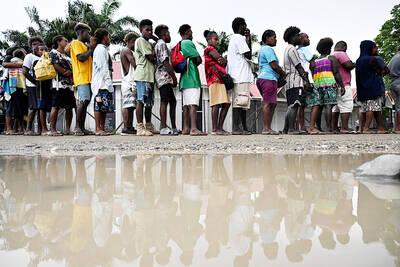
SEEKING CHANGE: A hospital worker said she did not vote in previous elections, but ‘now I can see that maybe my vote can change the system and the country’ Voting closed yesterday across the Solomon Islands in the south Pacific nation’s first general election since the government switched diplomatic allegiance from Taiwan to Beijing and struck a secret security pact that has raised fears of the Chinese navy gaining a foothold in the region. The Solomon Islands’ closer relationship with China and a troubled domestic economy weighed on voters’ minds as they cast their ballots. As many as 420,000 registered voters had their say across 50 national seats. For the first time, the national vote also coincided with elections for eight of the 10 local governments. Esther Maeluma cast her vote in the
Nearly half of China’s major cities are suffering “moderate to severe” levels of subsidence, putting millions of people at risk of flooding, especially as sea levels rise, according to a study of nationwide satellite data released yesterday. The authors of the paper, published by the journal Science, found that 45 percent of China’s urban land was sinking faster than 3mm per year, with 16 percent at more than 10mm per year, driven not only by declining water tables, but also the sheer weight of the built environment. With China’s urban population already in excess of 900 million people, “even a small portion

UNSETTLING IMAGES: The scene took place in front of TV crews covering the Trump trial, with a CNN anchor calling it an ‘emotional and unbelievably disturbing moment’ A man who doused himself in an accelerant and set himself on fire outside the courthouse where former US president Donald Trump is on trial has died, police said yesterday. The New York City Police Department (NYPD) said the man was declared dead by staff at an area hospital. The man was in Collect Pond Park at about 1:30pm on Friday when he took out pamphlets espousing conspiracy theories, tossed them around, then doused himself in an accelerant and set himself on fire, officials and witnesses said. A large number of police officers were nearby when it happened. Some officers and bystanders rushed

HYPOCRISY? The Chinese Ministry of Foreign Affairs yesterday asked whether Biden was talking about China or the US when he used the word ‘xenophobic’ US President Joe Biden on Wednesday called for a hike in steel tariffs on China, accusing Beijing of cheating as he spoke at a campaign event in Pennsylvania. Biden accused China of xenophobia, too, in a speech to union members in Pittsburgh. “They’re not competing, they’re cheating. They’re cheating and we’ve seen the damage here in America,” Biden said. Chinese steel companies “don’t need to worry about making a profit because the Chinese government is subsidizing them so heavily,” he said. Biden said he had called for the US Trade Representative to triple the tariff rates for Chinese steel and aluminum if Beijing was


 RSS
RSS