


A nanotechnologist has created the world's smallest and most plentiful Smiley -- a tiny face measuring a few billionths of a meter across that is assembled from strands of DNA.
Some fifty billion Smileys, each a thousand times smaller than the diameter of a human hair, can be made at a stroke using the technique pioneered by Paul Rothemund at the California Institute of Technology (Caltech).
DNA, the molecule that comprises living things, has long been known for its versatility as a microscopic building block.
The molecule can be "cut" using enzymes and reassembled using matching rungs in its double-helix structure. This theoretically opens the way to making DNA quantum computers and nano-level devices including injectable robots that can monitor the body's tissues for good health.
But, until now, nano-assembly has been a complex atom-by-atom procedure that is also costly, because it is carried out in a vacuum or at extremely cold temperatures.
Rothemund, writing in yesterday's issue of Nature, describes a far simpler and much cheaper process in which long, single strands of DNA can be folded back and forth to form a basic scaffold.
The basic structure is then supplemented by around 200 shorter strands, which both strengthen it and act rather like pixels in a computer or TV image, thus providing a shape that can bear a complex pattern.
In a potent demonstration of his so-called DNA origami technique, Rothemund has created half a dozen shapes, including a five-pointed star, a snowflake, a picture of the double helix and a map of the Americas in which one nanometre (one billionth of a meter) represents 120km.
Rothemund has been working on flat, two-dimensional shapes but says that 3-D structures in DNA should be quite feasible with this technique, Caltech said in a press release.
One application would be a nano-scale "cage" in which pharmaceutical researchers, working on novel drugs, could sequester enzymes until they were ready for use in turning other proteins on and off.
Nearly half of China’s major cities are suffering “moderate to severe” levels of subsidence, putting millions of people at risk of flooding, especially as sea levels rise, according to a study of nationwide satellite data released yesterday. The authors of the paper, published by the journal Science, found that 45 percent of China’s urban land was sinking faster than 3mm per year, with 16 percent at more than 10mm per year, driven not only by declining water tables, but also the sheer weight of the built environment. With China’s urban population already in excess of 900 million people, “even a small portion

UNSETTLING IMAGES: The scene took place in front of TV crews covering the Trump trial, with a CNN anchor calling it an ‘emotional and unbelievably disturbing moment’ A man who doused himself in an accelerant and set himself on fire outside the courthouse where former US president Donald Trump is on trial has died, police said yesterday. The New York City Police Department (NYPD) said the man was declared dead by staff at an area hospital. The man was in Collect Pond Park at about 1:30pm on Friday when he took out pamphlets espousing conspiracy theories, tossed them around, then doused himself in an accelerant and set himself on fire, officials and witnesses said. A large number of police officers were nearby when it happened. Some officers and bystanders rushed
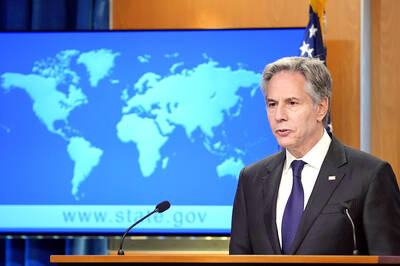
Beijing is continuing to commit genocide and crimes against humanity against Uyghurs and other Muslim minorities in its western Xinjiang province, U.S. Secretary of State Antony Blinken said in a report published on Monday, ahead of his planned visit to China this week. The State Department’s annual human rights report, which documents abuses recorded all over the world during the previous calendar year, repeated language from previous years on the treatment of Muslims in Xinjiang, but the publication raises the issue ahead of delicate talks, including on the war in Ukraine and global trade, between the top U.S. diplomat and Chinese

HYPOCRISY? The Chinese Ministry of Foreign Affairs yesterday asked whether Biden was talking about China or the US when he used the word ‘xenophobic’ US President Joe Biden on Wednesday called for a hike in steel tariffs on China, accusing Beijing of cheating as he spoke at a campaign event in Pennsylvania. Biden accused China of xenophobia, too, in a speech to union members in Pittsburgh. “They’re not competing, they’re cheating. They’re cheating and we’ve seen the damage here in America,” Biden said. Chinese steel companies “don’t need to worry about making a profit because the Chinese government is subsidizing them so heavily,” he said. Biden said he had called for the US Trade Representative to triple the tariff rates for Chinese steel and aluminum if Beijing was


 RSS
RSS