


Many here hoped for the kind of public drama Italy loves, that something decisive might happen on this night Prime Minister Silvio Berlusconi and his challenger Romano Prodi finally faced each other in their first televised debate of this tight race.
But an unwelcome bit of the US came to Italy on Tuesday night, in the form of a strictly orchestrated presidential debate. Answers were limited to two-and-a-half minutes. Interruptions were not allowed -- and, amazingly, no one did interrupt.
"It's clear this is not a system where you can make a speech in an efficient way," grumbled Berlusconi, who, behind in the polls, needed to make a bigger impression and seemed to strain harder at the rules.
Prodi, of course, disagreed, as he did throughout the 90-minute debate, less than a month away from the voting on April 9 and 10.
"This is a system that gives equality," he said. "It is a system that is used by the United States. It is a good system."
That the debate lacked excitement seemed especially odd given that this remains an open race, in which perhaps the least predictable leader in Europe, Berlusconi, 69, in office for five years, is fighting hard for his political survival and having a tough time of it recently.
He is several points behind in the polls, with economic growth at zero and his brash, personal style of politics far less popular now than when he took office. His center-right coalition continues to erode, prosecutors are again breathing down his neck, and he lost a skirmish with Prodi on how the debates and television air time would be divvied up.
On Sunday, when he stormed out of a television interview with a particularly persistent left-leaning reporter, his critics said he seemed to be cracking slightly under the pressure.
Compared with that performance, his debating skills on Tuesday seemed back to form. He was relaxed, communing with his usual skill with cameras, as he spilled forth figures on his accomplishments and tried to skewer his center-left opponent.
"The left holds an old ideology, with the same people that never change, that are recycled and that are inherited from an old ideology that views the state as an entity that the citizens must work for," he said in his closing remarks.
But Prodi, 66, a former prime minister and EU commissioner, seemed unusually animated and combative, as he worked to dispel his reputation as dull and too much the professor he once was. (Berlusconi seemed to taunt him slightly by constantly referring to him as "professor.")
"You have had five years of uninterrupted government, and you talk as if you are in the opposition," Prodi said to Berlusconi, who had just reeled off a litany of failures of past leftist governments. "What have you done?"
Berlusconi, despite having admitted that he knew he needed to offer something new to invigorate his campaign, stuck largely to old themes -- a fact that Renato Mannheimer, one of Italy's top pollsters, said gave the debate, only narrowly, to Prodi.
"He was boring," Mannheimer said of Prodi. "But if you compare him to other times, he was a little bit better than in the past, and Berlusconi was the same."
A poll released on Tuesday by Mannheimer showed that 64 percent of Italians had already decided whom to vote for, and both men are chasing after the 24 percent of undecideds, only about 14 percent of whom seemed likely to vote.
But Berlusconi's old arguments still resonate with many voters: that the coalition of six parties that Prodi heads is unstable and cynical; that past center-left governments spent a lot and did little; that the left is beholden to the Communists, who are part of their coalition.
"How is he going to get anything done when he will have Communists in his government?" Berlusconi asked.
Prodi hit back that Berlusconi had not lived up to his promises; had governed in a way that benefited him personally; and lacked the "seriousness" to be a suitable leader of one of Europe's leading nations.
Some Italian commentators have complained that the race, for all the serious economic problems Italy faces, has failed to come up with new ideas or new faces. Indeed, the debate on Tuesday had more than a whiff of the past in it: Berlusconi and Prodi had debated, if in a more free-wheeling form, in 1996.
Prodi went on to win the race, but his government was toppled two years later.
Mannheimer said he expected the undecided voters to make up their minds in the last days of the race, making the second and last debate on April 3 the decisive one.
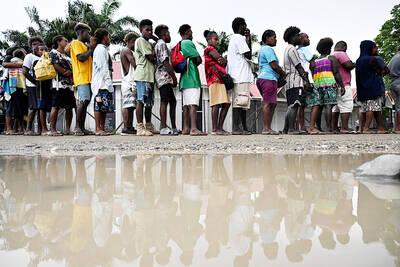
SEEKING CHANGE: A hospital worker said she did not vote in previous elections, but ‘now I can see that maybe my vote can change the system and the country’ Voting closed yesterday across the Solomon Islands in the south Pacific nation’s first general election since the government switched diplomatic allegiance from Taiwan to Beijing and struck a secret security pact that has raised fears of the Chinese navy gaining a foothold in the region. The Solomon Islands’ closer relationship with China and a troubled domestic economy weighed on voters’ minds as they cast their ballots. As many as 420,000 registered voters had their say across 50 national seats. For the first time, the national vote also coincided with elections for eight of the 10 local governments. Esther Maeluma cast her vote in the
Nearly half of China’s major cities are suffering “moderate to severe” levels of subsidence, putting millions of people at risk of flooding, especially as sea levels rise, according to a study of nationwide satellite data released yesterday. The authors of the paper, published by the journal Science, found that 45 percent of China’s urban land was sinking faster than 3mm per year, with 16 percent at more than 10mm per year, driven not only by declining water tables, but also the sheer weight of the built environment. With China’s urban population already in excess of 900 million people, “even a small portion

UNSETTLING IMAGES: The scene took place in front of TV crews covering the Trump trial, with a CNN anchor calling it an ‘emotional and unbelievably disturbing moment’ A man who doused himself in an accelerant and set himself on fire outside the courthouse where former US president Donald Trump is on trial has died, police said yesterday. The New York City Police Department (NYPD) said the man was declared dead by staff at an area hospital. The man was in Collect Pond Park at about 1:30pm on Friday when he took out pamphlets espousing conspiracy theories, tossed them around, then doused himself in an accelerant and set himself on fire, officials and witnesses said. A large number of police officers were nearby when it happened. Some officers and bystanders rushed

HYPOCRISY? The Chinese Ministry of Foreign Affairs yesterday asked whether Biden was talking about China or the US when he used the word ‘xenophobic’ US President Joe Biden on Wednesday called for a hike in steel tariffs on China, accusing Beijing of cheating as he spoke at a campaign event in Pennsylvania. Biden accused China of xenophobia, too, in a speech to union members in Pittsburgh. “They’re not competing, they’re cheating. They’re cheating and we’ve seen the damage here in America,” Biden said. Chinese steel companies “don’t need to worry about making a profit because the Chinese government is subsidizing them so heavily,” he said. Biden said he had called for the US Trade Representative to triple the tariff rates for Chinese steel and aluminum if Beijing was


 RSS
RSS