


As the newest Mars craft approached its critical rendezvous with the red planet yesterday, NASA specialists were watching anxiously from Earth, mindful of the number of things that had gone wrong in the past.
The Mars Reconnaissance Orbiter (MRO) started slowing down last month after travelling nearly 500 million kilometers in less than seven months, and was to maneuver into orbit around the planet at 5:25am today.
If the maneuver fails, the probe could skip past Mars to be claimed by the universe beyond.
The maneuver is difficult because the control center in Pasadena, California, will lose communications with the craft for a half an hour while the orbiter flies around the far side of Mars.
The mission was entering a "very critical phase" in the coming days, said NASA scientist Fuk Li during a press conference on Wednesday. Only two of the four attempts to put expeditions in orbit around Mars in the last 15 years had succeeded, which Li said were "sobering" odds.
Mars is interesting for researchers because it is most like the Earth. It's also the only planet that could be visited by humans in the foreseeable future -- according to NASA plans, perhaps in 20 years.
NASA is looking for a good landing place for the Phoenix probe in 2007 and a Mars laboratory in 2009.
NASA aims to greatly expand its scientific understanding of the red planet, collecting more data than all previous Mars missions combined.
"This mission will ... pave the way for future robotic missions later in this decade, and help us prepare for sending humans to Mars," said Doug McCuistion, NASA's Director of the Mars Exploration Program, last month.
Over the next six months, the probe's orbit will gradually drop near enough to gather information -- about 300km above the planet's surface.
NASA said the probe carries the most powerful telescopic camera ever sent to another planet, with the capacity to capture rocks the size of a small desk.
NASA is particularly interested in finding any water on the planet and tracking down past water traces to help determine if Mars ever supported life.
Yesterday, the journal Science was to publish an article showing that NASA's Cassini probe had found what could be water on Saturn's moon Enceladus.
The probe's descent will include hundreds of carefully calculated dips into the upper atmosphere -- a process called aerobraking -- that will lower it into smaller orbits.
"Aerobraking is like a high-wire act in open air," said Jim Graf, NASA's orbiter project manager in a telecast news conference. "It's a dangerous part of the mission."
Nearly half of China’s major cities are suffering “moderate to severe” levels of subsidence, putting millions of people at risk of flooding, especially as sea levels rise, according to a study of nationwide satellite data released yesterday. The authors of the paper, published by the journal Science, found that 45 percent of China’s urban land was sinking faster than 3mm per year, with 16 percent at more than 10mm per year, driven not only by declining water tables, but also the sheer weight of the built environment. With China’s urban population already in excess of 900 million people, “even a small portion

UNSETTLING IMAGES: The scene took place in front of TV crews covering the Trump trial, with a CNN anchor calling it an ‘emotional and unbelievably disturbing moment’ A man who doused himself in an accelerant and set himself on fire outside the courthouse where former US president Donald Trump is on trial has died, police said yesterday. The New York City Police Department (NYPD) said the man was declared dead by staff at an area hospital. The man was in Collect Pond Park at about 1:30pm on Friday when he took out pamphlets espousing conspiracy theories, tossed them around, then doused himself in an accelerant and set himself on fire, officials and witnesses said. A large number of police officers were nearby when it happened. Some officers and bystanders rushed

HYPOCRISY? The Chinese Ministry of Foreign Affairs yesterday asked whether Biden was talking about China or the US when he used the word ‘xenophobic’ US President Joe Biden on Wednesday called for a hike in steel tariffs on China, accusing Beijing of cheating as he spoke at a campaign event in Pennsylvania. Biden accused China of xenophobia, too, in a speech to union members in Pittsburgh. “They’re not competing, they’re cheating. They’re cheating and we’ve seen the damage here in America,” Biden said. Chinese steel companies “don’t need to worry about making a profit because the Chinese government is subsidizing them so heavily,” he said. Biden said he had called for the US Trade Representative to triple the tariff rates for Chinese steel and aluminum if Beijing was
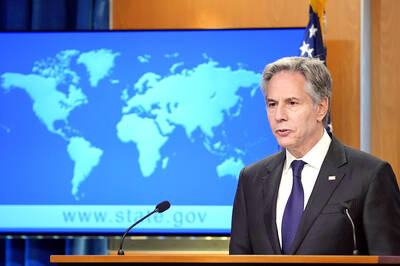
Beijing is continuing to commit genocide and crimes against humanity against Uyghurs and other Muslim minorities in its western Xinjiang province, U.S. Secretary of State Antony Blinken said in a report published on Monday, ahead of his planned visit to China this week. The State Department’s annual human rights report, which documents abuses recorded all over the world during the previous calendar year, repeated language from previous years on the treatment of Muslims in Xinjiang, but the publication raises the issue ahead of delicate talks, including on the war in Ukraine and global trade, between the top U.S. diplomat and Chinese


 RSS
RSS