


More and more US women are swapping briefcases and suits for jeans and diaper bags as they opt to stay home and raise children, putting the brakes on decades of female advances in the workplace.
For the first time in the post-feminist era, the number of working women has begun to retreat, with even graduates from prestigious universities giving up promising careers for old-fashioned domesticity.
A new magazine launched in California has seized on the trend: the cover of Total 180 shows a slender, radiant woman balancing her daughter on one hip as she tosses her briefcase into the trash.
"With practical information that validates, supports and reassures their lifestyle, Total 180 is the sustenance for professional women turned stay-at-home moms," the magazine's Web site says.
Some 6 million women have chosen to leave the workforce to stay home and raise their children, said the magazine's chief editor, Erika Kotite.
But they feel isolated, she said, and the magazine aims to address their needs "with humor and lightheartedness."
But not everyone sees this positively, especially feminists who fought decades ago to open workplace doors to women.
Rose Olver, a professor of women's studies at Amherst College in Massachusetts, called the trend "somewhat alarming."
"Women in the 1970s fought for access and my sense is that the urgency to open the work place to women has subsided," Olver said.
"Opportunities open for women may decrease" in the future if more women drop out, she said.
"The older generation feel may be a bit put out that this generation is so cavalierly assuming that these possibilities will be open to them," she said.
"The child-rearing issue is much thornier than many feminists thought it would be," said professor Linda Fowler of Dartmouth College in New Hampshire.
"What feminist theorists thought was that, if enough women were in the workplace in high-scale and highly qualified jobs, the whole workplace economy would be more humanized. That has not happened," Fowler said.
"There is still a difference on obstacles women face as they are trying to juggle a career and family," she said.
But behind the debate of whether the trend is good or bad is a broader stagnation or even decline in women holding jobs in the US workplace after rising for 50 years straight.
"The new factor at play is the change in the trend in the female participation rate, which has edged down on balance since 2000 after having risen for five decades," a White House report said last month.
In 2000, 77 percent of women between 25 and 54 held a job in the US. By last year, the level had dropped to 75 percent, a significant demographic shift.
How much the data represents voluntary workplace dropouts by women and how much they are forced is still debated.
Kim Gandy, president of the National Organization of Women, which helped promote working women from the 1960s, said the decline of women in the US workforce reflects in part simple economics: the fall in overall jobs since the US economy slowed sharply in 2000.
However, she said that other factors, like wages and the cost of childcare, impact working women much more than men.
"When good jobs are plentiful, it becomes easier to cover the cost of child care with your wages," she said.
"When wages are depressed ... it becomes a much closer question as to whether it's worth a tradeoff," she said.
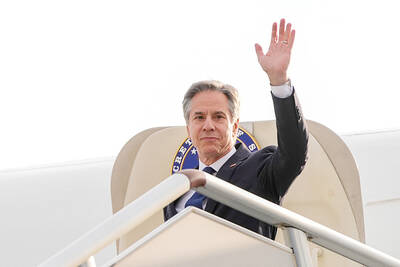
‘IN A DIFFERENT PLACE’: The envoy first visited Shanghai, where he attended a Chinese basketball playoff match, and is to meet top officials in Beijing tomorrow US Secretary of State Antony Blinken yesterday arrived in China on his second visit in a year as the US ramps up pressure on its rival over its support for Russia while also seeking to manage tensions with Beijing. The US diplomat tomorrow is to meet China’s top brass in Beijing, where he is also expected to plead for restraint as Taiwan inaugurates president-elect William Lai (賴清德), and to raise US concerns on Chinese trade practices. However, Blinken is also seeking to stabilize ties, with tensions between the world’s two largest economies easing since his previous visit in June last year. At the
Nearly half of China’s major cities are suffering “moderate to severe” levels of subsidence, putting millions of people at risk of flooding, especially as sea levels rise, according to a study of nationwide satellite data released yesterday. The authors of the paper, published by the journal Science, found that 45 percent of China’s urban land was sinking faster than 3mm per year, with 16 percent at more than 10mm per year, driven not only by declining water tables, but also the sheer weight of the built environment. With China’s urban population already in excess of 900 million people, “even a small portion

UNSETTLING IMAGES: The scene took place in front of TV crews covering the Trump trial, with a CNN anchor calling it an ‘emotional and unbelievably disturbing moment’ A man who doused himself in an accelerant and set himself on fire outside the courthouse where former US president Donald Trump is on trial has died, police said yesterday. The New York City Police Department (NYPD) said the man was declared dead by staff at an area hospital. The man was in Collect Pond Park at about 1:30pm on Friday when he took out pamphlets espousing conspiracy theories, tossed them around, then doused himself in an accelerant and set himself on fire, officials and witnesses said. A large number of police officers were nearby when it happened. Some officers and bystanders rushed
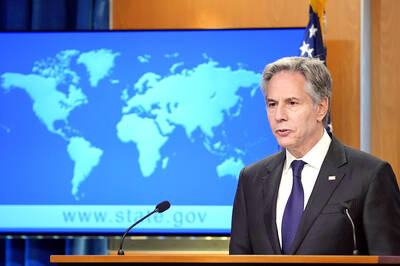
Beijing is continuing to commit genocide and crimes against humanity against Uyghurs and other Muslim minorities in its western Xinjiang province, U.S. Secretary of State Antony Blinken said in a report published on Monday, ahead of his planned visit to China this week. The State Department’s annual human rights report, which documents abuses recorded all over the world during the previous calendar year, repeated language from previous years on the treatment of Muslims in Xinjiang, but the publication raises the issue ahead of delicate talks, including on the war in Ukraine and global trade, between the top U.S. diplomat and Chinese


 RSS
RSS