


China yesterday urged other governments to share more information about bird flu cases in people to prevent a human pandemic, and an official report said many residents in China's vast hinterland are uninformed about the disease.
Few developing countries other than China have submitted bird flu samples from humans to international organizations, the state-run China Daily newspaper said, citing an unidentified Agriculture Ministry official.
"The international community should further improve the information-sharing mechanism for the disease," the official was quoted as saying.
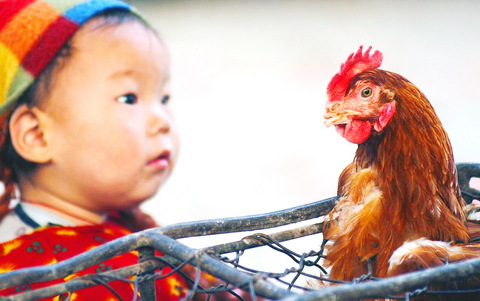
PHOTO: AP
The report came as health experts were attending a WHO conference in Geneva that was meant to produce guidelines for public health officials to stop a possible human pandemic in its early stages.
The WHO's Asia-Pacific regional director, Doctor Shigeru Omi, criticized China's Agriculture Ministry in December for refusing to share samples from animal outbreaks. The ministry did not respond.
China could reap an economic windfall if it creates an effective bird flu vaccine or treatment before foreign competitors that might be helped by access to its virus samples.
On Monday, China's official Xinhua News Agency quoted pandemic control expert Zhong Nanshan as saying bird flu has not been sufficiently publicized, especially in some rural areas.
"Some people there [in the countryside] are not alert for bird flu," Zhong said, who is also a delegate to the top panel that advises the country's parliament, currently in session.
He said people should realize that other animals, such as cats and pigs, may carry the virus.
China this week reported its ninth bird flu death out of 15 confirmed human cases.
Meanwhile US federal health officials announced plans on Monday for a second vaccine to protect people from bird flu because the virus spreading among birds in Asia, Africa and Europe is changing.
The US government has several million doses of an earlier bird flu vaccine, but it was based on a sample of virus taken from Vietnam in 2004. It is believed to have mutated enough since then that the form now circulating in Africa and Europe may be different, health officials said.
US Health and Human Services Secretary Mike Leavitt said on Monday that he had authorized the National Institutes of Health and the federal Centers for Disease Control and Prevention to begin working on a second vaccine for humans.
Government flu experts would not speculate on whether the earlier vaccine would still protect most people. They said only that they believe it would be less effective than a new vaccine based on a more recent virus sample.
Health officials plan to base the second vaccine on a sample taken from Indonesia last year, said Ruben Donis, leader of the molecular genetics team at the CDC's influenza branch.
The virus circulating in Indonesia is related to the Vietnamese virus, but it is not a descendant and causes a different immune system response, he said.
A vaccine based on the Vietnamese virus would be protective for people in the Vietnam region, but less effective against viruses circulating elsewhere, Donis said.
He said that perhaps scientists will one day develop a vaccine that protects against several different forms of bird flu.
The US government is already spending US$250 million for about 8 million doses to protect against the Vietnamese version of bird flu.
Federal officials contracted with two companies -- Chiron Corp. and Sanofi Pasteur -- for those doses, and most already have been produced, said Bill Hall, a spokesman for Health and Human Services (HHS).
The second vaccine must be developed and tested, and HHS had no estimate for the cost of that work.
Margaret Chan, who is spearheading the WHO efforts against the virus, said it poses a greater challenge to the world than any previous infectious disease.
Poland on Monday confirmed its first outbreak of the disease, saying laboratory tests found that two wild swans died of the lethal strain.
Several cats have also tested positive for the deadly strain in Austria's first reported case of the disease spreading to an animal other than a bird, officials in that country said on Monday.
Nearly half of China’s major cities are suffering “moderate to severe” levels of subsidence, putting millions of people at risk of flooding, especially as sea levels rise, according to a study of nationwide satellite data released yesterday. The authors of the paper, published by the journal Science, found that 45 percent of China’s urban land was sinking faster than 3mm per year, with 16 percent at more than 10mm per year, driven not only by declining water tables, but also the sheer weight of the built environment. With China’s urban population already in excess of 900 million people, “even a small portion

UNSETTLING IMAGES: The scene took place in front of TV crews covering the Trump trial, with a CNN anchor calling it an ‘emotional and unbelievably disturbing moment’ A man who doused himself in an accelerant and set himself on fire outside the courthouse where former US president Donald Trump is on trial has died, police said yesterday. The New York City Police Department (NYPD) said the man was declared dead by staff at an area hospital. The man was in Collect Pond Park at about 1:30pm on Friday when he took out pamphlets espousing conspiracy theories, tossed them around, then doused himself in an accelerant and set himself on fire, officials and witnesses said. A large number of police officers were nearby when it happened. Some officers and bystanders rushed

HYPOCRISY? The Chinese Ministry of Foreign Affairs yesterday asked whether Biden was talking about China or the US when he used the word ‘xenophobic’ US President Joe Biden on Wednesday called for a hike in steel tariffs on China, accusing Beijing of cheating as he spoke at a campaign event in Pennsylvania. Biden accused China of xenophobia, too, in a speech to union members in Pittsburgh. “They’re not competing, they’re cheating. They’re cheating and we’ve seen the damage here in America,” Biden said. Chinese steel companies “don’t need to worry about making a profit because the Chinese government is subsidizing them so heavily,” he said. Biden said he had called for the US Trade Representative to triple the tariff rates for Chinese steel and aluminum if Beijing was

Beijing is continuing to commit genocide and crimes against humanity against Uyghurs and other Muslim minorities in its western Xinjiang province, U.S. Secretary of State Antony Blinken said in a report published on Monday, ahead of his planned visit to China this week. The State Department’s annual human rights report, which documents abuses recorded all over the world during the previous calendar year, repeated language from previous years on the treatment of Muslims in Xinjiang, but the publication raises the issue ahead of delicate talks, including on the war in Ukraine and global trade, between the top U.S. diplomat and Chinese


 RSS
RSS