


Budget cuts and poor management may be jeopardizing the future of the US' fleet of environmental satellites, -- vital tools for forecasting hurricanes, protecting water supplies and predicting global warming.
"The system of environmental satellites is at risk of collapse," said Richard Anthes, president of the University Corporation for Atmospheric Research."Every year that goes by without the system being addressed is a problem.''
Anthes chairs a National Academy of Sciences committee that advises the federal government on developing and operating environmental satellites. In a report issued last year, the committee warned that "the vitality of Earth science and application programs has been placed at substantial risk by a rapidly shrinking budget."
Since that report came out, NASA has chosen to cancel or mothball at least three planned satellites in an effort to save money. Cost overruns have delayed a new generation of weather satellites until at least 2010 and probably 2012, leading a Government Accountability Office official to label the enterprise "a program in crisis."
Scientists warn of the consequences of neglecting Earth observing satellites. It is possible that when a big volcano starts rumbling in the Pacific Northwest or a massive hurricane bears down on New Orleans, the people in harm's way -- and those responsible for their safety -- will have a lot less information than they would like about the impending threat.
NASA officials say that tight budgets tie their hands, forcing them to cut all but the most vital programs.
The agency's proposed budget request next year contains US$2.2 billion for satellites that observe the Earth and sun, compared with US$6.2 billion for operating the space shuttle and International Space Station and US$4 billion for developing future missions to the moon and Mars.
"We simply cannot afford all of the missions that our scientific constituencies would like us to sponsor," NASA administrator Michael Griffin said when he testified before the House Science Committee on Feb. 16.
Griffin is faced with the difficult task of balancing the space agency's science and aeronautics programs against the cost of operating the space station and shuttle, while simultaneously planning the future of human space flight.
"I truly wish that it could be otherwise, but there is only so much money," Griffin said in his congressional testimony. "We must set priorities."
The space agency has said that many science programs that have had their budgets slashed or eliminated will be revived if the budgetary situation improves.
Meanwhile, the list of delayed, downsized and canceled satellites is a long one.
For instance, Landsat, a series of satellites that have provided detailed images of the ground surface for more than 30 years, is in danger of experiencing a gap in service. Landsat 7, launched in April 1999, is scheduled to be replaced by a next-generation satellite in 2011.
However, if the existing satellite fails before that date, and NASA has not developed a contingency plan, scientists, land managers and others who depend on Landsat images could be out of luck.
Another project, the Global Precipitation Measurement Mission, which is designed to measure rainfall over the entire Earth, has been pushed back to 2012. But the satellite it is designed to replace, the Tropical Rainfall Measuring Mission, cannot possibly last that long.
That means there will be a period of several years when scientists have no access to the accurate global precipitation measurements that help them improve hurricane forecasts and predict the severity of droughts and flooding.
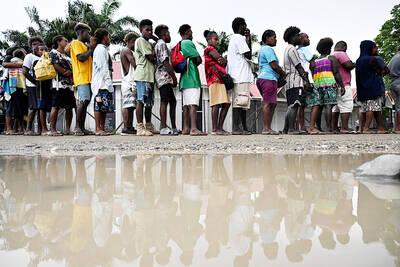
SEEKING CHANGE: A hospital worker said she did not vote in previous elections, but ‘now I can see that maybe my vote can change the system and the country’ Voting closed yesterday across the Solomon Islands in the south Pacific nation’s first general election since the government switched diplomatic allegiance from Taiwan to Beijing and struck a secret security pact that has raised fears of the Chinese navy gaining a foothold in the region. The Solomon Islands’ closer relationship with China and a troubled domestic economy weighed on voters’ minds as they cast their ballots. As many as 420,000 registered voters had their say across 50 national seats. For the first time, the national vote also coincided with elections for eight of the 10 local governments. Esther Maeluma cast her vote in the
Nearly half of China’s major cities are suffering “moderate to severe” levels of subsidence, putting millions of people at risk of flooding, especially as sea levels rise, according to a study of nationwide satellite data released yesterday. The authors of the paper, published by the journal Science, found that 45 percent of China’s urban land was sinking faster than 3mm per year, with 16 percent at more than 10mm per year, driven not only by declining water tables, but also the sheer weight of the built environment. With China’s urban population already in excess of 900 million people, “even a small portion

UNSETTLING IMAGES: The scene took place in front of TV crews covering the Trump trial, with a CNN anchor calling it an ‘emotional and unbelievably disturbing moment’ A man who doused himself in an accelerant and set himself on fire outside the courthouse where former US president Donald Trump is on trial has died, police said yesterday. The New York City Police Department (NYPD) said the man was declared dead by staff at an area hospital. The man was in Collect Pond Park at about 1:30pm on Friday when he took out pamphlets espousing conspiracy theories, tossed them around, then doused himself in an accelerant and set himself on fire, officials and witnesses said. A large number of police officers were nearby when it happened. Some officers and bystanders rushed

HYPOCRISY? The Chinese Ministry of Foreign Affairs yesterday asked whether Biden was talking about China or the US when he used the word ‘xenophobic’ US President Joe Biden on Wednesday called for a hike in steel tariffs on China, accusing Beijing of cheating as he spoke at a campaign event in Pennsylvania. Biden accused China of xenophobia, too, in a speech to union members in Pittsburgh. “They’re not competing, they’re cheating. They’re cheating and we’ve seen the damage here in America,” Biden said. Chinese steel companies “don’t need to worry about making a profit because the Chinese government is subsidizing them so heavily,” he said. Biden said he had called for the US Trade Representative to triple the tariff rates for Chinese steel and aluminum if Beijing was


 RSS
RSS