


The Australian prime minister met yesterday with Indian leaders after expressing his willingness to reconsider Australia's ban on uranium sales to India.
Prime Minister John Howard, who arrived on Sunday on a four-day trip to India, said Australia would not suddenly change its policy of blocking sales to countries that fail to sign the Nuclear Nonproliferation Treaty.
But he said that he would be happy to discuss the issue with Indian Prime Minister Manmohan Singh during talks yesterday because New Delhi has agreed with Washington to open its civilian nuclear plants to inspection.
"We have some of the largest uranium deposits in the world and provided the rules are followed and the safeguards are met we are willing to sell. But we have to be satisfied about the safeguards," Howard told reporters in New Delhi late on Sunday.
Australia and India were also scheduled yesterday to sign agreements on promoting trade, joint scientific research, and defense and customs cooperation, the Hindu newspaper reported.
Details were not immediately available.
Howard is scheduled to meet Prime Minister Manmohan Singh, the Congress party chief, Sonia Gandhi, and opposition leader L. K. Advani yesterday, an External Affairs Ministry statement said.
Meanwhile, Singh has reportedly said he will urge Howard to lift the ban. "We are short of uranium. We need uranium and our needs will increase in years to come," the Australian newspaper quoted him as saying.
Although second to Canada in production, Australia boasts the world's biggest uranium reserves.
The Olympic Dam mine in South Australia state holds 38 percent of the world's known uranium resources.
Last week, US President George W. Bush secured a landmark nuclear energy agreement which will open most of India's reactors to international inspections and provide the nation with US nuclear technology.
Subject to US congressional approval, the US will share its nuclear know-how and fuel with India to help power its fast-growing economy.
It represents a major shift in policy for the US, which imposed temporary sanctions on India in 1998 after it conducted nuclear weapons tests.
Following last week's announcement, Australian Foreign Minister Alexander Downer ruled out selling uranium to India, unless the country signed the Nuclear Nonproliferation Treaty.
But Howard said he would study the deal which he said represented a "very big step forward."
"We do have a long-standing policy of only selling uranium to countries that are part of the NPT regime, but we will have a look at what the Americans have done and when we get a bit more information about that we'll further assess it," he said.
Howard also said that his government had a "very positive attitude toward India."
Howard is the third world leader to visit New Delhi in as many weeks, following French President Jacques Chirac and Bush -- all looking to boost trade ties with one of the world's fastest growing economies.
Howard is accompanied by a 20-member business delegation, including executives from Australia's biggest banks, retailer, and mining and energy companies.
Trade between India and Australia was valued at US$5.4 billion in 2004 and last year.
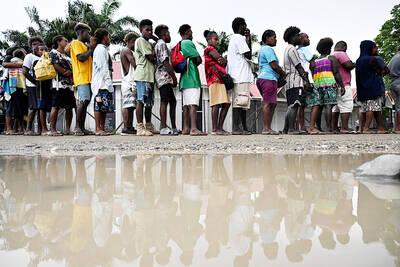
SEEKING CHANGE: A hospital worker said she did not vote in previous elections, but ‘now I can see that maybe my vote can change the system and the country’ Voting closed yesterday across the Solomon Islands in the south Pacific nation’s first general election since the government switched diplomatic allegiance from Taiwan to Beijing and struck a secret security pact that has raised fears of the Chinese navy gaining a foothold in the region. The Solomon Islands’ closer relationship with China and a troubled domestic economy weighed on voters’ minds as they cast their ballots. As many as 420,000 registered voters had their say across 50 national seats. For the first time, the national vote also coincided with elections for eight of the 10 local governments. Esther Maeluma cast her vote in the
Nearly half of China’s major cities are suffering “moderate to severe” levels of subsidence, putting millions of people at risk of flooding, especially as sea levels rise, according to a study of nationwide satellite data released yesterday. The authors of the paper, published by the journal Science, found that 45 percent of China’s urban land was sinking faster than 3mm per year, with 16 percent at more than 10mm per year, driven not only by declining water tables, but also the sheer weight of the built environment. With China’s urban population already in excess of 900 million people, “even a small portion

UNSETTLING IMAGES: The scene took place in front of TV crews covering the Trump trial, with a CNN anchor calling it an ‘emotional and unbelievably disturbing moment’ A man who doused himself in an accelerant and set himself on fire outside the courthouse where former US president Donald Trump is on trial has died, police said yesterday. The New York City Police Department (NYPD) said the man was declared dead by staff at an area hospital. The man was in Collect Pond Park at about 1:30pm on Friday when he took out pamphlets espousing conspiracy theories, tossed them around, then doused himself in an accelerant and set himself on fire, officials and witnesses said. A large number of police officers were nearby when it happened. Some officers and bystanders rushed

HYPOCRISY? The Chinese Ministry of Foreign Affairs yesterday asked whether Biden was talking about China or the US when he used the word ‘xenophobic’ US President Joe Biden on Wednesday called for a hike in steel tariffs on China, accusing Beijing of cheating as he spoke at a campaign event in Pennsylvania. Biden accused China of xenophobia, too, in a speech to union members in Pittsburgh. “They’re not competing, they’re cheating. They’re cheating and we’ve seen the damage here in America,” Biden said. Chinese steel companies “don’t need to worry about making a profit because the Chinese government is subsidizing them so heavily,” he said. Biden said he had called for the US Trade Representative to triple the tariff rates for Chinese steel and aluminum if Beijing was


 RSS
RSS