


Millions of documents that could shed light on alleged government efforts to eliminate leftists and guerrilla sympathizers during Guatemala's 36-year civil war have survived for decades inside a dusty, humid warehouse.
They may not last much longer.
Protecting the information from roof leaks, vermin and potential sabotage has become a full-time job for civilian activists and personnel from Guatemala's human rights defender's office.
Human-rights officials believe the files, compiled by the infamous, now-disbanded National Police, could shed light on the role police and shadowy security groups played in the killings and disappearances of thousands of government opponents.
"There could be evidence of human-rights violations, but we might never find out if the files decay or are destroyed," said Carla Villagran, director of analysis for Guatemala's national human rights ombudsman, whose office stumbled upon the towering stacks of mildewing documents last summer while investigating a report of explosives hidden in the area.
Containing at least 48 million pages, the files are currently stacked haphazardly from floor to ceiling across five spacious rooms inside the decrepit, two-story remains of an unfinished hospital-turned-warehouse. The building is surrounded by a semi-abandoned police complex filled with junked cars in a crowded northern Guatemala City neighborhood.
Cracks in the roof and walls provide little protection from heavy spring and summer rains, which flood the building and drench paperwork already coated in mold. Decades of dust and dirt also make it tough to decipher information, as do the rats, bats, cockroaches and other critters that live among the piles of pages.
"When the rains start, we have to put buckets everywhere and move the files all over the place, to parts of the building where there are fewer leaks," said Ana Corado, one of a team of police clerks who have been in charge of sorting the files since long before human-rights officials knew they existed.
Authorities also worry that current or former police officers -- or anybody, really -- could steal or destroy bundles of documents to keep investigators from uncovering evidence that may incriminate them.
The warehouse is so exposed that several years ago during Christmas street celebrations, a firecracker flew in through a broken window and charred some files, Corado said.
The building has no security cameras, and authorities only on Monday finished construction of a 2.7m fence topped with razor wire that extends along most of the length of the warehouse. Before that, hundreds of residents used the area as a shortcut, traipsing past the warehouse on their way home.
The police complex does house kennels for drug-sniffing dogs and sleeping quarters for some officers, meaning there are always law enforcement personnel around. The human rights ombudsman has hired six security guards, who work 24-hour shifts in teams of three to provide extra protection.
"Everything has been calm. We haven't seen any threats or indications there will be an attack on the files," said security guard Pedro Garcia. "But with the fence, they will be safer."
Guatemala's civil war was Latin America's bloodiest, pitting guerrilla groups against a string of US-backed military and civilian governments. About 200,000 people, most of them civilians, died or vanished before UN-brokered peace accords ended the fighting in December 1996.
Human rights groups hope to save the files because they may provide evidence that the National Police -- disbanded in 1997 because of its notorious reputation -- and other shadowy government security forces wrongfully imprisoned, tortured and killed suspected insurgents.
"They are concrete proof from an official source and they all are intact," said Iduvina Hernandez, director of the Institute for Democratic Security, a non-governmental group helping to analyze and protect the Guatemalan files. "They detail everything, not like US declassified documents that come with the names of those responsible for many atrocities blacked out."
Heavily redacted US government files about the Guatemalan war have been made public in Washington thanks to Freedom of Information Act requests by the non-profit National Security Archive, which has published them online. In contrast, the Guatemalan effort is shockingly low-tech: Simply cleaning off and sorting through the sheer magnitude of documents, some of which date back to 1900, may take decades.
Complicating matters is the fact that potentially useful information, such as pictures depicting torture and lists of people classified as "disappeared," "assassinated" or "political detainee," are mixed with such mundane paperwork as applications for new driver's licenses, or reports detailing what songs a police band played during an independence day celebration.

Republican US lawmakers on Friday criticized US President Joe Biden’s administration after sanctioned Chinese telecoms equipment giant Huawei unveiled a laptop this week powered by an Intel artificial intelligence (AI) chip. The US placed Huawei on a trade restriction list in 2019 for contravening Iran sanctions, part of a broader effort to hobble Beijing’s technological advances. Placement on the list means the company’s suppliers have to seek a special, difficult-to-obtain license before shipping to it. One such license, issued by then-US president Donald Trump’s administration, has allowed Intel to ship central processors to Huawei for use in laptops since 2020. China hardliners
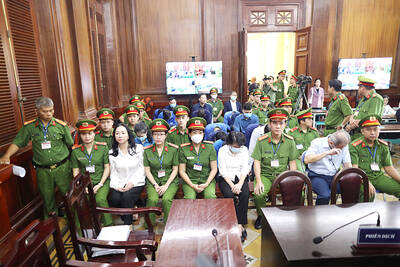
A top Vietnamese property tycoon was on Thursday sentenced to death in one of the biggest corruption cases in history, with an estimated US$27 billion in damages. A panel of three hand-picked jurors and two judges rejected all defense arguments by Truong My Lan, chair of major developer Van Thinh Phat, who was found guilty of swindling cash from Saigon Commercial Bank (SCB) over a decade. “The defendant’s actions ... eroded people’s trust in the leadership of the [Communist] Party and state,” read the verdict at the trial in Ho Chi Minh City. After the five-week trial, 85 others were also sentenced on

‘DELUSIONAL’: Targeting the families of Hamas’ leaders would not push the group to change its position or to give up its demands for Palestinians, Ismail Haniyeh said Israeli aircraft on Wednesday killed three sons of Hamas’ top political leader in the Gaza Strip, striking high-stakes targets at a time when Israel is holding delicate ceasefire negotiations with the militant group. Hamas said four of the leader’s grandchildren were also killed. Ismail Haniyeh’s sons are among the highest-profile figures to be killed in the war so far. Israel said they were Hamas operatives, and Haniyeh accused Israel of acting in “the spirit of revenge and murder.” The deaths threatened to strain the internationally mediated ceasefire talks, which appeared to gain steam in recent days even as the sides remain far
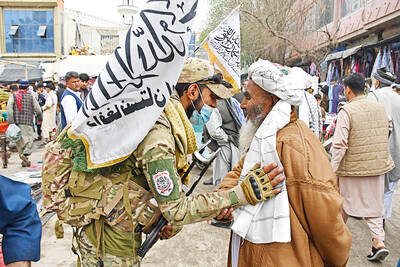
The Taliban’s reclusive supreme leader made a rare public appearance yesterday, an Afghan government spokesman said, leading thousands of worshipers in prayers marking Eid al-Fitr. Hibatullah Akhundzada has made only a handful of public appearances since inheriting the leadership of the Taliban in 2016 and leading the movement back to power with the withdrawal of US forces in 2021. Taliban government spokesman Zabihullah Mujahid said prayer in the largest mosque in Kandahar was “performed under the leadership of the supreme leader.” In a statement on X, he said the early-morning service “was attended by thousands of compatriots” in the southern province considered the


 RSS
RSS