


Russian President Vladimir Putin on Tuesday acknowledged Moscow's moral responsibility for the brutal Soviet suppression of the 1956 Hungarian uprising.
Putin was on the first day of a visit to Hungary -- only the second by a Russian leader since the collapse of the Soviet Union -- amid signs that Russia is seeking a bigger economic role in a region Moscow once dominated.
President Laszlo Solyom and an honor guard welcomed the Russian leader at the presidential residence perched high above the Danube River before closed-door meetings between Putin and Hungarian officials. Putin later joined Prime Minister Ferenc Gyurcsany and other officials at parliament.
Although energy issues were expected to dominate talks during Putin's two-day visit, the main event was to be the formal return of a trove of priceless, centuries-old books seized by the Soviet Army during World War II and taken to Russia.
Budapest has long demanded them, and Gyurcsany is playing up the event as the final "spiritual gesture" in normalizing the two countries' relations.
Yet, other divisive issues lurk below the surface, including the anniversary later this year of the 1956 uprising that was suppressed by Soviet tanks.
Speaking to reporters after nearly an hour of talks with Solyom, Putin noted that his predecessor, Boris Yeltsin, had come to Hungary in 1992 and condemned the Soviet role in crushing the revolt.
"Of course, modern Russia is not the Soviet Union, but we can still feel some sort of moral responsibility for these events," he said.
"Our task is not to forget the past and to think about the future," Putin said.
The two heads of state hailed an ongoing thaw after years of cool relations following the Soviet breakup. Hungary's prime minister said during his talks with Putin that the time had come to heal wounds from the Soviet period, and he said Hungarian policies toward Russia would be driven by "less ideology."
"With this visit, the past has come to a close," Gyurcsany said.
Budapest has moved more slowly through its post-communist reform process, compared with Poland, for example, which while stoking its economy has also angered Moscow with strident pro-Western orientation.
Hungary has, though, swiftly integrated itself into Western alliances and trade blocs, joining the U two years ago and NATO in 1999. The country also sent troops to Iraq as part of the US-led coalition there.
Putin and Gyurcsany oversaw the signing of more than a half-dozen agreements on telecommunications, migration, cultural ties and debt repayment.
They also emphasized oil and natural gas cooperation; Russian oil giant OAO Lukoil and the state-controlled gas monopoly OAO Gazprom have been eyeing Hungary's energy sector, including the country's largest gas and oil company, MOL Rt.
Hungary relies on Russia for gas -- by as much as 90 percent -- and last month, the country was rattled when a Siberian cold snap resulted in a significant drop in gas deliveries.
Putin touted Hungary's potential role as a hub for gas supplies to southern Europe, and he sought to quell criticism about Russia's reliability as Europe's largest single gas supplier.
A New Year's dispute with Ukraine -- through which most of Russia's European-bound gas travels -- resulted in shortfalls in several European countries and a round of criticism for the Kremlin.
"No one in Europe should ever have any doubts about the reliability of Russia gas to Europe. Never," Putin said.
Across from the parliament, a small group of protesters waved banners reading "Respect Human Rights." On Monday, Amnesty International and other groups published newspaper ads calling on Gyurcsany to discuss with Putin the increasing restrictions on human rights groups in Russia.
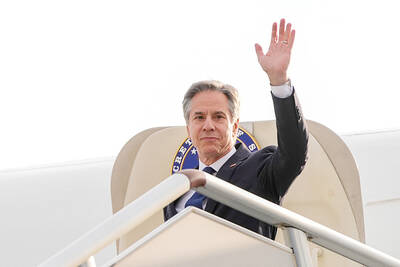
‘IN A DIFFERENT PLACE’: The envoy first visited Shanghai, where he attended a Chinese basketball playoff match, and is to meet top officials in Beijing tomorrow US Secretary of State Antony Blinken yesterday arrived in China on his second visit in a year as the US ramps up pressure on its rival over its support for Russia while also seeking to manage tensions with Beijing. The US diplomat tomorrow is to meet China’s top brass in Beijing, where he is also expected to plead for restraint as Taiwan inaugurates president-elect William Lai (賴清德), and to raise US concerns on Chinese trade practices. However, Blinken is also seeking to stabilize ties, with tensions between the world’s two largest economies easing since his previous visit in June last year. At the
Nearly half of China’s major cities are suffering “moderate to severe” levels of subsidence, putting millions of people at risk of flooding, especially as sea levels rise, according to a study of nationwide satellite data released yesterday. The authors of the paper, published by the journal Science, found that 45 percent of China’s urban land was sinking faster than 3mm per year, with 16 percent at more than 10mm per year, driven not only by declining water tables, but also the sheer weight of the built environment. With China’s urban population already in excess of 900 million people, “even a small portion

UNSETTLING IMAGES: The scene took place in front of TV crews covering the Trump trial, with a CNN anchor calling it an ‘emotional and unbelievably disturbing moment’ A man who doused himself in an accelerant and set himself on fire outside the courthouse where former US president Donald Trump is on trial has died, police said yesterday. The New York City Police Department (NYPD) said the man was declared dead by staff at an area hospital. The man was in Collect Pond Park at about 1:30pm on Friday when he took out pamphlets espousing conspiracy theories, tossed them around, then doused himself in an accelerant and set himself on fire, officials and witnesses said. A large number of police officers were nearby when it happened. Some officers and bystanders rushed

Beijing is continuing to commit genocide and crimes against humanity against Uyghurs and other Muslim minorities in its western Xinjiang province, U.S. Secretary of State Antony Blinken said in a report published on Monday, ahead of his planned visit to China this week. The State Department’s annual human rights report, which documents abuses recorded all over the world during the previous calendar year, repeated language from previous years on the treatment of Muslims in Xinjiang, but the publication raises the issue ahead of delicate talks, including on the war in Ukraine and global trade, between the top U.S. diplomat and Chinese


 RSS
RSS