


Survivors of the two atomic bombs dropped on Japan at the end of World War II are now at greater risk of developing certain thyroid diseases, including tumors and cysts, according to a study.
The risk increases the younger the survivor was at the time of exposure to the bombs' radiation.
The thyroid gland sits under the voice box and produces hormones to regulate growth and metabolism. Diseases there are a useful way for scientists to study the effects of radiation on the body. Thyroid cancers were the first solid tumors to increase in frequency among atomic bomb survivors, for example.
Misa Imaizumi, of the Radiation Effects Research Foundation, studied more than 4,000 survivors of the 1945 atomic bombs on Hiroshima and Nagasaki between 2000 and 2003 to look for thyroid problems. The Japanese researchers found thyroid diseases in almost 45 percent of the participants, with the risk of developing problems related directly to the level of exposure.
"The present study revealed that 55 to 58 years after radiation exposure, a significant linear dose-response relationship existed in the prevalence of not only malignant thyroid tumors but also benign thyroid nodules, and that the relationship was significantly higher in those exposed at younger ages," the researchers wrote in the Journal of the American Medical Association.
"On the other hand, autoimmune thyroid diseases were not found to be significantly associated with radiation exposure in this study," they wrote.
"Careful examination of the thyroid is still important long after radiation exposure, especially for people exposed at younger ages," they wrote.
John Boice, of Vanderbilt University school of medicine, said in an accompanying article: "The study of atomic bomb survivors remains the single most important study of radiation effects in humans, but the exposure was brief, lasting less than a second."
He added it was "remarkable that a biological effect from a single brief environmental exposure nearly 60 years in the past is still present and can be detected."
Survivors aged under 10 at the time of the bombs were most at risk of developing thyroid problems, but there was no significant increase in risk (beyond the radiation exposure itself) for those exposed after the age of 20.
For those who were children in 1945, the increased risk seemingly lasts for life.
"The radiosensitivity of the young thyroid gland is high and most likely relates to subsequent proliferative activity of the gland during puberty and growth, but the reasons for the absence of risk following adult exposures are not entirely clear," Boice said.
Nearly half of China’s major cities are suffering “moderate to severe” levels of subsidence, putting millions of people at risk of flooding, especially as sea levels rise, according to a study of nationwide satellite data released yesterday. The authors of the paper, published by the journal Science, found that 45 percent of China’s urban land was sinking faster than 3mm per year, with 16 percent at more than 10mm per year, driven not only by declining water tables, but also the sheer weight of the built environment. With China’s urban population already in excess of 900 million people, “even a small portion

UNSETTLING IMAGES: The scene took place in front of TV crews covering the Trump trial, with a CNN anchor calling it an ‘emotional and unbelievably disturbing moment’ A man who doused himself in an accelerant and set himself on fire outside the courthouse where former US president Donald Trump is on trial has died, police said yesterday. The New York City Police Department (NYPD) said the man was declared dead by staff at an area hospital. The man was in Collect Pond Park at about 1:30pm on Friday when he took out pamphlets espousing conspiracy theories, tossed them around, then doused himself in an accelerant and set himself on fire, officials and witnesses said. A large number of police officers were nearby when it happened. Some officers and bystanders rushed
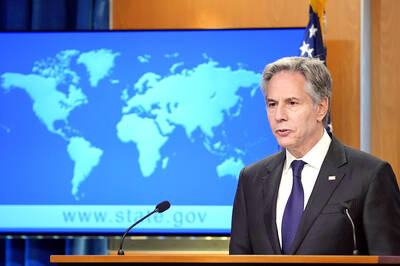
Beijing is continuing to commit genocide and crimes against humanity against Uyghurs and other Muslim minorities in its western Xinjiang province, U.S. Secretary of State Antony Blinken said in a report published on Monday, ahead of his planned visit to China this week. The State Department’s annual human rights report, which documents abuses recorded all over the world during the previous calendar year, repeated language from previous years on the treatment of Muslims in Xinjiang, but the publication raises the issue ahead of delicate talks, including on the war in Ukraine and global trade, between the top U.S. diplomat and Chinese

‘IN A DIFFERENT PLACE’: The envoy first visited Shanghai, where he attended a Chinese basketball playoff match, and is to meet top officials in Beijing tomorrow US Secretary of State Antony Blinken yesterday arrived in China on his second visit in a year as the US ramps up pressure on its rival over its support for Russia while also seeking to manage tensions with Beijing. The US diplomat tomorrow is to meet China’s top brass in Beijing, where he is also expected to plead for restraint as Taiwan inaugurates president-elect William Lai (賴清德), and to raise US concerns on Chinese trade practices. However, Blinken is also seeking to stabilize ties, with tensions between the world’s two largest economies easing since his previous visit in June last year. At the


 RSS
RSS