


The Israeli Cabinet overwhelmingly approved the imposition of a range of sanctions against the Palestinian Authority yesterday following the formation of a government led by Hamas, public radio reported.
The sanctions will see Israel halt the payment of customs duties it collects on behalf of the Palestinian Authority, worth around US$50 million a month, as well as prevent residents of the West Bank and Gaza Strip from crossing into Israel for work.
Israel collects and transfers tens of millions of dollars in tax money for the Palestinians each month. The money is essential for the Palestinian Authority [PA] to meet its monthly payroll for about 140,000 workers.
Withhold aid
The ministers also urged the international community to withhold most aid to the Palestinian Authority, although it said humanitarian assistance should continue. But they stopped short of more drastic measures, including sealing off the Gaza Strip, favored by security officials.
Acting Prime Minister Ehud Olmert put forward the range of sanctions for approval before the Cabinet after declaring that a government led by Hamas, the landslide winners of a Jan. 25 general election, would be regarded as a terrorist regime.
The new Hamas-dominated parliament was sworn in on Saturday while Palestinian Authority President Mahmud Abbas is due to hold talks in Gaza later in the day to ask Hamas to form a new government.
"It is clear that in light of the Hamas majority in the PLC [parliament] and the instructions to form a new government that were given to the head of Hamas, the PA is, in practice, becoming a terrorist authority. The state of Israel will not agree to this," Olmert said at the Cabinet.
"As we stated immediately after the PA elections, upon the conclusion of the transitional government, Israel will immediately cease the transfer of funds to the PA."
Meanwhile, Ismail Haniyeh, a prominent Hamas leader in the Gaza Strip, was nominated to be Palestinian prime minister.
The militant group announced the nomination in a text message, a day after its members were sworn into the new Hamas-dominated Palestinian parliament. The nomination was widely expected.
Haniyeh, 46, is seen as a leader of the more pragmatic wing of Hamas.
Abbas was expected later yesterday to formally charge Haniyeh with the task of putting together a new Cabinet. Haniyeh would then have three weeks to submit a government to Abbas for approval.
Peace accords
Addressing the parliament on Saturday, Abbas said he expected Hamas to honor existing peace accords with Israel and halt violence. Hamas leaders rejected those calls, but signaled a willingness to compromise.
Born in Gaza's Shati refugee camp, Haniyeh graduated from Islamic University in 1987 with a degree in Arabic literature and became a close associate of Hamas founder Sheik Ahmed Yassin.
Haniyeh was expelled by Israel to south Lebanon in 1992, returned to Gaza a year later and became the dean of the Islamic University. In 1998, he took charge of Yassin's office.
A pragmatist, he served as a liaison between Hamas and Palestinian Authority, established in 1994 and dominated by the rival Fatah movement.
He rose to prominence after Israel's assassinations in 2004 of Yassin and Yassin's successor, Abdel Aziz Rantisi. He has been a member of the political leadership of Hamas since the 1990s.
Nearly half of China’s major cities are suffering “moderate to severe” levels of subsidence, putting millions of people at risk of flooding, especially as sea levels rise, according to a study of nationwide satellite data released yesterday. The authors of the paper, published by the journal Science, found that 45 percent of China’s urban land was sinking faster than 3mm per year, with 16 percent at more than 10mm per year, driven not only by declining water tables, but also the sheer weight of the built environment. With China’s urban population already in excess of 900 million people, “even a small portion

UNSETTLING IMAGES: The scene took place in front of TV crews covering the Trump trial, with a CNN anchor calling it an ‘emotional and unbelievably disturbing moment’ A man who doused himself in an accelerant and set himself on fire outside the courthouse where former US president Donald Trump is on trial has died, police said yesterday. The New York City Police Department (NYPD) said the man was declared dead by staff at an area hospital. The man was in Collect Pond Park at about 1:30pm on Friday when he took out pamphlets espousing conspiracy theories, tossed them around, then doused himself in an accelerant and set himself on fire, officials and witnesses said. A large number of police officers were nearby when it happened. Some officers and bystanders rushed
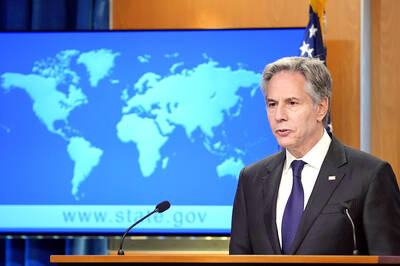
Beijing is continuing to commit genocide and crimes against humanity against Uyghurs and other Muslim minorities in its western Xinjiang province, U.S. Secretary of State Antony Blinken said in a report published on Monday, ahead of his planned visit to China this week. The State Department’s annual human rights report, which documents abuses recorded all over the world during the previous calendar year, repeated language from previous years on the treatment of Muslims in Xinjiang, but the publication raises the issue ahead of delicate talks, including on the war in Ukraine and global trade, between the top U.S. diplomat and Chinese

HYPOCRISY? The Chinese Ministry of Foreign Affairs yesterday asked whether Biden was talking about China or the US when he used the word ‘xenophobic’ US President Joe Biden on Wednesday called for a hike in steel tariffs on China, accusing Beijing of cheating as he spoke at a campaign event in Pennsylvania. Biden accused China of xenophobia, too, in a speech to union members in Pittsburgh. “They’re not competing, they’re cheating. They’re cheating and we’ve seen the damage here in America,” Biden said. Chinese steel companies “don’t need to worry about making a profit because the Chinese government is subsidizing them so heavily,” he said. Biden said he had called for the US Trade Representative to triple the tariff rates for Chinese steel and aluminum if Beijing was


 RSS
RSS