


Sitting astride his horse in a warlike pose, the bronze Genghis Khan in the middle of the Inner Mongolia University campus emits a clear signal.
This is a national hero, a Chinese hero. This is not the mass murderer vilified by generations of Western historians, but the brave founder of the biggest land empire ever.
"Many of us are proud of Genghis Khan," said Wang Youde, a student of forestry science, strolling around the statue.
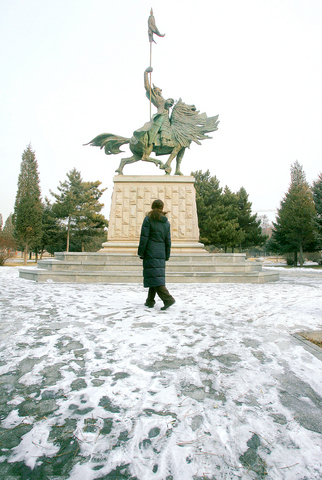
PHOTO: AFP
"It's no small feat to conquer the entire known world all the way to the Danube from horseback," he said.
The 800th anniversary of the founding of Genghis Khan's empire in 1206 will be celebrated this year not just in Mongolia proper but also in Inner Mongolia, historically part of the same culture but now under China's firm control.
Although the great Khan has been dead for nearly eight centuries, his memory is alive and he remains an important political factor in this part of the world.
The Chinese Communist government is attempting to co-opt him as a great historical figure transcending ethnic barriers.
"He's become part of the Chinese pantheon of generals and great cultural figures," said Flemming Christiansen, an expert on Chinese politics at Leeds University.
It has been the same story whenever new rulers have taken over in what is now Inner Mongolia, whether Chinese Republicans in the early 20th century, or Japanese imperialists before and during World War II.
All were convinced, probably rightly, that they were better off with Genghis Khan as their ally and tried to harness him for their political purposes.
The Mongolians themselves, now a small minority accounting for about 20 percent of the total population in their own region, are not impressed.
heroic symbol
"For the Mongolians, Genghis Khan is a symbol. It's because of him that the Mongolian people exists," said Tengus Bayaryn, an anthropologist at the university.
"The official Chinese view is that Genghis Khan was a Chinese emperor, but Mongolians think he was a Mongolian ruler and had nothing much to do with China," he said.
In Inner Mongolia today, Genghis Khan is a ubiquitous, Che Guevara-style icon, but local affection runs much deeper than that, and an entire religious cult is built around the great founding father.
In officially atheist China, many Mongolian families worship him as a demi-god, setting up regular shrines to him at home.
However, signs are emerging that Genghis Khan's status is declining among younger generations, according to Christopher Atwood, an expert on Inner Mongolia at Indiana University.
"I wouldn't say that Genghis Khan is passe, but my sense is that especially young Mongolians have limited interest in Genghis Khan, because he's been taken over by the Chinese," he said.
A parallel in the west would be the fading allure of Martin Luther King, Jr to black Americans once he was embraced by white American liberals, he said.
Desperate for other role models, young Mongolians now prefer to celebrate the likes of Gada Meiren, a rebel leader of the early 20th century, especially in their songs.
Gada Meiren is tolerated by the Chinese government, but only because he can be conveniently depicted as a rebel against feudal oppression, not against the Chinese or the communists.
In between youthful indifference and government attempts to usurp Genghis Khan, modern Mongolian scholars are left to try and figure out what the legacy of the great warrior actually is.
literate
For Bayaryn, it is important to salvage Genghis Khan from his reputation as just a fierce, hardly civilized warrior chieftain.
Bayaryn has uncovered documents which he claims are evidence that the Khan was actually literate -- even if the Mongolian writing system was only invented when he was at a mature age.
Given the straightforward, phonetic Mongolian writing that existed at the time, it would not have been too difficult, he argued.
"It would have taken an average adult two months to learn written Mongolian, while a relatively intelligent person would be able to do it in one month. And Genghis Khan was intelligent," he said.
"If it's accepted that he was indeed literate, it will change our perception of him as simply an uncivilized mass murderer," he said.
Even if he could not read and write, the Khan was much more than a military man, according to Baladugqi, an ethnic Mongolian and a professor at the Inner Mongolia Modern History Research Institute.
open-minded
"Only under Genghis Khan and his successors was the Silk Road under one political authority. You could transport a product all the way from Beijing to Moscow and sell it there," he said.
"Political, economic, social, cultural and religious exchanges thrived on a scale never seen before," he said.
For Baladugqi, it is an undeniable fact that Genghis Khan founded his empire on raw power, but if his skills had been only military he would never have been able to create a world empire.
"Genghis Khan was open-minded and not at all conservative. He adjusted his rule to local conditions," Baladugqi said.
"Mongolians have a very open mind, and it could be because they are used to the wide-open steppes," he said.
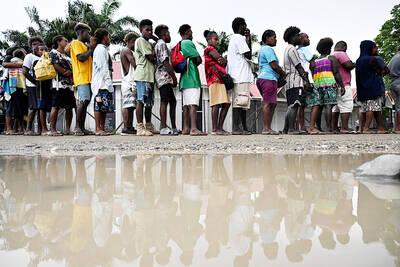
SEEKING CHANGE: A hospital worker said she did not vote in previous elections, but ‘now I can see that maybe my vote can change the system and the country’ Voting closed yesterday across the Solomon Islands in the south Pacific nation’s first general election since the government switched diplomatic allegiance from Taiwan to Beijing and struck a secret security pact that has raised fears of the Chinese navy gaining a foothold in the region. The Solomon Islands’ closer relationship with China and a troubled domestic economy weighed on voters’ minds as they cast their ballots. As many as 420,000 registered voters had their say across 50 national seats. For the first time, the national vote also coincided with elections for eight of the 10 local governments. Esther Maeluma cast her vote in the
Nearly half of China’s major cities are suffering “moderate to severe” levels of subsidence, putting millions of people at risk of flooding, especially as sea levels rise, according to a study of nationwide satellite data released yesterday. The authors of the paper, published by the journal Science, found that 45 percent of China’s urban land was sinking faster than 3mm per year, with 16 percent at more than 10mm per year, driven not only by declining water tables, but also the sheer weight of the built environment. With China’s urban population already in excess of 900 million people, “even a small portion

UNSETTLING IMAGES: The scene took place in front of TV crews covering the Trump trial, with a CNN anchor calling it an ‘emotional and unbelievably disturbing moment’ A man who doused himself in an accelerant and set himself on fire outside the courthouse where former US president Donald Trump is on trial has died, police said yesterday. The New York City Police Department (NYPD) said the man was declared dead by staff at an area hospital. The man was in Collect Pond Park at about 1:30pm on Friday when he took out pamphlets espousing conspiracy theories, tossed them around, then doused himself in an accelerant and set himself on fire, officials and witnesses said. A large number of police officers were nearby when it happened. Some officers and bystanders rushed

HYPOCRISY? The Chinese Ministry of Foreign Affairs yesterday asked whether Biden was talking about China or the US when he used the word ‘xenophobic’ US President Joe Biden on Wednesday called for a hike in steel tariffs on China, accusing Beijing of cheating as he spoke at a campaign event in Pennsylvania. Biden accused China of xenophobia, too, in a speech to union members in Pittsburgh. “They’re not competing, they’re cheating. They’re cheating and we’ve seen the damage here in America,” Biden said. Chinese steel companies “don’t need to worry about making a profit because the Chinese government is subsidizing them so heavily,” he said. Biden said he had called for the US Trade Representative to triple the tariff rates for Chinese steel and aluminum if Beijing was


 RSS
RSS