


Fossil hunters in China say they have found the earliest known forerunner of the Tyrannosaurus rex, the mighty flesh-ripping dinosaur beloved of children and Hollywood.
Uncovered in Wucaiwan in the western province of Xinjiang, the species has been dubbed Guanlong wucaii -- "crowned dragon of the five-colored rocks," a reference to the tint of the earth in which it was found.
It hails from the Late Jurassic period, around 161 million to 156 million years ago, according to the discoverers, led by Xu Xing (徐星) of the Institute of Vertebrate Paleontology and Paleoanthropology in Beijing.
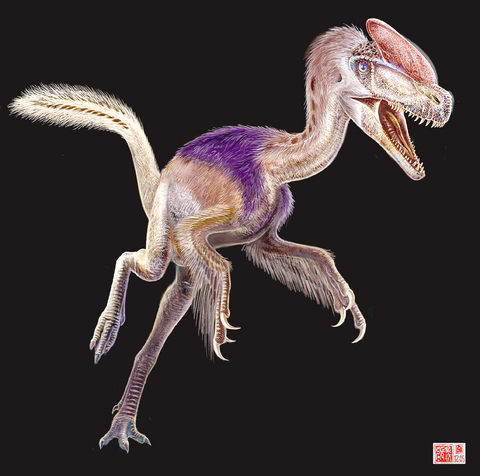
PHOTO: AFP
By comparison, the T. rex lived much later, in the Late Cretaceous era, enjoying a 20-million-year reign of terror that ended with the extinction of the dinosaurs some 65 million years ago.
Nose to tail, T. rex measured up to 13m in length, whereas the best preserved of the two fossils unearthed in Wucaiwan suggest a creature that was about 3m long.
Despite these differences, the "crowned dragon" shows all the key ancestral hallmarks of the tyrannosaurids.
It shares their enlarged skull, two powerful rear feet, stubby forelimbs -- and long, blade-like teeth that suggests it, too, was a predator to be reckoned with.
The beast sported relatively long, three-fingered arms, rather than the two-fingered stubby arms T. rex had.
Scientists suspect it had feathers because related dinosaurs did.
But the "primitive" look of the pelvis also suggests something else, Xu said.
It supports a theory, first put forward in the 1990s, that the tyrannosaurids, despite their great size, evolved from a species of swift, small-bodied dinosaurs called "coelurosaurs."
The big surprise, said study co-author James Clark of George Washington University in Washington, was the narrow, delicate, largely hollow crest on its head. While other dinosaurs had similar features, this one was unusually large and elaborate for a two-legged meat-eater, Clark and co-authors wrote.
Nobody knows its purpose, but it was probably some kind of display to other members of its own species, said Clark, co-leader of 2002 expedition that found the beast.
This crest is "surprising," given that it would have surely hampered the beast in its hunt for food, the authors say.
They speculate that it was an ornament that may have been used to lure a mate or show off status. Many vertebrate species today use these tools, such as peacocks with their tails and elks with their antlers, even if the device carries a cost in movement.
Because it preserves anatomical features from its ancestors that were lost in T. rex and other tyrannosaurs, the primitive beast helps scientists understand where tyrannosaurs fit in the evolutionary tree, said an expert not involved in the discovery.
"This is the best look so far at the ancestral condition from which the tyrant dinosaurs, T. rex and company, evolved," said the expert, Thomas Holtz Jr. of the University of Maryland.
Along with some other finds, the creature helps illustrate the sequence of anatomical changes that occurred along the way to the later, more specialized tyrannosaurs, said Philip Currie of the University of Alberta in Canada.
Ken Carpenter, curator of lower vertebrate paleontology at the Denver Museum of Nature and Science, said he tentatively accepted the creature as a tyrannosaur but was not convinced of its age. It could be much younger, he said. Clark said that other data, not yet published, supported the proposed age of 160 million years.
Xu has earned a reputation for being the world's most successful fossil finder, unearthing extraordinary specimens that have shed light in particular on birds, spurring the theory that modern birds are the descendants of dinosaurs.
The study is published today in Nature, the British weekly science journal.
SEEKING CHANGE: A hospital worker said she did not vote in previous elections, but ‘now I can see that maybe my vote can change the system and the country’ Voting closed yesterday across the Solomon Islands in the south Pacific nation’s first general election since the government switched diplomatic allegiance from Taiwan to Beijing and struck a secret security pact that has raised fears of the Chinese navy gaining a foothold in the region. The Solomon Islands’ closer relationship with China and a troubled domestic economy weighed on voters’ minds as they cast their ballots. As many as 420,000 registered voters had their say across 50 national seats. For the first time, the national vote also coincided with elections for eight of the 10 local governments. Esther Maeluma cast her vote in the
Nearly half of China’s major cities are suffering “moderate to severe” levels of subsidence, putting millions of people at risk of flooding, especially as sea levels rise, according to a study of nationwide satellite data released yesterday. The authors of the paper, published by the journal Science, found that 45 percent of China’s urban land was sinking faster than 3mm per year, with 16 percent at more than 10mm per year, driven not only by declining water tables, but also the sheer weight of the built environment. With China’s urban population already in excess of 900 million people, “even a small portion

UNSETTLING IMAGES: The scene took place in front of TV crews covering the Trump trial, with a CNN anchor calling it an ‘emotional and unbelievably disturbing moment’ A man who doused himself in an accelerant and set himself on fire outside the courthouse where former US president Donald Trump is on trial has died, police said yesterday. The New York City Police Department (NYPD) said the man was declared dead by staff at an area hospital. The man was in Collect Pond Park at about 1:30pm on Friday when he took out pamphlets espousing conspiracy theories, tossed them around, then doused himself in an accelerant and set himself on fire, officials and witnesses said. A large number of police officers were nearby when it happened. Some officers and bystanders rushed

HYPOCRISY? The Chinese Ministry of Foreign Affairs yesterday asked whether Biden was talking about China or the US when he used the word ‘xenophobic’ US President Joe Biden on Wednesday called for a hike in steel tariffs on China, accusing Beijing of cheating as he spoke at a campaign event in Pennsylvania. Biden accused China of xenophobia, too, in a speech to union members in Pittsburgh. “They’re not competing, they’re cheating. They’re cheating and we’ve seen the damage here in America,” Biden said. Chinese steel companies “don’t need to worry about making a profit because the Chinese government is subsidizing them so heavily,” he said. Biden said he had called for the US Trade Representative to triple the tariff rates for Chinese steel and aluminum if Beijing was


 RSS
RSS