


Costa Rica's presidential election was surprisingly close early yesterday as a staunch critic of the country's free-trade pact with the US pulled nearly even with the candidate largely expected to win, Nobel Peace laureate Oscar Arias.
Arias was facing a surprisingly strong challenge from Otton Solis of the Citizens' Action Party. Solis contends the Central American Free Trade Agreement would hurt Costa Rican farmers and should be renegotiated.
Arias, of the center-right National Liberation Party, had 40.7 percent support compared to 40 percent for Solis, with 75 percent of the votes counted.
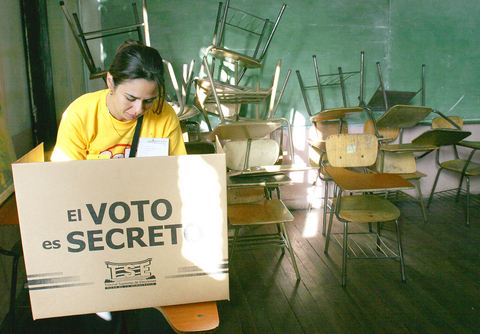
PHOTO: AP
Pre-election polls predicted that Solis would receive less than a quarter of the vote.
The winner will need at least 40 percent of the votes to win outright and avoid a second round of voting in April.
Under Costa Rican law, President Abel Pacheco of the Social Christian Unity Party cannot seek immediate re-election. But the Constitutional Court ruled in 2003 that former presidents could run again after leaving office and sitting out at least one four-year term -- allowing Arias to run.
Analysts said the surprising results could be because of the large number of undecided voters. A poll published last week showed 20 percent of voters had not made up their minds three days before the election.
"The polls never told the truth," Solis told reporters. "We said it many times."
Solis asked his supporters, who were gathering at his party's headquarters, to stay calm and wait for complete results.
Twelve other candidates were also vying for the presidency in an election that officials said had a 66 percent turnout -- the lowest in Costa Rican history.
Arias' supporters who had gathered at a hotel in the capital, San Jose, stopped dancing to salsa music after screens showed their candidate was closely followed by Solis. Arias had yet to address his supporters.
Arias won the 1987 Nobel Peace Prize for working to end Central America's civil wars while serving as president from 1986-1990.
The scion of a wealthy coffee farming family, Arias has pushed for Costa Rica to join the Central American Free Trade Agreement with the US, arguing it would help revitalize the country's stagnant economy.
Nicaragua, Guatemala, Honduras, El Salvador and the Dominican Republic have already agreed to join the pact. Costa Rica is the only country that hasn't signed on, a topic that dominated the election campaign.
Solis, a 51-year-old economist, says the free-trade pact should be renegotiated because it would exacerbate poverty and drive under small-scale farmers.
He also proposes subsidies for farmers and small businesses.
Solis lost the presidential election four years ago and served as minister of planning during Arias' first administration.
After splitting from the National Liberation Party he created Citizens' Action in 2001, a party that he says "puts people before foreign corporations."
He has the support of some leftists, but Solis stops short of declaring an ideological position and instead says his party is an oppositional force to the two parties that have ruled Costa Rica for almost 50 years.
Costa Ricans traditionally have treated presidential elections as a national holiday, and the country has had Central America's highest voter turnout.
In past electoral campaigns it was common to see people wearing party colors and driving in caravans waving flags the night before the election.
Nearly half of China’s major cities are suffering “moderate to severe” levels of subsidence, putting millions of people at risk of flooding, especially as sea levels rise, according to a study of nationwide satellite data released yesterday. The authors of the paper, published by the journal Science, found that 45 percent of China’s urban land was sinking faster than 3mm per year, with 16 percent at more than 10mm per year, driven not only by declining water tables, but also the sheer weight of the built environment. With China’s urban population already in excess of 900 million people, “even a small portion

UNSETTLING IMAGES: The scene took place in front of TV crews covering the Trump trial, with a CNN anchor calling it an ‘emotional and unbelievably disturbing moment’ A man who doused himself in an accelerant and set himself on fire outside the courthouse where former US president Donald Trump is on trial has died, police said yesterday. The New York City Police Department (NYPD) said the man was declared dead by staff at an area hospital. The man was in Collect Pond Park at about 1:30pm on Friday when he took out pamphlets espousing conspiracy theories, tossed them around, then doused himself in an accelerant and set himself on fire, officials and witnesses said. A large number of police officers were nearby when it happened. Some officers and bystanders rushed

Beijing is continuing to commit genocide and crimes against humanity against Uyghurs and other Muslim minorities in its western Xinjiang province, U.S. Secretary of State Antony Blinken said in a report published on Monday, ahead of his planned visit to China this week. The State Department’s annual human rights report, which documents abuses recorded all over the world during the previous calendar year, repeated language from previous years on the treatment of Muslims in Xinjiang, but the publication raises the issue ahead of delicate talks, including on the war in Ukraine and global trade, between the top U.S. diplomat and Chinese

HYPOCRISY? The Chinese Ministry of Foreign Affairs yesterday asked whether Biden was talking about China or the US when he used the word ‘xenophobic’ US President Joe Biden on Wednesday called for a hike in steel tariffs on China, accusing Beijing of cheating as he spoke at a campaign event in Pennsylvania. Biden accused China of xenophobia, too, in a speech to union members in Pittsburgh. “They’re not competing, they’re cheating. They’re cheating and we’ve seen the damage here in America,” Biden said. Chinese steel companies “don’t need to worry about making a profit because the Chinese government is subsidizing them so heavily,” he said. Biden said he had called for the US Trade Representative to triple the tariff rates for Chinese steel and aluminum if Beijing was


 RSS
RSS