


The West Bank city of Ramallah, Fatah's political headquarters, went to sleep on Wednesday night to the sound of celebratory gunfire as the party's young supporters drove through the streets cheering exit polls which suggested victory.
By Thursday morning the euphoria had turned to shock as Palestinians tried to assess the effects of Hamas' victory.
What happens now, was the most frequently asked question in the most secular of Palestinian cities. Not many people had answers, but several joked about having a last alcoholic drink before it is banned by the Islamic movement that won four out of five seats in the city, formerly a Fatah stronghold.
Bassem Khoury, a Christian restaurant owner, said he feared Christians would be persecuted and that corruption among Fatah politicians would be replaced by corruption by Hamas.
"I can't see any problems with Hamas in the first year or six months. But once they get comfortable in their positions they may promote social change and my wife will be forced to wear headscarves and an abaya," said Khoury.
"If they declare that secular law has priority over Islamic law I will relax, but if they elevate Islamic law, I will pack my bags. It is not only Christians that are scared. Moderate Muslims who live a modern life are also fearful," he said.
According to Khoury, the son of a Hamas leader dined at his restaurant this week. He did not drink, but sat by racks of wine.
"He told me that we had nothing to worry about because Hamas would respect individual liberties, but I know that has not been the case in Gaza," said Khoury.
Nearby, Mahmoud Muhammad, 28, waited outside a mosque for the start of a Hamas victory parade. Unlike Fatah supporters, who celebrate with guns, Hamas supporters carried only their green flags.
"I am astonished by our victory. Things can only get better for the Palestinian people. I want Hamas to form a government and I don't want there to be any partnership with Fatah," he said.
"We have clean hands so all the money we receive will go directly to the people and not the pockets of the corrupt. Not everyone regards us as terrorists and we have our ways of raising money," he said.
Muhammad joined the crowds marching through Ramallah to the parliament building where Hamas now has a majority.
Supporters climbed the walls of the building and replaced Palestinian flags with the green flag of Hamas.
Two Fatah supporters then climbed the building and threw the flags into the crowd, who replied by throwing stones which hit them and smashed windows.
Police arrived as the Hamas supporters drifted away to mosques, answering the call to prayer.
A furious police chief ordered the Palestinian flag to be raised again and screamed over a loudspeaker: "No one takes down the Palestinian flag."
It was the first confrontation between Hamas and Fatah since the election but many fear it will not be the last.
Hishab Abu Ghosh, a member of the Democratic Front for the Liberation of Palestine, a leftist group which won four seats, said he was concerned about Hamas' ability to turn their emotional appeal into practical policies.
"Now they will have to deal with creating paradise on the earth not just in the heavens. They have no real political programme. What will they say to the World Bank? What will they say to the United Nations?" he said.
Hamas: The facts
What is Hamas?
In Arabic it means "zeal", but it also stands for Harakat al-Muqawamah al-Islamiyyah, or Islamic Resistance Movement. It began as an offshoot of Egypt's Muslim Brotherhood in the 1970s. The movement's goal is to establish an Islamic theocracy in Israel, the West Bank and Gaza Strip. Hamas is committed to the destruction of the state of Israel, which it does not recognize.
How does it operate?
Hamas has built a strong grassroots base through preaching and its network of health, education and welfare services throughout Gaza and the West Bank. It preaches armed resistance against Israel and has carried out dozens of suicide bombings and other attacks against Israeli targets, killing hundreds.
How is it funded?
Its community services are financed by Arab agencies and Islamic charities. Israel claims funding for its military wing comes from Iran, Syria and Palestinians living abroad.
Who are its leaders?
Ismail Haniya, 45, heads the Hamas national list of candidates. He teaches at the Islamic University in Gaza City and owes his prominence in the movement to his previous close relationship to the assassinated former leader Sheik Yassin.
Mahmoud Zahar, 51, is also believed to be a leader of Hamas, although he only appeared at number six in their national list of candidates. Israel bombed his home in Gaza City in 2003, killing his son and injuring him and his wife. Zahar is a surgeon and teaches medicine at the Islamic University.
Mohamed Deif, believed to be in his 40s, has not been seen in public for years but as head of the Hamas military wing, the Izz al-Din Qassam Brigades, he is possibly the most influential Hamas leader. It is rumored that he is partially blinded and crippled from an Israeli assassination attempt in 2003.
Khaled Mashaal, who is based in Damascus, is also seen as an important figure in Hamas despite his absence from the West Bank and Gaza. He survived an Israeli assassination attempt in Jordan in 1997.
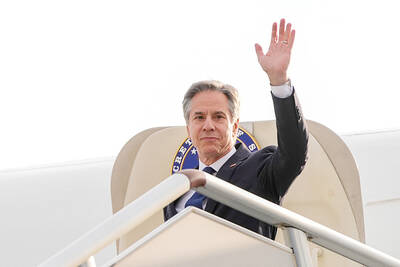
‘IN A DIFFERENT PLACE’: The envoy first visited Shanghai, where he attended a Chinese basketball playoff match, and is to meet top officials in Beijing tomorrow US Secretary of State Antony Blinken yesterday arrived in China on his second visit in a year as the US ramps up pressure on its rival over its support for Russia while also seeking to manage tensions with Beijing. The US diplomat tomorrow is to meet China’s top brass in Beijing, where he is also expected to plead for restraint as Taiwan inaugurates president-elect William Lai (賴清德), and to raise US concerns on Chinese trade practices. However, Blinken is also seeking to stabilize ties, with tensions between the world’s two largest economies easing since his previous visit in June last year. At the
Nearly half of China’s major cities are suffering “moderate to severe” levels of subsidence, putting millions of people at risk of flooding, especially as sea levels rise, according to a study of nationwide satellite data released yesterday. The authors of the paper, published by the journal Science, found that 45 percent of China’s urban land was sinking faster than 3mm per year, with 16 percent at more than 10mm per year, driven not only by declining water tables, but also the sheer weight of the built environment. With China’s urban population already in excess of 900 million people, “even a small portion

UNSETTLING IMAGES: The scene took place in front of TV crews covering the Trump trial, with a CNN anchor calling it an ‘emotional and unbelievably disturbing moment’ A man who doused himself in an accelerant and set himself on fire outside the courthouse where former US president Donald Trump is on trial has died, police said yesterday. The New York City Police Department (NYPD) said the man was declared dead by staff at an area hospital. The man was in Collect Pond Park at about 1:30pm on Friday when he took out pamphlets espousing conspiracy theories, tossed them around, then doused himself in an accelerant and set himself on fire, officials and witnesses said. A large number of police officers were nearby when it happened. Some officers and bystanders rushed

Beijing is continuing to commit genocide and crimes against humanity against Uyghurs and other Muslim minorities in its western Xinjiang province, U.S. Secretary of State Antony Blinken said in a report published on Monday, ahead of his planned visit to China this week. The State Department’s annual human rights report, which documents abuses recorded all over the world during the previous calendar year, repeated language from previous years on the treatment of Muslims in Xinjiang, but the publication raises the issue ahead of delicate talks, including on the war in Ukraine and global trade, between the top U.S. diplomat and Chinese


 RSS
RSS