


Over the past year Myanmar's generals have shown little inclination to hasten political reform and free detained opposition leader Aung San Suu Kyi amid increased international pressure, even from ASEAN.
"Political change in Burma is so slow it's like glue going up a hill," the Australian Prime Minister John Howard recently remarked.
But there are significant changes developing behind the junta's apparent inflexibility.
Myanmar's military junta has begun to prepare for a major transfer of power from the current top generals to the next generation of military leaders, while moving the seat of government into the hills some 400km north of Yangon.
The massive shake-up in the army and government is expected to include the country's top military ruler General Than Shwe standing down.
The planned changes are intended to prepare the army for the next phase in the country's move towards political reform and the introduction of a civilian administration, after the National Convention, which reconvened early this month, finishes drawing up the principles of the new constitution.
The country's top general, Than Shwe, is reportedly planning to give up at least one of the three key posts he holds -- chairman of the junta, supreme commander of the army and defense minister.
There are increasing doubts about Than Shwe's health, which may have prompted the senior general to take a back seat for the time being.
"Even if Than Shwe officially retires he will not give up his power. Instead he'll remain the grey eminence behind the throne, along the line of the Chinese leader Deng Xiaoping (
General Thura Shwe Mann is tipped to replace General Maung Aye as the army's commander-in-chief, according to many diplomats in Yangon.
"This is the new generation of military leaders who are being readied to take over power," according to a senior Indian diplomat who deals with Yangon. But, he warns, this group of generals lack the manners and intelligence of their superiors.
"These men are uncouth, uneducated and only know how to bark orders," the Indian diplomat said.
In the meantime, the regime insists it's following its roadmap to democracy, announced by the former prime minister Khin Nyunt in August 2003. The first phase piggybacks on the National Convention -- which has been meeting intermittently for more than a decade, drawing up the guidelines for the new constitution.
"The National Convention will have drawn up a new constitution in the near future and it will be put to a referendum sometime in 2006," said a senior Chinese diplomat. New elections are likely before the end of the following year, sources say.
Most analysts and diplomats in Yangon believe the pro-democracy parties -- especially the National League for Democracy (NLD), led by Suu Kyi, and the Shan Nationalities League for Democracy (SNLD) which won almost all the seats in the 1990 elections -- would not be allowed to contest the elections.
"The Chinese have been advising the junta to adopt Pakistan's General Musharaff's political model," according to a senior Asian diplomat in Yangon. "This would mean the main political parties would be banned from the election because they would threaten the country's stability."
Myanmar's military leaders are apprehensive about any change for fear that it may loosen their grip on power. As part of their grand strategy to centralize the government the junta decided to abandon Yangon, the capital since 1948, for Pyinmana. A 100km square complex is being built and even though it is far from complete, thousands of civil servants have been forced to move there since the beginning of last month.
"The main reason to move the capital is to avoid the situation that took place in 1988," said a political activist in Yangon, U Win Naing, referring to the months of mass demonstrations that brought an end to the former regime of Ne Win and led to the military coup that brought this group of generals to power.
In the meantime, Suu Kyi, who recently had her house arrest extended for a further six months, seems certain to remain in detention for the foreseeable future.
"She is unlikely to be released before the referendum on the new constitution takes place, and is more likely to remain locked up until after any future elections," said a Western diplomat in Yangon who is closely associated with the national reconciliation process.
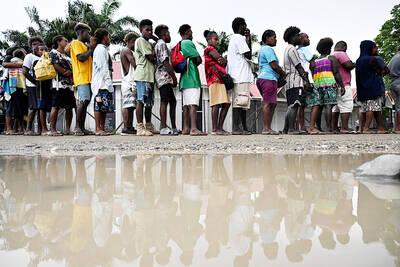
SEEKING CHANGE: A hospital worker said she did not vote in previous elections, but ‘now I can see that maybe my vote can change the system and the country’ Voting closed yesterday across the Solomon Islands in the south Pacific nation’s first general election since the government switched diplomatic allegiance from Taiwan to Beijing and struck a secret security pact that has raised fears of the Chinese navy gaining a foothold in the region. The Solomon Islands’ closer relationship with China and a troubled domestic economy weighed on voters’ minds as they cast their ballots. As many as 420,000 registered voters had their say across 50 national seats. For the first time, the national vote also coincided with elections for eight of the 10 local governments. Esther Maeluma cast her vote in the
Nearly half of China’s major cities are suffering “moderate to severe” levels of subsidence, putting millions of people at risk of flooding, especially as sea levels rise, according to a study of nationwide satellite data released yesterday. The authors of the paper, published by the journal Science, found that 45 percent of China’s urban land was sinking faster than 3mm per year, with 16 percent at more than 10mm per year, driven not only by declining water tables, but also the sheer weight of the built environment. With China’s urban population already in excess of 900 million people, “even a small portion

UNSETTLING IMAGES: The scene took place in front of TV crews covering the Trump trial, with a CNN anchor calling it an ‘emotional and unbelievably disturbing moment’ A man who doused himself in an accelerant and set himself on fire outside the courthouse where former US president Donald Trump is on trial has died, police said yesterday. The New York City Police Department (NYPD) said the man was declared dead by staff at an area hospital. The man was in Collect Pond Park at about 1:30pm on Friday when he took out pamphlets espousing conspiracy theories, tossed them around, then doused himself in an accelerant and set himself on fire, officials and witnesses said. A large number of police officers were nearby when it happened. Some officers and bystanders rushed

HYPOCRISY? The Chinese Ministry of Foreign Affairs yesterday asked whether Biden was talking about China or the US when he used the word ‘xenophobic’ US President Joe Biden on Wednesday called for a hike in steel tariffs on China, accusing Beijing of cheating as he spoke at a campaign event in Pennsylvania. Biden accused China of xenophobia, too, in a speech to union members in Pittsburgh. “They’re not competing, they’re cheating. They’re cheating and we’ve seen the damage here in America,” Biden said. Chinese steel companies “don’t need to worry about making a profit because the Chinese government is subsidizing them so heavily,” he said. Biden said he had called for the US Trade Representative to triple the tariff rates for Chinese steel and aluminum if Beijing was


 RSS
RSS