


Evo Morales, a seasoned protest leader and hero to Bolivia's majority Quechua and Aymara communities, is front-runner to become the impoverished country's first indigenous president.
Morales, 46, is ahead in the polls as Bolivians prepare to vote in today's presidential and congressional elections. But unless he attracts half of the vote it will be up to Congress to select Bolivia's next president.
If elected Morales, better known simply as Evo, has vowed to nationalize the country's oil and gas industry to distribute wealth in South America's poorest country.
He also supports the free cultivation of coca -- the source plant for cocaine -- opposes the "imperialist" policies of the US, and openly admires Cuban president Fidel Castro and leftist Venezuelan President Hugo Chavez.
Morales, who wears sneakers and is never seen in a coat or tie, says his country needs of drastic change.
"For a handful of people there is money, for the others, repression," he has often said.
The son of both Aymara and Quechua indigenous parents who grew up in poverty and dropped out of high school, Morales was born in Oct. 29, 1959 in the mining region of Orinoca, high in the mountains in the department of Oruro.
His family was so poor that four of his six siblings died before reaching the age of two.
Morales left home in the early 1980s as the region was struck by a drought and a collapse of the mining industry, and migrated like many indigenous highlanders to farm in the Chapare region where many raised coca, the source plant for cocaine.
To survive Morales took on a series of odd jobs, including work as a traveling musician and as a football player.
With that background he became sports secretary of the Chapare coca producers guild. Soon he was the leader of some 30,000 poor families linked to farming coca plants.
Coca has been cultivated in the Andes for thousands of years, used mainly for medicinal and religious purposes. Coca leaf tea is taken to fight altitude sickness.
But cultivation boomed in the 1980s with the growth of the international drug trafficking trade, and especially with the growth of the Colombian drug cartels.
In the 1990s the US government pumped millions of dollars into the region in an effort to eradicate coca production by spraying the plants with herbicide and paying to have them physically uprooted.
Coca farmers and US-funded anti-drug police clashed frequently and often with much violence.
Morales, now a popular and charismatic coca farmer leader, was elected to Congress in 1997 representing the region. In 2002 he made a run for the presidency representing the Movement Towards Socialism, currently the country's main political group. He came just two points behind conservative Gonzalo Sanchez de Lozada, who became president.
In October 2003 Morales was instrumental in leading mass protests that led to Sanchez de Lozada's resignation in the so-called "gas wars."
In his final campaign rally in La Paz, Morales vowed to a delirious crowd of 10,000 supporters to "re-found Bolivia" and end "the colonial state" that has maintained the social status unchanged since Bolivia's independence from Spain in 1824.
Morales rose in the polls over the past six months from a low of 12 percent to the current 34 percent -- five points ahead of his nearest rival, conservative former president Jorge Quiroga. Businessman Samuel Doria Medina is running third with nine percent support, according to a Wednesday poll published on the Usted Elige Web site.
Morales has his detractors in the protest movement.
Felipe Quispe, an indigenous Aymara leader and one-time classmate of Morales, said that Morales was not up to the job.
And if he does not nationalize the oil and gas industry, "we indigenous will throw him out with even more anger," he said.

Republican US lawmakers on Friday criticized US President Joe Biden’s administration after sanctioned Chinese telecoms equipment giant Huawei unveiled a laptop this week powered by an Intel artificial intelligence (AI) chip. The US placed Huawei on a trade restriction list in 2019 for contravening Iran sanctions, part of a broader effort to hobble Beijing’s technological advances. Placement on the list means the company’s suppliers have to seek a special, difficult-to-obtain license before shipping to it. One such license, issued by then-US president Donald Trump’s administration, has allowed Intel to ship central processors to Huawei for use in laptops since 2020. China hardliners
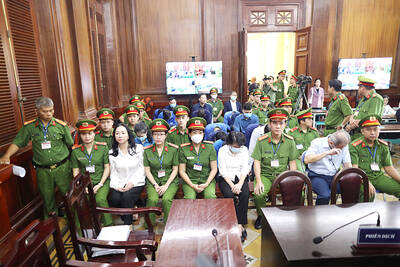
A top Vietnamese property tycoon was on Thursday sentenced to death in one of the biggest corruption cases in history, with an estimated US$27 billion in damages. A panel of three hand-picked jurors and two judges rejected all defense arguments by Truong My Lan, chair of major developer Van Thinh Phat, who was found guilty of swindling cash from Saigon Commercial Bank (SCB) over a decade. “The defendant’s actions ... eroded people’s trust in the leadership of the [Communist] Party and state,” read the verdict at the trial in Ho Chi Minh City. After the five-week trial, 85 others were also sentenced on

Conjoined twins Lori and George Schappell, who pursued separate careers, interests and relationships during lives that defied medical expectations, died this month in Pennsylvania, funeral home officials said. They were 62. The twins, listed by Guinness World Records as the oldest living conjoined twins, died on April 7 at the Hospital of the University of Pennsylvania, obituaries posted by Leibensperger Funeral Homes of Hamburg said. The cause of death was not detailed. “When we were born, the doctors didn’t think we’d make 30, but we proved them wrong,” Lori said in an interview when they turned 50, the Philadelphia Inquirer reported. The
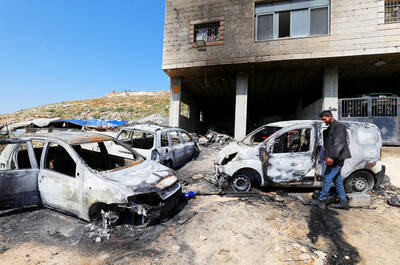
RAMPAGE: A Palestinian man was left dead after dozens of Israeli settlers searching for a missing 14-year-old boy stormed a village in the Israeli-occupied West Bank US President Joe Biden on Friday said he expected Iran to attack Israel “sooner, rather than later” and warned Tehran not to proceed. Asked by reporters about his message to Iran, Biden simply said: “Don’t,” underscoring Washington’s commitment to defend Israel. “We are devoted to the defense of Israel. We will support Israel. We will help defend Israel and Iran will not succeed,” he said. Biden said he would not divulge secure information, but said his expectation was that an attack could come “sooner, rather than later.” Israel braced on Friday for an attack by Iran or its proxies as warnings grew of


 RSS
RSS