


The young woman twirled the M16 rifle like a baton, placing the weapon upright, its butt firmly in the dust. At less than 5ft tall, when she talked her lips moved just above the barrel of the gun.
Navina Khatri Chhetri, 26, is a veteran of the People's Liberation Army (PLA), having led soldiers eight times into "battle" against the Royal Nepalese Army.
From a poor village in midwestern Nepal, she followed her parents into the underground Maoist movement, starting as a student activist eight years ago. With a quick tongue and a gift for sloganeering, Navina rose quickly through the ranks.
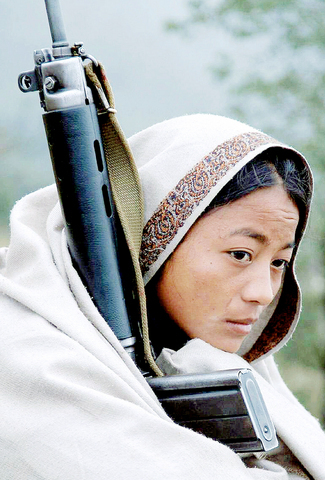
PHOTO: AFP
"In my village there is no water, no electricity, no roads, no doctor. Nepal needs progress and we will only get these things by following the Prachanda Path," she says, referring to the doctrine of the Nepalese Maoists' chairman.
With the party's permission Navina married a fellow communist, a member of the party's cultural wing. Five years ago she picked up the gun, joining the ranks of women fighters that comprise a third of the rebels.
She is now a battalion vice-commander in charge of 270 soldiers, both men and women, and says that the Maoist party policy of "total equality" means she has no problems being a female leader.
For Navina, life is more about war than love.
"The people's war is the most important thing in my life," she said. "Then family. I will think about children when the war is won and the king is gone."
Costly war
Navina's story is a glimpse into Nepal's civil war that in less than 10 years has cost almost 13,000 lives. A landlocked nation pressed against the Himalayas and not much bigger than England, Nepal is one of the poorest countries in the world.
What began in the villages of Rolpa district strung across the foothills of the Himalayas is now the world's longest-running communist insurgency, spreading hope and fear.
To their critics, the Maoists are a throwback to the bloody absurdities of Cambodia's Pol Pot and China's Mao Zedong (毛澤東). Led by an elusive leader called Prachanda, who comes from a peasant family, Nepal's revolutionaries have been accused of using terror to flatten centuries-old social hierarchies based on caste and ethnicity.
Landlords have been driven from villages; children have been kidnapped for indoctrination. Those who speak against Maoist beliefs have been tortured. Political opponents have been killed.
The army and police of the Nepalese government have been accused of similar human rights violations.
Nepal tops one international league table: for unexplained disappearances.
Contrary to the global trend of the last decade, communism in Nepal has flowered, attracting recruits convinced that only revolution will end the rule of the royal court and usher in modernity.
The result is that the war today pits a generation of gun-toting youths clad in fatigues and trainers led by leftwing ideologues against an absolute monarchy ruled by King Gyanendra, a chain-smoking royal who many in the country believe is a living Hindu god.
More than 1,350 people have been killed since February, an average of five deaths a day.
Last week thousands of villagers gathered in a natural hillside amphitheater waving red banners and banging drums. Beneath the snow-topped peaks were large hand-painted flags that lined up Marx, Trotsky, Lenin, Stalin and Mao. Above their faces were the words Prachanda Path.
Surrounding the crowd were scores of armed rebel soldiers, keeping an eye on the skies above from under baseball caps. The last time such a meeting was held late last month, a Nepalese army helicopter gunship sprayed the stage with bullets, killing a Maoist commander.
The villagers were there to listen to Maoist leaders talk about the new weapon in their struggle against the king: democracy.
Since the king seized power in February, sacking the government and imposing a state of emergency, the Maoists and the politicians they once regarded as "bourgeois class enemies" have edged closer together.
Both sides have begun to question the legitimacy of the monarchy -- especially since the present king assumed the throne in 2001 after a massacre in which his brother was shot dead. In a series of speeches, the Maoist leaders railed against the "fascism" of the monarchy.
But interspersed in the rhetoric is a clear message that King Gyanendra is being offered a last chance to exit the political stage. In return, the Maoists say they will give up the armed struggle.
Mistakes made
In a press conference, Comrade Viplav, a member of the central committee of the Maoist party, and the rebels' deputy commander, Comrade Prabraker, accepted that mistakes had been made in the past.
The leadership blames its cadre's wayward behavior on its recruits' village backgrounds.
"Our people's mindset comes from older traditions. This can cause problems when following party orders," said Comrade Viplav.
The new strategy revolves around development projects such as a new 90km road, a third of which has been completed, linking Maoist-controlled hamlets in the hills to the plains below. There is also a fish farm being built and a workers co-operative being set up to harvest crops. It was work "for the people, by the people," claimed the Maoists.
But when the Guardian questioned villagers they said they had been forced into working for such projects. If they disobeyed there was a fine. Unpaid dues would see their homes confiscated.
The Maoists say these are "rare instances."
New pragmatism
Analysts say that the new policy of Nepal's Maoists is based on pragmatism. Hari Roka, who has written and travelled with the guerrillas, said there were three main reasons for the change.
First, the king had frozen out the political parties, leading democrats to the Maoists. Second, the rebels could not capture Kathmandu, which is guarded by 35,000 troops -- half of the Royal Nepalese Army. Third, the situation is not the same as in China in the 1940s.
"The geopolitics has changed. Nepal is sandwiched between the emerging powers of India and China and the world would not stand by and watch a Maoist takeover here which would destabilize the whole region," Roka said.
The Maoists' "new line of thinking" appears more of a swerve than a switch. The guerrillas say the king's municipal polls to be held next year will be "unsuccessful." The political parties have already called for a boycott but the Maoists go one step further saying they will use violence to stop balloting from taking place.
Nearly half of China’s major cities are suffering “moderate to severe” levels of subsidence, putting millions of people at risk of flooding, especially as sea levels rise, according to a study of nationwide satellite data released yesterday. The authors of the paper, published by the journal Science, found that 45 percent of China’s urban land was sinking faster than 3mm per year, with 16 percent at more than 10mm per year, driven not only by declining water tables, but also the sheer weight of the built environment. With China’s urban population already in excess of 900 million people, “even a small portion

UNSETTLING IMAGES: The scene took place in front of TV crews covering the Trump trial, with a CNN anchor calling it an ‘emotional and unbelievably disturbing moment’ A man who doused himself in an accelerant and set himself on fire outside the courthouse where former US president Donald Trump is on trial has died, police said yesterday. The New York City Police Department (NYPD) said the man was declared dead by staff at an area hospital. The man was in Collect Pond Park at about 1:30pm on Friday when he took out pamphlets espousing conspiracy theories, tossed them around, then doused himself in an accelerant and set himself on fire, officials and witnesses said. A large number of police officers were nearby when it happened. Some officers and bystanders rushed

HYPOCRISY? The Chinese Ministry of Foreign Affairs yesterday asked whether Biden was talking about China or the US when he used the word ‘xenophobic’ US President Joe Biden on Wednesday called for a hike in steel tariffs on China, accusing Beijing of cheating as he spoke at a campaign event in Pennsylvania. Biden accused China of xenophobia, too, in a speech to union members in Pittsburgh. “They’re not competing, they’re cheating. They’re cheating and we’ve seen the damage here in America,” Biden said. Chinese steel companies “don’t need to worry about making a profit because the Chinese government is subsidizing them so heavily,” he said. Biden said he had called for the US Trade Representative to triple the tariff rates for Chinese steel and aluminum if Beijing was
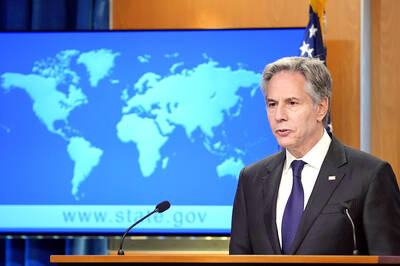
Beijing is continuing to commit genocide and crimes against humanity against Uyghurs and other Muslim minorities in its western Xinjiang province, U.S. Secretary of State Antony Blinken said in a report published on Monday, ahead of his planned visit to China this week. The State Department’s annual human rights report, which documents abuses recorded all over the world during the previous calendar year, repeated language from previous years on the treatment of Muslims in Xinjiang, but the publication raises the issue ahead of delicate talks, including on the war in Ukraine and global trade, between the top U.S. diplomat and Chinese


 RSS
RSS