


Moderates are imploring colleagues in the US Congress to tone down the rhetoric on Iraq as debate about US President George W. Bush's war policies has become increasingly bitter and partisan.
Their pleas are likely to be ignored. The war is expected to be front and center in the upcoming congressional election year, particularly in several races where the Democratic candidates are Iraq war veterans.
Neither party has much incentive to pull its punches, with Republicans eager to paint Democratic critics of Bush's Iraq policies as soft on defense and Democrats looking to exploit his woes as polls show declining support for the war.
Nevertheless, some senior lawmakers are appealing for courteousness, saying that while debate is essential to democracy, politics and partisanship should stop at the waters' edge.
"The quality of congressional debate has an impact on events in Iraq and our prospects for success," Senator Richard Lugar of Indiana, chairman of the Senate Foreign Relations Committee, said in the first of several letters he plans to write to House and Senate members on the issue.
"We should continually strive to elevate our debate by studying thoughtful sources of information and embracing civility in our discourse," he said.
Senator Joe Lieberman of Connecticut, who in recent weeks has broken with most of his Democratic brethren and largely supported the president's Iraq strategy, urged discussion that goes beyond "dueling partisan press conferences."
"I hope that it goes on with a recognition that there are Republicans and Democrats on both sides, and that it should be conducted in the spirit of mutual respect and national interest," Lieberman said.
It's no surprise that moderates are acting as referees.
"They're the ones who are reaching across partisan aisles, trying to find common ground," said Kathleen Hall Jamieson, an expert on political rhetoric and campaigns.

Republican US lawmakers on Friday criticized US President Joe Biden’s administration after sanctioned Chinese telecoms equipment giant Huawei unveiled a laptop this week powered by an Intel artificial intelligence (AI) chip. The US placed Huawei on a trade restriction list in 2019 for contravening Iran sanctions, part of a broader effort to hobble Beijing’s technological advances. Placement on the list means the company’s suppliers have to seek a special, difficult-to-obtain license before shipping to it. One such license, issued by then-US president Donald Trump’s administration, has allowed Intel to ship central processors to Huawei for use in laptops since 2020. China hardliners

DISADVANTAGE: Erin O’Toole, who led the Conservatives during the election campaign in 2021, estimated that the interference cost his party as many as nine legislative seats Canada’s domestic spy agency on Monday concluded that China interfered in the past two elections, an official probe heard, the firmest evidence so far of suspected Chinese meddling in Canadian politics. Canadian Prime Minister Justin Trudeau’s Liberal Party won both the elections, held in 2019 and 2021. Under pressure from opposition lawmakers unhappy about media reports on China’s possible role, Trudeau set up a commission into foreign interference. The commission was shown a slide on Monday containing an extract of a briefing in February last year from the Canadian Security Intelligence Service (CSIS). “We know that the PRC [People’s Republic of China] clandestinely
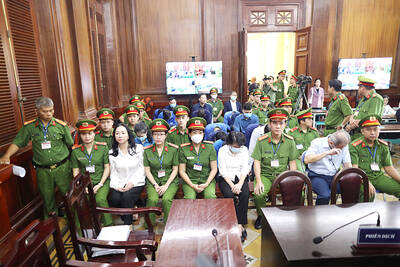
A top Vietnamese property tycoon was on Thursday sentenced to death in one of the biggest corruption cases in history, with an estimated US$27 billion in damages. A panel of three hand-picked jurors and two judges rejected all defense arguments by Truong My Lan, chair of major developer Van Thinh Phat, who was found guilty of swindling cash from Saigon Commercial Bank (SCB) over a decade. “The defendant’s actions ... eroded people’s trust in the leadership of the [Communist] Party and state,” read the verdict at the trial in Ho Chi Minh City. After the five-week trial, 85 others were also sentenced on

‘DELUSIONAL’: Targeting the families of Hamas’ leaders would not push the group to change its position or to give up its demands for Palestinians, Ismail Haniyeh said Israeli aircraft on Wednesday killed three sons of Hamas’ top political leader in the Gaza Strip, striking high-stakes targets at a time when Israel is holding delicate ceasefire negotiations with the militant group. Hamas said four of the leader’s grandchildren were also killed. Ismail Haniyeh’s sons are among the highest-profile figures to be killed in the war so far. Israel said they were Hamas operatives, and Haniyeh accused Israel of acting in “the spirit of revenge and murder.” The deaths threatened to strain the internationally mediated ceasefire talks, which appeared to gain steam in recent days even as the sides remain far


 RSS
RSS