


Hospital patients, prison detainees and security forces were voting yesterday at the start of elections for a full-term parliament set to restore full sovereignty to war-torn Iraq nearly three years after the US-led invasion.
Three days before the rest of the country goes to the polls in the watershed vote, Iraqis being treated in hospitals, those being held in prisons and members of the security forces were casting their ballots.
Draconian security measures, similar to those enforced during two earlier elections this year, have been imposed to keep attacks at bay and minimize bloodshed during Thursday's main event.
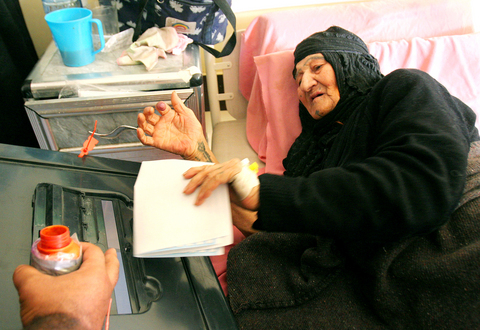
PHOTO: AP
Airports and borders will shut from tomorrow until Friday or Saturday, curfews extended and a ban on carrying weapons imposed for even those with permits. A five-day public holiday will also be in effect.
"We are hoping for a calm day as during the referendum," Interior Minister Bayan Jabr Solagh said.
A vote on the country's new constitution on Oct. 15 passed without the spectacular suicide bombings that have become Iraq's trademark.
The special polling booths opened at 7am yesterday and were to close at 5pm, electoral official Farid Ayar confirmed.
In the northern Kurdish city of Sulaimaniyah, 19,800 hospital patients, detainees and security forces had registered to vote in 499 special polling booths, said Sheikh Latif, a local electoral commission official.
This week's election marks a new beginning for Iraq following the chaos of a lightning drive to oust Saddam Hussein, two transitional governments and the adoption of a constitution in October.
When the dust settles on the inevitable political horse trading, Iraqis will be left with a four-year parliament capable of carving out a new direction for the country, which is teetering on the tightrope of inter-communal tensions.
Moves toward democracy, marked by well-organized ballots and determined turnout, are a cornerstone of US policy in the Middle East with Washington increasingly focused on an ultimate exit strategy from Iraq.
But the success of the election and future prospects of stability hinge on turnout among the fallen Sunni elite who boycotted the Jan. 30 election for a transitional parliament, Iraq's first free vote in half a century.
Iraq's 15.5 million voters will elect a 275-member assembly from around 7,000 candidates in the first full-term legislature since former president Saddam Hussein's regime fell in April 2003.
The 228 political entities that have presented candidates are roughly double the 111 groups that contested the initial poll in January.
Nearly half of China’s major cities are suffering “moderate to severe” levels of subsidence, putting millions of people at risk of flooding, especially as sea levels rise, according to a study of nationwide satellite data released yesterday. The authors of the paper, published by the journal Science, found that 45 percent of China’s urban land was sinking faster than 3mm per year, with 16 percent at more than 10mm per year, driven not only by declining water tables, but also the sheer weight of the built environment. With China’s urban population already in excess of 900 million people, “even a small portion

UNSETTLING IMAGES: The scene took place in front of TV crews covering the Trump trial, with a CNN anchor calling it an ‘emotional and unbelievably disturbing moment’ A man who doused himself in an accelerant and set himself on fire outside the courthouse where former US president Donald Trump is on trial has died, police said yesterday. The New York City Police Department (NYPD) said the man was declared dead by staff at an area hospital. The man was in Collect Pond Park at about 1:30pm on Friday when he took out pamphlets espousing conspiracy theories, tossed them around, then doused himself in an accelerant and set himself on fire, officials and witnesses said. A large number of police officers were nearby when it happened. Some officers and bystanders rushed

Beijing is continuing to commit genocide and crimes against humanity against Uyghurs and other Muslim minorities in its western Xinjiang province, U.S. Secretary of State Antony Blinken said in a report published on Monday, ahead of his planned visit to China this week. The State Department’s annual human rights report, which documents abuses recorded all over the world during the previous calendar year, repeated language from previous years on the treatment of Muslims in Xinjiang, but the publication raises the issue ahead of delicate talks, including on the war in Ukraine and global trade, between the top U.S. diplomat and Chinese

HYPOCRISY? The Chinese Ministry of Foreign Affairs yesterday asked whether Biden was talking about China or the US when he used the word ‘xenophobic’ US President Joe Biden on Wednesday called for a hike in steel tariffs on China, accusing Beijing of cheating as he spoke at a campaign event in Pennsylvania. Biden accused China of xenophobia, too, in a speech to union members in Pittsburgh. “They’re not competing, they’re cheating. They’re cheating and we’ve seen the damage here in America,” Biden said. Chinese steel companies “don’t need to worry about making a profit because the Chinese government is subsidizing them so heavily,” he said. Biden said he had called for the US Trade Representative to triple the tariff rates for Chinese steel and aluminum if Beijing was


 RSS
RSS