


Chileans will choose between a Socialist single mother and a conservative multimillionaire in a presidential runoff next month, after center-left coalition leader Michelle Bachelet fell shy of an outright majority on Sunday.
Aligned with President Ricardo Lagos' ruling coalition that has governed Chile since the collapse of General Augusto Pinochet's military dictatorship in 1990, Bachelet easily defeated two feuding right-wing candidates, who say they have now joined forces.
Businessman and economist Sebastian Pinera, who trailed Bachelet in second place by about 20 percentage points on Sunday night, came late to the race but surged in the polls with a barnstorming campaign dubbed "The Locomotive."

PHOTO: AFP
He earned a boost on Sunday night when fellow conservative Joaquin Lavin quickly conceded and joined the campaign to defeat Bachelet.
"Between the two of us, Sebastian, we had more votes than Bachelet and we have a clear chance to win the presidency," Lavin said before finding Pinera at a downtown hotel to personally offer his support. The two embraced amid applause from hundreds of supporters.
Bachelet, who had once been imprisoned by Chile's military dictatorship and later went on to serve as the country's defense minister, won 45.8 percent of the vote with 96 percent of ballots counted.
Pinera was a distant second with 25.4 percent of the vote, while Lavin had captured 23.2 percent.
Opinion polls during the campaign have showed that Bachelet would likely triumph in any runoff scenario.
On Sunday night, a top aide for Bachelet, Jaime Mulet, downplayed concerns over the two right-wing candidates winning more combined votes.
"Their votes cannot be added. You don't add apples and pears," Mulet said.
Bachelet could pick up support from voters who backed fourth-place finisher Tomas Hirsch. Representing a coalition that includes the Communist Party, Hirsch received 5.1 percent of votes counted.
Lagos, who cannot run for re-election, is ending his term with an approval rate of over 70 percent. His successor will be sworn in on March 11 for a four-year term.
The president said his coalition won a majority in both houses of congress on Sunday, although no final results were available.
Both Bachelet and Pinera campaigned on promises to reduce the gap between the rich and the poor, curb an 8 percent unemployment rate and rising crime in large cities -- with no major changes to the current economic model.
Chileans appeared to put the legacy of Pinochet behind them during the election.
The 90-year-old former dictator played no role in the campaign.
He was not even able to cast a vote on Sunday, as he remained under house arrest, facing human rights and corruption charges.
Bachelet is the daughter of an air force general who opposed the Pinochet coup and was jailed and tortured by his peers and died in prison.
Bachelet herself was also briefly jailed along with her mother. Both were blindfolded and mistreated in prison before being allowed to go into exile, first in Australia then in East Germany.
The candidate for the center-right National Renewal party, Pinera is unusual among Chilean conservatives, having openly opposed the Pinochet dictatorship.
Pinera has made inroads against Bachelet since his entrance to the race in May with a platform aimed at the middle class and the poor, including offers of pensions to housewives and incentives to small and medium-sized enterprises.
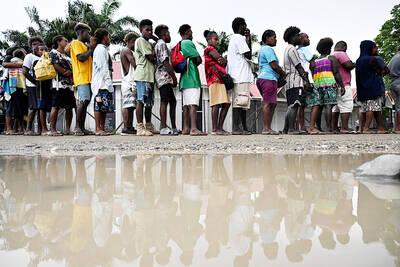
SEEKING CHANGE: A hospital worker said she did not vote in previous elections, but ‘now I can see that maybe my vote can change the system and the country’ Voting closed yesterday across the Solomon Islands in the south Pacific nation’s first general election since the government switched diplomatic allegiance from Taiwan to Beijing and struck a secret security pact that has raised fears of the Chinese navy gaining a foothold in the region. The Solomon Islands’ closer relationship with China and a troubled domestic economy weighed on voters’ minds as they cast their ballots. As many as 420,000 registered voters had their say across 50 national seats. For the first time, the national vote also coincided with elections for eight of the 10 local governments. Esther Maeluma cast her vote in the
Nearly half of China’s major cities are suffering “moderate to severe” levels of subsidence, putting millions of people at risk of flooding, especially as sea levels rise, according to a study of nationwide satellite data released yesterday. The authors of the paper, published by the journal Science, found that 45 percent of China’s urban land was sinking faster than 3mm per year, with 16 percent at more than 10mm per year, driven not only by declining water tables, but also the sheer weight of the built environment. With China’s urban population already in excess of 900 million people, “even a small portion

UNSETTLING IMAGES: The scene took place in front of TV crews covering the Trump trial, with a CNN anchor calling it an ‘emotional and unbelievably disturbing moment’ A man who doused himself in an accelerant and set himself on fire outside the courthouse where former US president Donald Trump is on trial has died, police said yesterday. The New York City Police Department (NYPD) said the man was declared dead by staff at an area hospital. The man was in Collect Pond Park at about 1:30pm on Friday when he took out pamphlets espousing conspiracy theories, tossed them around, then doused himself in an accelerant and set himself on fire, officials and witnesses said. A large number of police officers were nearby when it happened. Some officers and bystanders rushed

HYPOCRISY? The Chinese Ministry of Foreign Affairs yesterday asked whether Biden was talking about China or the US when he used the word ‘xenophobic’ US President Joe Biden on Wednesday called for a hike in steel tariffs on China, accusing Beijing of cheating as he spoke at a campaign event in Pennsylvania. Biden accused China of xenophobia, too, in a speech to union members in Pittsburgh. “They’re not competing, they’re cheating. They’re cheating and we’ve seen the damage here in America,” Biden said. Chinese steel companies “don’t need to worry about making a profit because the Chinese government is subsidizing them so heavily,” he said. Biden said he had called for the US Trade Representative to triple the tariff rates for Chinese steel and aluminum if Beijing was


 RSS
RSS