


Two years ago, Lattit's farms were arid wasteland and its villagers refugees.
Now, thanks to a new earthen dam, green fields stretch into the distance, producing food for sale and to feed hundreds of families who have returned. And they are a reason for hope in a poor and violence-wracked corner of Sudan, and perhaps for other trouble spots in a troubled country.
Most importantly, villagers say, they -- not aid agencies -- initiated the transformation, at one point bargaining with a road crew for use of a bulldozer to build the dam.
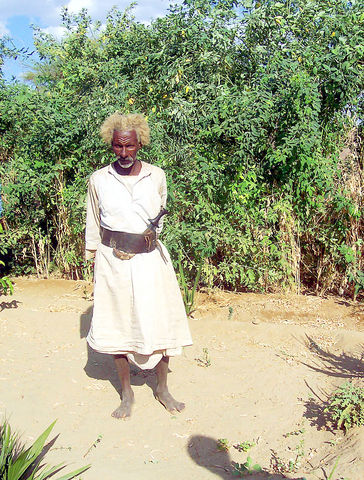
PHOTO: AP
"Aid comes in the morning and is consumed by evening," said Sheik Ali Mussah Hammid, a leader of the region's Sinkat people, contrasting that with projects led by the community he believes can last a lifetime.
"There is no way to compare the two, no way," he said.
Successive years of drought had devastated this region in the 1980s, forcing thousands of families to leave in search of jobs in cities like Port Sudan, 600km east of Khartoum on the Red Sea, the hub of the region that is home to the Beja ethnic group.
Fighting in the neighborhood as Eritrea struggled for independence from Ethiopia meant even more displaced people, and more strain on scarce resources.
War in eastern Sudan only contributed to the decline that started with the drought, forcing more people to flee. At one time, nearly all of Lattit's 500 or so families left.
They did not find life easier in the cities, where their farming skills counted for little.
Abdullah Issa, a Lattit community leader, said the rehabilitation of this village 220km west of Port Sudan started with one of the displaced who had managed to get an education in the city.
Sheik Mohamed Tahir proposed building a dam across a creek that runs near Lattit only during the rainy season to hold water for a few weeks, long enough to soak into the land and ready it for cultivation.
By coincidence, Tahir, now a representative in the state legislature, was presenting his ideas to his neighbors as a road crew was working in the area. Villagers offered the road crew access to their well water in exchange for use of a bulldozer for a few weeks.
Once the dam was completed, villagers approached the UN for tools and seeds under a poverty alleviation project for eastern Sudan to which the UN contributes US$1.4 million and the state government US$400,000.
The program offers small loans for projects designed by villagers, such as buying cows to start a milk business or simple technology for a grain mill. UN experts advise villagers on how to manage the loans and projects, and money from loan repayments funds more projects.
The UN hopes the program can be a model for Sudan's other volatile regions.
The first growing season on Lattit's reclaimed farmland was a success. Family incomes from selling vegetables were 10 times what they had been from menial jobs in the cities.
The first year, almost every family that had moved away sent at least one member back to work Lattit's fields. The second year, entire families began to return.
"In two years, 90 percent, or over 500 families that had left this place ... have now returned," said Issa, the village headman.
"This is a wonder. We hadn't realized that miracles could happen,"' he said.

Republican US lawmakers on Friday criticized US President Joe Biden’s administration after sanctioned Chinese telecoms equipment giant Huawei unveiled a laptop this week powered by an Intel artificial intelligence (AI) chip. The US placed Huawei on a trade restriction list in 2019 for contravening Iran sanctions, part of a broader effort to hobble Beijing’s technological advances. Placement on the list means the company’s suppliers have to seek a special, difficult-to-obtain license before shipping to it. One such license, issued by then-US president Donald Trump’s administration, has allowed Intel to ship central processors to Huawei for use in laptops since 2020. China hardliners

Conjoined twins Lori and George Schappell, who pursued separate careers, interests and relationships during lives that defied medical expectations, died this month in Pennsylvania, funeral home officials said. They were 62. The twins, listed by Guinness World Records as the oldest living conjoined twins, died on April 7 at the Hospital of the University of Pennsylvania, obituaries posted by Leibensperger Funeral Homes of Hamburg said. The cause of death was not detailed. “When we were born, the doctors didn’t think we’d make 30, but we proved them wrong,” Lori said in an interview when they turned 50, the Philadelphia Inquirer reported. The
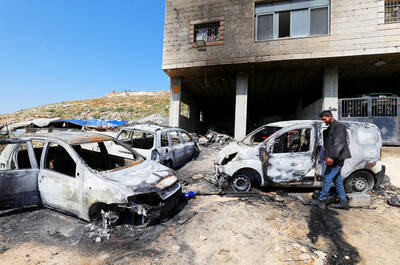
RAMPAGE: A Palestinian man was left dead after dozens of Israeli settlers searching for a missing 14-year-old boy stormed a village in the Israeli-occupied West Bank US President Joe Biden on Friday said he expected Iran to attack Israel “sooner, rather than later” and warned Tehran not to proceed. Asked by reporters about his message to Iran, Biden simply said: “Don’t,” underscoring Washington’s commitment to defend Israel. “We are devoted to the defense of Israel. We will support Israel. We will help defend Israel and Iran will not succeed,” he said. Biden said he would not divulge secure information, but said his expectation was that an attack could come “sooner, rather than later.” Israel braced on Friday for an attack by Iran or its proxies as warnings grew of

A prominent Christian leader has allegedly been stabbed at the altar during a Mass yesterday in southwest Sydney. Bishop Mar Mari Emmanuel was saying Mass at Christ The Good Shepherd Church in Wakeley just after 7pm when a man approached him at the altar and allegedly stabbed toward his head multiple times. A live stream of the Mass shows the congregation swarm forward toward Emmanuel before it was cut off. The church leader gained prominence during the COVID-19 pandemic, amassing a large online following, Officers attached to Fairfield City police area command attended a location on Welcome Street, Wakeley following reports a number


 RSS
RSS