


British Prime Minister Tony Blair's government unveils its proposals for the EU's budget yesterday, hoping an offer to sacrifice part of its cherished rebate will help secure a deal on future financing.
According to British officials, Britain will propose cutting economic aid to the EU's new member states by around 10 percent and offer to scale back its rebate, worth some 4.6 billion euros (US$5.5 billion) a year.
Officials have signaled that Britain will forego a substantial chunk of the rebate, reportedly up to 15 percent, by excluding from the complex calculations the economic aid spent on new member states. The bulk of the rebate will remain intact, however, until the EU agrees to slash farming subsidies. Britain will call for a review of EU spending, including agriculture, in 2008-2009.
European leaders will have just 10 days to consider the proposals for the 2007-2013 budget before a crunch Dec. 15-16 summit in Brussels, Belgium.
Britain has warned that tough negotiations lie ahead.
Blair plans one-on-one meetings Thursday and Friday with the leaders of Portugal, Finland, Slovenia, Sweden, the Netherlands, Luxembourg, Ireland, Greece and Spain. Failure to reach agreement would be a crippling blow to the 25-nation bloc, still reeling from France and the Netherlands rejecting the EU's first ever constitution earlier this year in referendums.
The budget negotiations are politically dangerous for current EU president Blair, risking his reputation as an international deal broker and supplying ammunition to critics at home who are furious he is prepared to forego a chunk of Britain's rebate.
The proposals were to be circulated to member states in Brussels and unveiled to British lawmakers in the House of Commons later yesterday.
Britain is considering substantial cuts to the European Union's seven-year budget and says the US$1.02 trillion package proposed by Luxembourg in June was too big. That represented 1.06 percent of the bloc's gross national income, a figure London is considering trimming to 1.03 percent.
Britain is also proposing to cut the level of economic aid paid to the bloc's 10 new member states. Blair is trying to sweeten the plan by making it easier for them to access and absorb the funding. But talks in Estonia and Hungary last week ended without an agreement and he risks alienating countries such as Poland which he regards as important allies.
An equally thorny problem for Blair is the budget rebate, a totemic political issue in Britain.
The cashback guarantee was secured in 1984 by former Conservative Prime Minister Margaret Thatcher, who successfully argued that Britain paid a disproportionate amount into EU coffers and received little back in regional grants and farming subsidies.
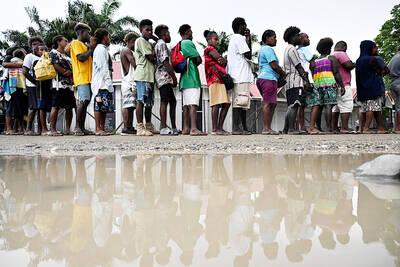
SEEKING CHANGE: A hospital worker said she did not vote in previous elections, but ‘now I can see that maybe my vote can change the system and the country’ Voting closed yesterday across the Solomon Islands in the south Pacific nation’s first general election since the government switched diplomatic allegiance from Taiwan to Beijing and struck a secret security pact that has raised fears of the Chinese navy gaining a foothold in the region. The Solomon Islands’ closer relationship with China and a troubled domestic economy weighed on voters’ minds as they cast their ballots. As many as 420,000 registered voters had their say across 50 national seats. For the first time, the national vote also coincided with elections for eight of the 10 local governments. Esther Maeluma cast her vote in the
Nearly half of China’s major cities are suffering “moderate to severe” levels of subsidence, putting millions of people at risk of flooding, especially as sea levels rise, according to a study of nationwide satellite data released yesterday. The authors of the paper, published by the journal Science, found that 45 percent of China’s urban land was sinking faster than 3mm per year, with 16 percent at more than 10mm per year, driven not only by declining water tables, but also the sheer weight of the built environment. With China’s urban population already in excess of 900 million people, “even a small portion

UNSETTLING IMAGES: The scene took place in front of TV crews covering the Trump trial, with a CNN anchor calling it an ‘emotional and unbelievably disturbing moment’ A man who doused himself in an accelerant and set himself on fire outside the courthouse where former US president Donald Trump is on trial has died, police said yesterday. The New York City Police Department (NYPD) said the man was declared dead by staff at an area hospital. The man was in Collect Pond Park at about 1:30pm on Friday when he took out pamphlets espousing conspiracy theories, tossed them around, then doused himself in an accelerant and set himself on fire, officials and witnesses said. A large number of police officers were nearby when it happened. Some officers and bystanders rushed

HYPOCRISY? The Chinese Ministry of Foreign Affairs yesterday asked whether Biden was talking about China or the US when he used the word ‘xenophobic’ US President Joe Biden on Wednesday called for a hike in steel tariffs on China, accusing Beijing of cheating as he spoke at a campaign event in Pennsylvania. Biden accused China of xenophobia, too, in a speech to union members in Pittsburgh. “They’re not competing, they’re cheating. They’re cheating and we’ve seen the damage here in America,” Biden said. Chinese steel companies “don’t need to worry about making a profit because the Chinese government is subsidizing them so heavily,” he said. Biden said he had called for the US Trade Representative to triple the tariff rates for Chinese steel and aluminum if Beijing was


 RSS
RSS