


When a psychiatrist gave her a mirror to hold up to her new face, the woman looked at her reflection. She paused for a moment. Unable to speak because of the breathing tube inserted in her throat, she wrote merci -- thank you -- on a piece of paper.
The 38-year-old mother of two teenage daughters cried when she saw the results of the world's first partial face transplant staring back at her. Sylvie Testelin, one of her surgeons, cried too. The results of the daring lips, nose and chin transplant were beyond what the doctors had hoped for.
The woman, whose identity has not been disclosed, was severely bitten in June by her dog, a cross Labrador retriever adopted from a rescue shelter. Before the operation, she could not chew her food or speak properly.
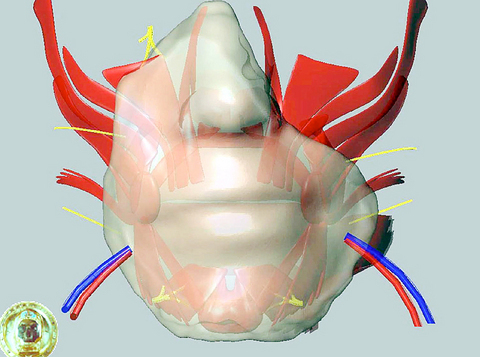
PHOTO: EPA
The tissue around the wound had contracted, pulling her face taught and preventing her from moving her mouth. Three-quarters of what she drank dribbled out of her mouth. She would only go out in public wearing a surgical mask to protect her from stares.
Difficult
Conventional reconstructive surgery may have been possible, but it would have been extremely difficult, if not impossible, to restore not only the look of her face, but also basic functions, her doctors said on Friday at the first news conference since her operation last weekend in Amiens in northern France. Several expert advisers agreed that traditional surgery involving skin and muscle grafts from elsewhere on the woman's own body was not a viable solution.
Leading transplant surgeon Jean-Michel Dubernard said he had initial reservations about the procedure, but when he saw the extent of the woman's disfigurement, "I no longer hesitated for a second."
"If we didn't perform this operation, her outcome would have been quite poor. She would have had to undergo four, maybe five conventional surgeries over a long period of time, with uncertain results," said another of her surgeons Benoit Lengele, of the Sain-Luc University Clinic in Brussels, Belgium. "We truly believe from the human standpoint and the scientific point of view that the solution we took was the best one."
The operation began at 12:30am on Sunday. One team of doctors flew to Lille to collect the lips, nose and chin from the donor, a brain-dead woman whose family donated her facial tissue to the doctors and the rest of her organs to other recipients. Engineers designed a silicone prosthetic mask that was fitted to the donor's face after the tissue was removed. The prosthetic had the same stiffness, color and shape as the donor's face.
Another team of surgeons prepared the patient at the hospital in Amiens. They cut away the fibrous tissue that had formed on her face since her accident.
When the transplant arrived in Amiens, a team of eight surgeons led by Bernard Devauchelle sewed the blood vessels in the woman's face to those of the donor tissue. They then connected the nerves and muscles, sewed in the lining of the mouth and skin from the nose to the chin.
Four hours into the 15-hour operation, the blood was circulating normally between the graft and the rest of the woman's face.
"When it was finished and we were washing the skin and applying the dressings, there was a big silence in the operating room. We were all surprised because the immediate result was completely outside our expectations -- it looked marvelous," Lengele said.
"There is simply a small scar around the outside of the graft. All the other scars are inside, in the mouth, in the nose. A small scar in the neck," he said.
Devauchelle said the team was "totally stupefied" by how perfectly the transplant was integrated into her face in terms of the color and the thickness of the skin. The end result was an uncanny resemblance to her former face, he said.
The woman already has some mobility in the transplant. She can eat, drink and speak clearly, Devauchelle said. But it will be another six months before the nerves start to regenerate. It's too early to tell how natural the transplant will look, but the doctors said they were optimistic.
The biggest hurdle now is the body's acceptance of the transplant. The woman must take drugs for the rest of her life to prevent her immune system from rejecting the tissue.
Experiment
In another experiment, the doctors infused the woman with stem cells taken from the bone marrow of the donor. They hope the cells will reduce the chance of the immune system rejecting the transplant and that subsequently the dose of the drugs can be lowered.
The woman is getting her main food pureed, but she has eaten chocolate and strawberries. Right now, she smiles with her eyes. She tries to move her mouth, but her doctors try to stop her from straining herself because it is still early.
The circumstances surrounding the injury remained cloudy.
"She doesn't blame the dog," Testelin said. "The dog liked her. He tried to wake her up, or whatever. I don't know. I was not there. It was no more than an accident, and she thinks like that."
Dubernard denied a media report that the woman was attacked by the dog after she passed out from having taken pills in a suicide attempt. Instead, he said, the woman took a pill to try to sleep after a family argument and was bitten by the dog during the night.
The dog was euthanized, but since then the patient has acquired a new dog, Testelin said.

Republican US lawmakers on Friday criticized US President Joe Biden’s administration after sanctioned Chinese telecoms equipment giant Huawei unveiled a laptop this week powered by an Intel artificial intelligence (AI) chip. The US placed Huawei on a trade restriction list in 2019 for contravening Iran sanctions, part of a broader effort to hobble Beijing’s technological advances. Placement on the list means the company’s suppliers have to seek a special, difficult-to-obtain license before shipping to it. One such license, issued by then-US president Donald Trump’s administration, has allowed Intel to ship central processors to Huawei for use in laptops since 2020. China hardliners
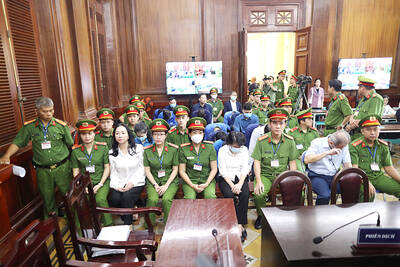
A top Vietnamese property tycoon was on Thursday sentenced to death in one of the biggest corruption cases in history, with an estimated US$27 billion in damages. A panel of three hand-picked jurors and two judges rejected all defense arguments by Truong My Lan, chair of major developer Van Thinh Phat, who was found guilty of swindling cash from Saigon Commercial Bank (SCB) over a decade. “The defendant’s actions ... eroded people’s trust in the leadership of the [Communist] Party and state,” read the verdict at the trial in Ho Chi Minh City. After the five-week trial, 85 others were also sentenced on

‘DELUSIONAL’: Targeting the families of Hamas’ leaders would not push the group to change its position or to give up its demands for Palestinians, Ismail Haniyeh said Israeli aircraft on Wednesday killed three sons of Hamas’ top political leader in the Gaza Strip, striking high-stakes targets at a time when Israel is holding delicate ceasefire negotiations with the militant group. Hamas said four of the leader’s grandchildren were also killed. Ismail Haniyeh’s sons are among the highest-profile figures to be killed in the war so far. Israel said they were Hamas operatives, and Haniyeh accused Israel of acting in “the spirit of revenge and murder.” The deaths threatened to strain the internationally mediated ceasefire talks, which appeared to gain steam in recent days even as the sides remain far

RAMPAGE: A Palestinian man was left dead after dozens of Israeli settlers searching for a missing 14-year-old boy stormed a village in the Israeli-occupied West Bank US President Joe Biden on Friday said he expected Iran to attack Israel “sooner, rather than later” and warned Tehran not to proceed. Asked by reporters about his message to Iran, Biden simply said: “Don’t,” underscoring Washington’s commitment to defend Israel. “We are devoted to the defense of Israel. We will support Israel. We will help defend Israel and Iran will not succeed,” he said. Biden said he would not divulge secure information, but said his expectation was that an attack could come “sooner, rather than later.” Israel braced on Friday for an attack by Iran or its proxies as warnings grew of


 RSS
RSS