


China's biggest oil company apologized for an explosion that polluted a northeastern river with benzene and prompted the government to cut off running water to 3.8 million people, while another blast in the country's southwest raised fears yesterday of a second toxic spill.
Zeng Yukang (曾玉康), deputy general manager of China National Petroleum Corp, expressed "sympathy and deep apologies" late on Thursday to the people of Harbin and others in China's northeast whose water supply was shut down due to the huge benzene slick in the Songhua River, the official Xinhua news agency reported.
The government, which blamed CNPC for the disaster, did not publicly confirm that the Songhua was poisoned with benzene until Wednesday -- 10 days after the spill was caused by a blast upstream at a chemical plant owned by a CNPC subsidiary. The slick reached Harbin early on Thursday.
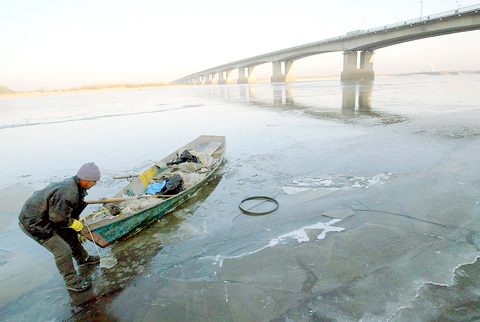
PHOTO: AFP
Environmental officials have defended the government's handling of the incident, saying that local authorities were advised of the spill and that nobody was sickened by the poisoned water.
However, the disaster highlighted the environmental damage caused by China's sizzling economic growth and complaints that the secretive communist government fails to enforce safety standards.
State television yesterday sought to depict the situation in Harbin as under control, showing scores of workers installing new water filtering material at the city's main water plant. They were replacing anthracite with activated carbon, which can absorb pollutants, China Central Television said.
Meanwhile, another chemical plant accident hundreds of kilometers away prompted fears of another benzene leak and warnings that residents not drink river water, Xinhua said yesterday.
The second incident took place in Dianjiang, a county in the southwestern region of Chongqing, where an explosion at the Yingte Chemical Company on Thursday killed one worker, Xinhua said. Nearby schools were closed, and about 6,000 people were evacuated, the Beijing Daily Messenger newspaper reported.
The massive slick in Harbin also was created by an explosion -- on Nov. 13 at a CNPC subsidiary plant. The blast killed five people and forced the evacuation of 10,000 others. Authorities blamed human error at a tower that processed benzene, a toxic, potentially cancer-causing chemical used in making plastics, detergents and pesticides.
Zhang Lijun (
"Authorities acted that day, and not one person has been sickened," Zhang said. "We will be very clear about who's responsible. It is the chemical plant of the CNPC."
Asked whether the company might face criminal charges or fines over the estimated 105 tonnes of pollutants released into the river, he said that had not been decided.
Also see story:
Spill highlights rust belt boom

Republican US lawmakers on Friday criticized US President Joe Biden’s administration after sanctioned Chinese telecoms equipment giant Huawei unveiled a laptop this week powered by an Intel artificial intelligence (AI) chip. The US placed Huawei on a trade restriction list in 2019 for contravening Iran sanctions, part of a broader effort to hobble Beijing’s technological advances. Placement on the list means the company’s suppliers have to seek a special, difficult-to-obtain license before shipping to it. One such license, issued by then-US president Donald Trump’s administration, has allowed Intel to ship central processors to Huawei for use in laptops since 2020. China hardliners
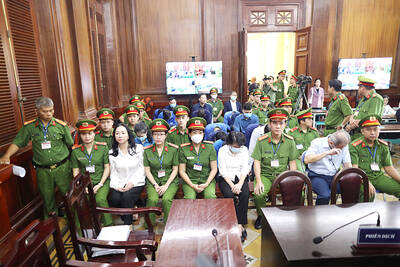
A top Vietnamese property tycoon was on Thursday sentenced to death in one of the biggest corruption cases in history, with an estimated US$27 billion in damages. A panel of three hand-picked jurors and two judges rejected all defense arguments by Truong My Lan, chair of major developer Van Thinh Phat, who was found guilty of swindling cash from Saigon Commercial Bank (SCB) over a decade. “The defendant’s actions ... eroded people’s trust in the leadership of the [Communist] Party and state,” read the verdict at the trial in Ho Chi Minh City. After the five-week trial, 85 others were also sentenced on

‘DELUSIONAL’: Targeting the families of Hamas’ leaders would not push the group to change its position or to give up its demands for Palestinians, Ismail Haniyeh said Israeli aircraft on Wednesday killed three sons of Hamas’ top political leader in the Gaza Strip, striking high-stakes targets at a time when Israel is holding delicate ceasefire negotiations with the militant group. Hamas said four of the leader’s grandchildren were also killed. Ismail Haniyeh’s sons are among the highest-profile figures to be killed in the war so far. Israel said they were Hamas operatives, and Haniyeh accused Israel of acting in “the spirit of revenge and murder.” The deaths threatened to strain the internationally mediated ceasefire talks, which appeared to gain steam in recent days even as the sides remain far
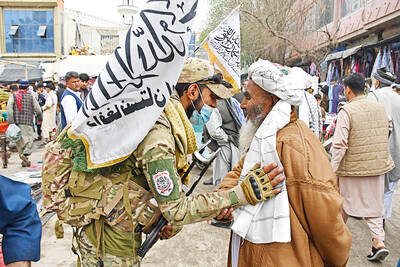
The Taliban’s reclusive supreme leader made a rare public appearance yesterday, an Afghan government spokesman said, leading thousands of worshipers in prayers marking Eid al-Fitr. Hibatullah Akhundzada has made only a handful of public appearances since inheriting the leadership of the Taliban in 2016 and leading the movement back to power with the withdrawal of US forces in 2021. Taliban government spokesman Zabihullah Mujahid said prayer in the largest mosque in Kandahar was “performed under the leadership of the supreme leader.” In a statement on X, he said the early-morning service “was attended by thousands of compatriots” in the southern province considered the


 RSS
RSS